
At the Edge of Al-Andalus
Lisbon’s Islamic Heritage in Text and Stone
21 October 2026
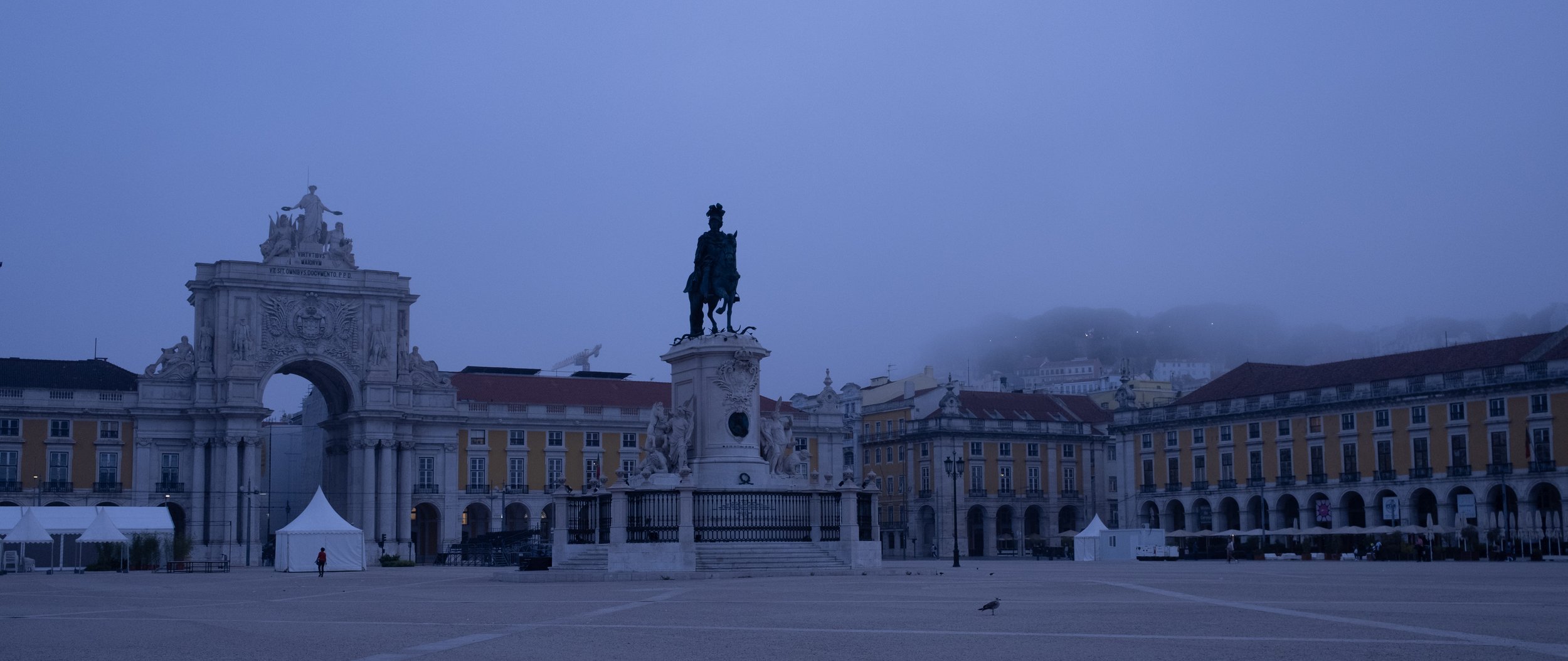
One of the gates of the city of Lisbon, facing Praça do Comércio (Commerce Square), A. Nusair.
For roughly 430 years, Lisbon - the current capital of Portugal - was an Arabic-speaking Atlantic port known as al-Ushbūna (al-Darwīsh & al-ʿAlyāwī, 2008, p. 2). Although the Islamic era spanned longer than Lisbon’s subsequent history as the capital of Portugal, it long remained a shortened section in national historiography. This gap stemmed largely from the nature of the written record authored primarily by external chroniclers removed from daily life in al-Uxbuna (Picard, 1997) and from the fact that systematic archaeological investigation of the city's Islamic layers only began in earnest in the late twentieth century (Torres & Macias, 1995; Matos, 1999).
Understanding this era requires examining how Muslim scholars and chroniclers viewed this distant settlement on the periphery of the Islamic world. Arabic geographers such as al-Rāzī, al-Bakrī, al-Idrīsī, Yāqūt, al-Ḥimyarī, and Abū al-Fidāʾ documented al-Ushbūna (Lisbon) from far-off cultural hubs including Córdoba, Sicily, Mosul, Ceuta, and Hama. They consistently described a frontier town situated at the edge of the known world, frequently repeating core descriptions from one text to another. Meanwhile, chroniclers such as Ibn al-Qūṭiyya, Ibn ʿIdhārī, Ibn al-Athīr, and al-Maqqarī recorded events in al-Ushbūna primarily when violent disruptions occurred.
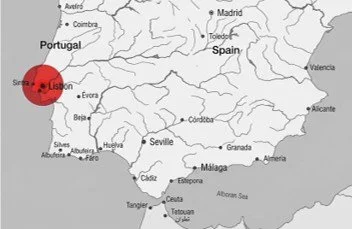
Location of Lisbon, Google Earth.
Lisbon, in Arabic geographical literature, entered the record as a heavily fortified river mouth settlement on the most western border of al-Andalus. Nearly every classical writer who described the city began by detailing its relationship with water. The name appeared in Arabic texts as Ushbūna or al-Ushbūna (al-Ḥimyarī, 1938, p. 16).
Administratively, the city formed part of the Lower March (al-Thaghr al-Adnā), alongside regional centers such as Beja, Évora, Santarém, Sintra, and Coimbra (al-Bakrī, 1992, p. 892).
Geographers frequently emphasized the town's impressive fortifications and natural position. Al-Ḥimyarī described it as standing "on the sword-edge of the sea, whose waves break against its wall" (1938, p. 16).
Moreover, he provided further details regarding the urban layout, describing it as a fine city with natural hot springs located in the middle of town that stayed warm throughout winter and summer. Al-Ḥimyarī wrote:
Its walls are of great construction and has a remarkable design. Over its western gate, arches are turned above arches on columns of marble. It has a southern gate called the Sea Gate, into which the waves enter at high tide, an eastern gate known as the Gate of the Hot Spring, and a gate known as the Cemetery Gate. And the city itself is beautiful and stretches along the river, possessing a wall and an impregnable citadel. Ushbūna (Lisbon) lies right upon the throat of the Dark Sea (the Atlantic) and on the southern shore of the sea, directly facing the city of Ushbūna (Lisbon), stands the Citadel of the Ore (Ḥiṣn al-Ma‘dan - Almada). It is so named because when the sea is violent, it casts up gold dust there. Thus, when winter arrives, the people of those regions head to this fortress to work the deposit until the end of winter, and it is among the wonders of the earth. (Translation of author, al-Ḥimyarī, 1938, p. 16).
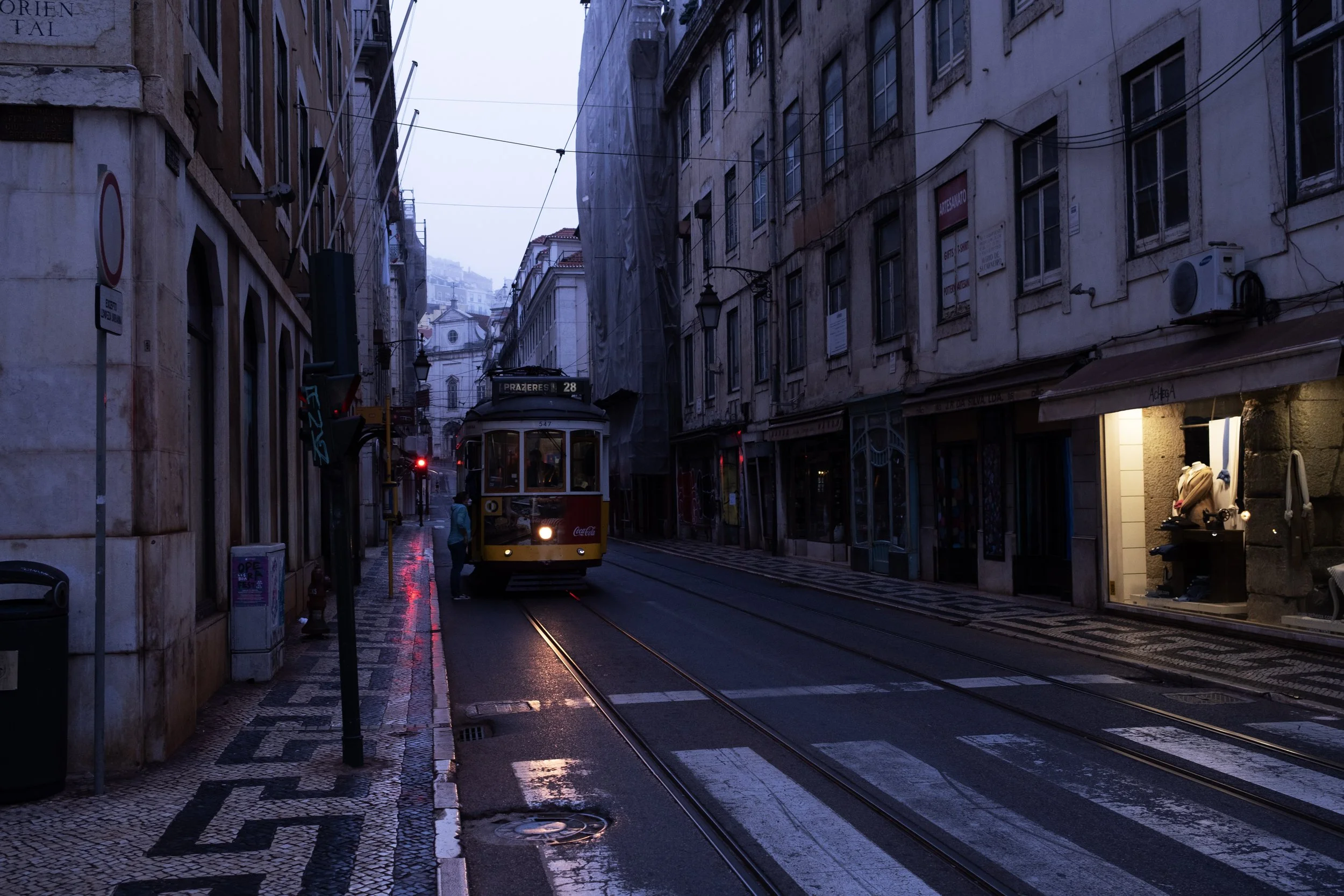
The downtown area of Lisbon, A. Nusair.
Substantial physical evidence from this period has been uncovered through modern archaeology across several key sites in the city. Inside the Castelo de São Jorge, formerly referenced in historical contexts as Qalʿat al-ʿArab archaeologists uncovered the Alcáçova residential quarter, a complex laid out during the second half of the 11th century. Excavations revealed two connected courtyard houses measuring 160 and 187 square meters, each constructed around a central open patio leading to reception rooms, private chambers, a kitchen, a pantry, and a latrine. The preserved elements include red and white mortar floors, slab-paved patios, underground grain silos, food storage jars, and intact drainage systems running to external tanks (Castelo de São Jorge, n.d.).
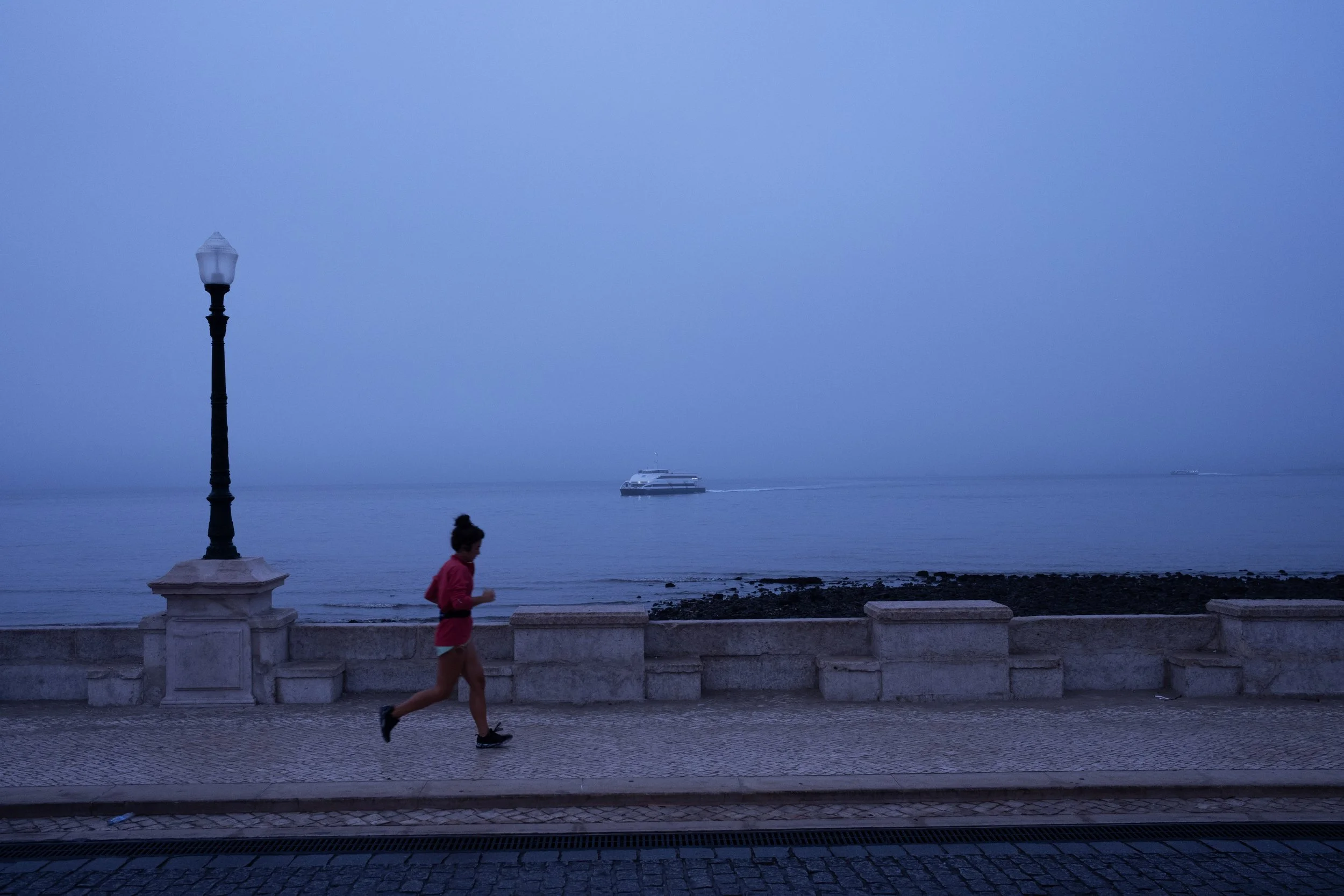
The sea of darkness (Atlantic Ocean) early morning in Lisbon, A. Nusair.
Once integrated into al-Andalus, Lisbon's position on the Atlantic Ocean exposed it to new maritime dangers from northern Europe. In 843 CE, the local governor, Wahb Allāh b. Ḥazm, dispatched an urgent report to Amir ʿAbd al-Raḥmān II stating that 54 Norse ships and 54 support boats had appeared off the coast, prompting the amir to place the entire seaboard on high alert (Ibn ʿIdhārī, 2013, p. 258). The following year, Viking forces launched a major assault. Ibn ʿIdhārī recorded the arrival of the raiding fleet as follows:
“The Majus [Vikings] came out in some eighty ships, as though they had filled the sea with dark birds as they filled hearts with sorrow upon sorrow, and they descended on Ushbūna.” (Translation by author, Ibn ʿIdhārī 2013, Vol. 2, p. 80).
In response to these incursions, ʿAbd al-Raḥmān II fortified the Atlantic coastline by constructing a series of ribāṭs (coastal fortifications). Under this strategy, Lisbon was established as a forward naval base equipped with a dockyard and a permanent naval administration (al-Darwīsh & al-ʿAlyāwī, 2008, pp. 7–8).
While maritime defenses protected the coast, internal political fragmentation gradually weakened the region from within. Following the collapse of the Caliphate of Córdoba in 1031 CE, localized divisions competed for power across al-Andalus. Lisbon fell under the control of the Aftasid dynasty, a Berber family based in nearby Badajoz. Soon after, the ruler of Seville attempted to seize Lisbon by sending a military commander who briefly held the city. However, a negotiated peace agreement eventually restored Aftasid control over the port (Ibn al-Athīr, as cited in al-Darwīsh & al-ʿAlyāwī, 2008, p. 9).
Governance within the city remained unstable over the following decades. Lisbon was briefly ruled by two local brothers, but the younger brother, ʿAbd al-Malik, managed local affairs so poorly that the population revolted. Citizens secretly contacted the ruler of Badajoz, ʿAbd Allāh b. al-Afṭas, requesting intervention. In response, his son marched into Lisbon with the backing of the locals and arrested ʿAbd al-Malik (al-Darwīsh & al-ʿAlyāwī, 2008, p. 10).
By 1092 CE, an external military force emerged from North Africa who were called Almoravids, significantly altering the political landscape. To maintain his position, the Aftasid ruler al-Mutawakkil turned to King Alfonso VI of Castile for protection. In exchange for military support, al-Mutawakkil surrendered Lisbon, Sintra, and Santarém to the Christian king. This decision sparked an immediate rebellion among the local Muslim population, who refused to accept Christian rule. Recognizing this as an opportunity, the Almoravid general Sīr b. Abī Bakr captured Badajoz, executed al-Mutawakkil and his sons for allying with Castile, and secured Santarém and Lisbon for the Almoravids in November 1094 CE (al-Darwīsh & al-ʿAlyāwī, 2008, p. 11).
This period of centralized Almoravid rule proved short-lived. After roughly 50 years, western al-Andalus fractured once again during a widespread uprising known as the revolt of the disciples (thawrat al-murīdīn) which was led by the Sufi master Ibn Qasī against Almoravid rule. By uniting local rebels under a spiritual banner, it broke central Almoravid control and split western al-Andalus into independent kingdoms. As central authority broke down, individual towns were left to organize their own defenses (al-Darwīsh & al-ʿAlyāwī, 2008, p. 12).
Taking advantage of this division, Afonso Henriques captured Santarém in March 1147 CE and set his sights on Lisbon. Because he was lacking a navy of his own, Afonso had previously been unable to block the city's riverfront access. However, on July 1, 1147 CE, a fleet carrying between 164 and 200 ships filled with English, Norman, Flemish, German, and French crusaders bound for the Holy Land docked nearby for shelter and supplies. Afonso persuaded the crusaders to join his siege (al-Darwīsh & al-ʿAlyāwī, 2009, p. 12).
After a four-month siege during which the river access was fully cut off, the defenders agreed to surrender terms on October 21, 1147 CE. Portuguese and crusader forces entered the city four days later, though the agreed terms of surrender were broken almost immediately upon entry. Despite assurances to the contrary, the city's primary mosque was converted into a Christian cathedral following the conquest (Matos, 1999).
Despite the transition to Christian rule, the Islamic period left a lasting structural imprint on Lisbon. As historian José Luís de Matos has observed, while the urban fabric of Lisbon constantly renews itself, the fundamental layout of the historic center retains essential characteristics inherited from the Islamic era. The historic medina occupied the present Castelo hill and extended down toward the riverfront. Its surrounding wall, the Cerca Moura, was built upon late Roman foundations and adapted during Muslim rule; it continued to serve as the primary defensive wall for the city core long after 1147 CE (Matos, 1999).
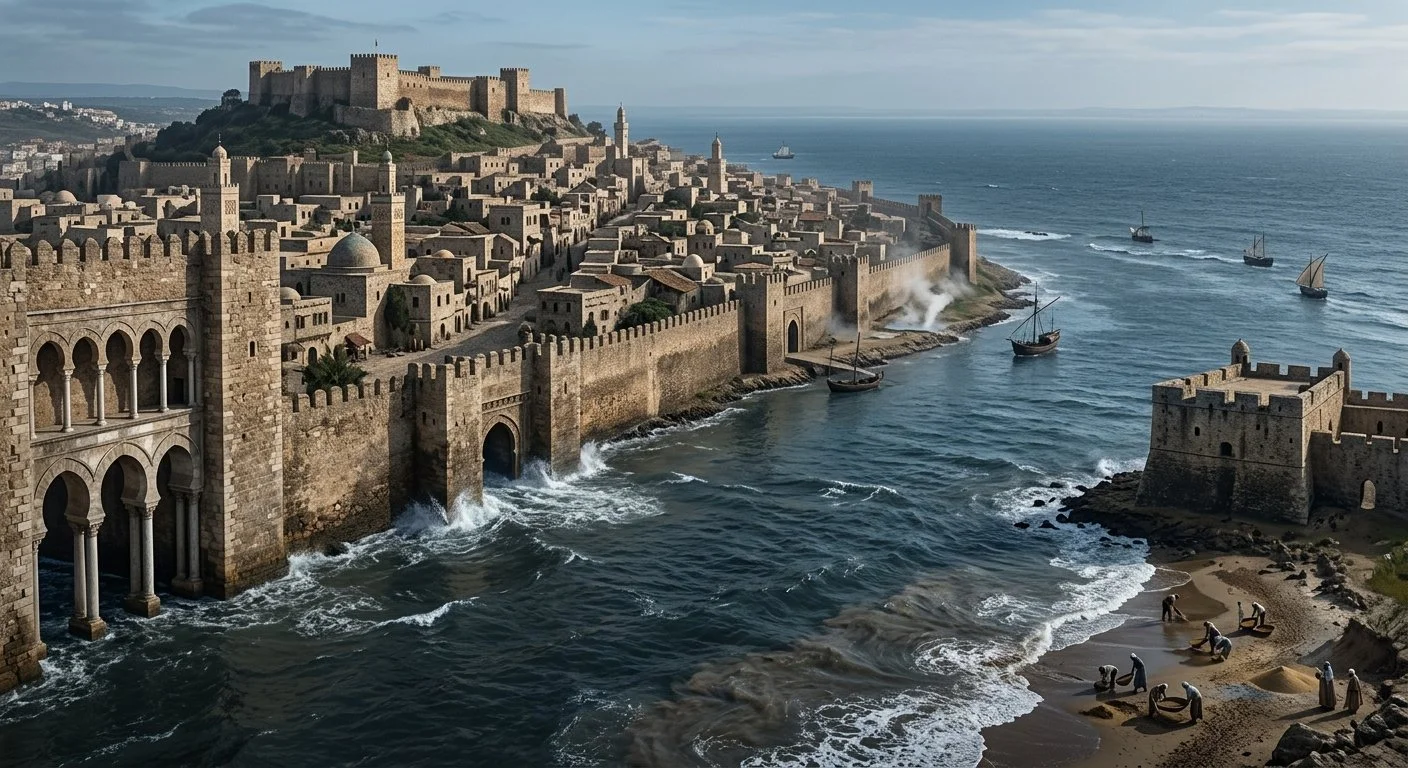
A digital visualization of Islamic-era Lisbon (Ushbūna) generated using Nanobanana based on the
12th-century historical descriptions of the geographer Ibn Abd al-Mun'im al-Himyarī.
Despite these detailed descriptions of the city's layout, early Arabic sources exclude any explicit account of Lisbon's initial military Islamic conquest. When Mūsā b. Nuṣayr led his forces through the Iberian Peninsula, his primary line of march ran northwest from Seville to Mārida (Merida), which he besieged and captured through a negotiated treaty, before advancing toward Toledo without mentioning the coastal settlements (Ibn ʿIdhārī, 2013).
Historical evidence indicates that Lisbon most likely submitted through capitulation under ʿAbd al-ʿAzīz b. Mūsā around 714 CE, accepting terms like those granted at Mārida and Tadmur (southeastern region of Spain) (al-Darwīsh & al-ʿAlyāwī, 2008, p. 5).
These surrender terms were as follows:
In the name of God, the Merciful, the Beneficent. This is a writ (kitāb) by ʿAbd al-ʿAzīz b. Mūsā for Tudmīr b. Ġandrīs when he entered into a peace agreement according to which he is entitled to a treaty (ʿahd) of God and His alliance (mīṯāq) and what He [God] has conveyed to His prophets and messengers, and that he is entitled to the protection (ḏimma) of God, may He be exalted and glorified, and the protection of Muḥammad, God bless him and grant him peace, that no one shall be set over him as a superior, that no harm shall befall any of his companions, that they shall not be led into captivity, that they shall not be separated from their wives and children, that they shall not be killed, that their churches shall not be burnt, that they not be alienated from their religion (dīnihim), and that their treaty (ṣulḥahum) shall be valid for seven cities: Orihuela, Mula, Lorca, Baltana, Alicante, Ello, and Elche, and that he shall not abandon the observance of the treaty (al-ʿahd) and not dissolve what he has consented to observe, and confirm what conditions we have imposed on him and what we have obliged him to perform: that he not conceal from us any news brought to him, that he and his companions are required to pay the poll-tax (ǧizya), of which each free man is to pay: one Dīnār, four measures (amdāʾ) of wheat, four measures of barley, four measures of condensed juice, four measures of vinegar, two measures of honey, and two measures of oil.’ Every slave is required to pay half of this amount.
Written in the month of Rajab in the year 94 of the Hijra [April 713 CE]. Witnessed by ʿUthmān b. Abī ʿAbda, Ḥabīb b. Abī ʿUbaida, Idrīs b. Maisara, and Abū al-Qāsim al-Muzanī. (Daniel G. König, 2020, p. 1).
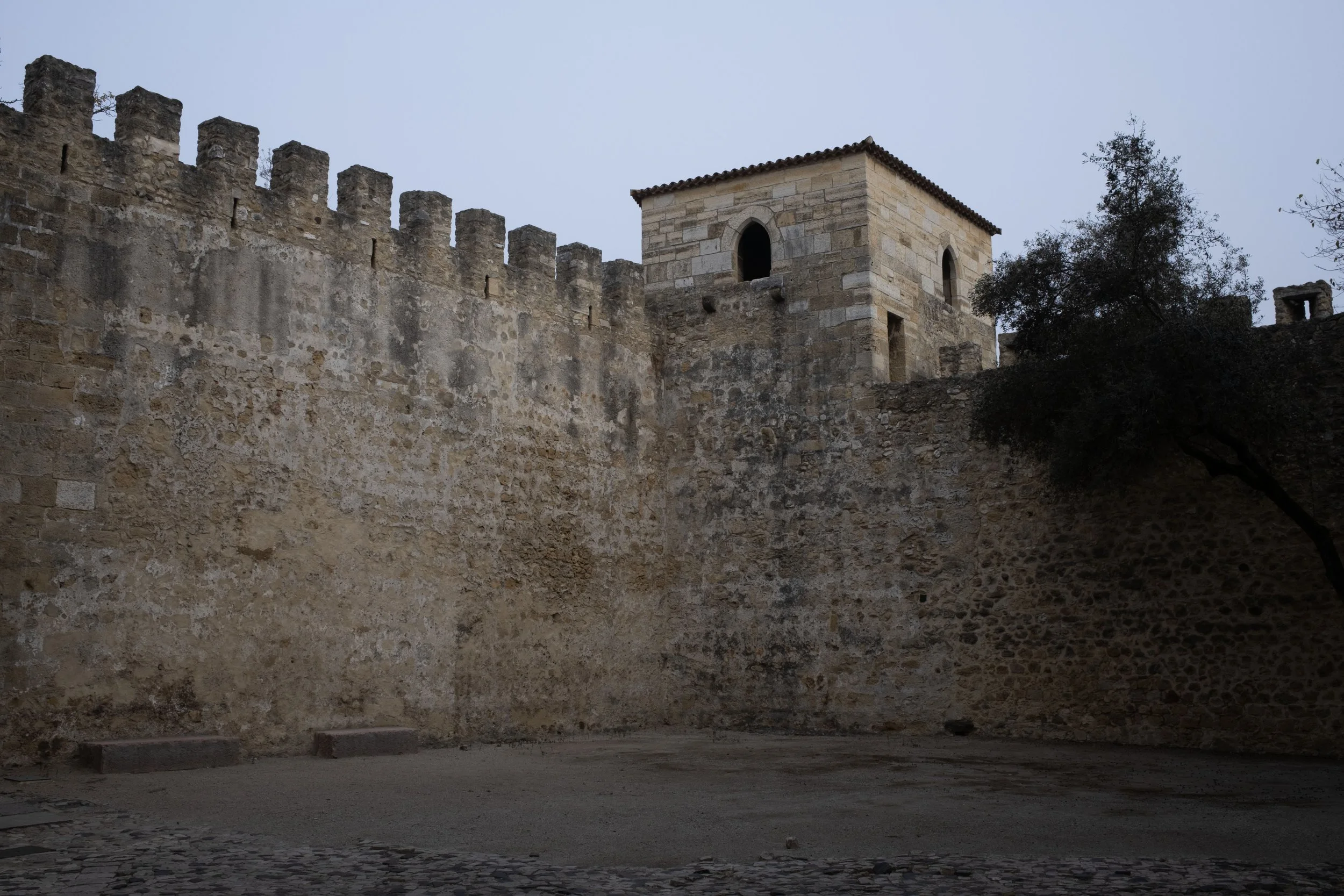
Inside Qalʿat al-ʿArab ( Castelo de São Jorge,), A. Nusair.
Further down the hill, additional archaeological investigations demonstrate how later Christian structures overlay the Islamic core. At the Sé Cathedral Site, built directly over the central mosque, excavations around the cathedral cloister have exposed original wall structures of the Islamic sanctuary alongside an earlier Roman cardo running beneath the site (Matos, 1999, pp. 10–11).
Similarly, beneath the Church of São Lourenço in the Mouraria neighborhood, excavations conducted during the 1990s uncovered 15 underground storage silos dating to the Islamic era, conserved prior to the church's construction after the Christan conquest (Rodrigues, 2019).
Beyond physical structures, the heritage of Islamic Lisbon persists throughout the modern city's language, geography, and traditions. Many prominent district names and landmarks directly reflect their Arabic origins. For instance, the name of the Alfama district derives from al-Ḥāmma, referring to the natural hot springs highlighted by the geographer al-Idrīsī (al-Idrīsī, 1989, Vol. 2, p. 542; Matos, 1999, p. 13).
Similarly, the term Alcáçova originates from al-qaṣaba, designating the citadel and official governor's residence (Matos, 1999, p. 11).
Meanwhile, the Mouraria neighborhood was named directly after the Moorish quarter designated for Muslim residents following the 1147 CE conquest. Even across the Tagus estuary, Almada stems from al-maʿdan (the mine), referencing early gold-washing activities recorded along the riverbank (al-Idrīsī, 1989, Vol. 2, p. 542).
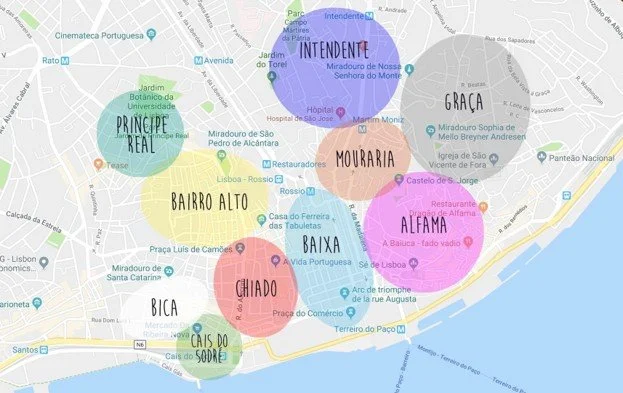
Neighborhoods of Lisbon, vizeo.net.
Alongside these enduring placenames, a notable religious continuity survived the shift in political power. The cult of Saint Vincent (São Vicente), maintained by the local Mozarabic Christian population living under Muslim rule, persisted throughout the entire Islamic period. Resident Mozarabic were instrumental in organizing the initial translation of the saint's relics following the Christian conquest of the city (Matos, 1999, pp. 31–32).
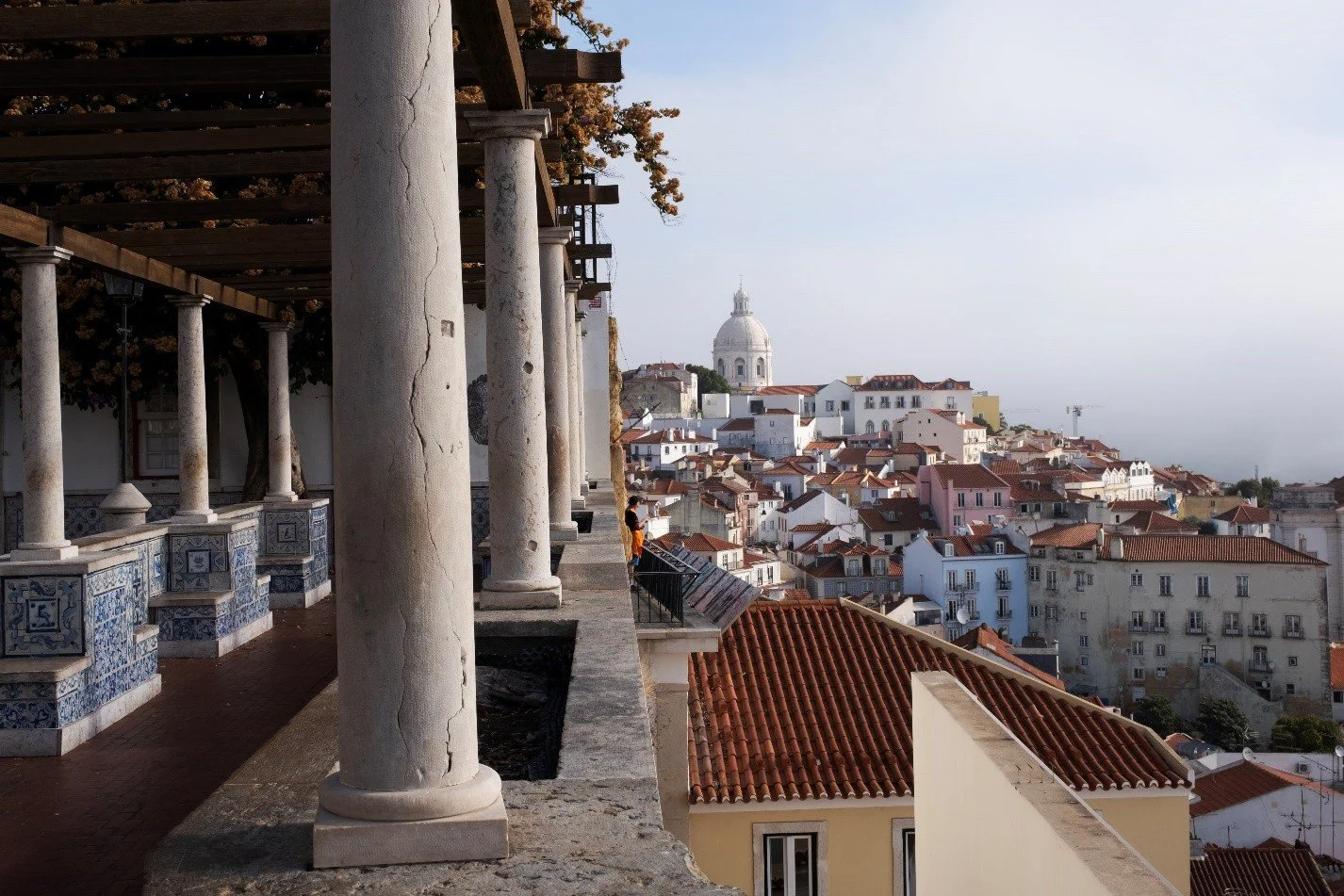
The city of Lisbon from above, A. Nusair.
Eventually, al-Ushbūna operated as a working Atlantic port on the far edge of al-Andalus, serving variously as a fishing town, a naval base, a trade customs point for gold dust, and a frontline defense against Viking fleets. Classical Arabic literature remembered it noting its coastal position alongside praise for its local honey and hawks. Lisbon's Islamic legacy forms the foundational framework of the city's historical structure. The hill and its citadel, the defensive walls, the layout of quarters like Alfama and Mouraria, and the local traditions formed a persistent foundation over which the modern city grew.
References and Further Reading
Abū al-Fidāʾ, I. b. ʿA. (1840). Taqwīm al-buldān (M. Reinaud & W. M. de Slane, Eds.). Imprimerie Royale. (Original work composed 14th century).
al-Bakrī, A. ʿU. ʿA. b. ʿA. (1992). Jughrāfiyat al-Andalus wa-Urubbā min kitāb al-Masālik wa-l-mamālik (ʿA. al-Raḥmān al-Ḥajjī, Ed.). Beirut. (Original work composed 5th/11th century).
Castelo de São Jorge. (n.d.). Archaeological Centre.
al-Darwīsh, J. Y., & al-ʿAlyāwī, Ḥ. J. (2008). Madīnat Lishbūna fī al-ʿaṣr al-islāmī [The city of Lisbon in the Islamic era]. Dirāsāt Tārīkhiyya, University of Basra, College of Education.
David, C. W. (Ed. & Trans.). (2001). De expugnatione Lyxbonensi: The conquest of Lisbon. Columbia University Press.
al-Ḥimyarī, M. b. ʿA. b. ʿA. al-Munʿim. (1938). Ṣifat jazīrat al-Andalus (É. Lévi-Provençal, Ed.). Cairo.
Ibn al-Abbār, M. b. ʿA. al-Quḍāʿī. (n.d.). Tuḥfat al-qādim (A. al-Bustānī, Ed.).
Ibn Ḥawqal, A. al-Qāsim al-Naṣībī. (1938). Ṣūrat al-arḍ (2nd ed.). Brill. (Coastal road to Lisbon, p. 31).
Ibn 'Idhari al-Marrakushi. (2013). Al-Bayan al-mughrib fi akhbar al-Andalus wa-al-Maghrib [The amazing story of the history of the kings of al-Andalus and the Maghreb] (B. A. Maruf & M. B. 'Awwad, Eds.). Dar al-Gharb al-Islami. (Original work published c. 1312).
Ibn al-Qūṭiyya, A. B. M. b. ʿU. (1989). Tārīkh iftitāḥ al-Andalus (ʿA. Allāh Anīs, Ed.). Beirut. (The basīṭ of Lisbon and ʿAbd al-Raḥmān II's fleet, pp. 50–51, 68).
Ibn Saʿīd al-Maghribī, ʿA. b. M. (1955–1964). al-Mughrib fī ḥulā al-Maghrib (Sh. Ḍayf, Ed., Vols. 1–2). Dār al-Maʿārif. (Kitāb al-mamlaka al-Ushbūniyya, Vol. 1, pp. 414–417).
al-Idrīsī, M. b. M. b. ʿA. (1989). Nuzhat al-mushtaq fī ikhtirāq al-āfāq (Vols. 1–2). Dār al-Kutub al-ʿIlmiyya. (Lisbon, the hot springs and the mugharrirūn: Vol. 2, fourth section of the fourth climate, c. pp. 541–549).
König, D. G. (2020). 713: The Treaty of Tudmir as a testimony to the Muslim subjection of the Iberian Peninsula. Transmediterranean History, 2(1). https://doi.org/10.18148/tmh/2020.2.1.24.
Matos, J. L. de. (1999). Lisboa Islâmica (Colecção Lazúli). Instituto Camões.
Muʾniṣ, Ḥ. (n.d.). al-Āthār al-Andalusiyya al-bāqiya fī Isbāniyā wa-l-Burtughāl.
Picard, C. (1997). L'Océan Atlantique musulman: De la conquête arabe à l'époque almohade: Navigation et mise en valeur des côtes d'al-Andalus et du Maghreb occidental. Éditions Maisonneuve et Larose.
Rodrigues, A. (2019). Nos arrabaldes de al-Uxbuna: A ocupação islâmica no sítio arqueológico da igreja de São Lourenço, Mouraria, Lisboa. Academia.edu.
Torres, C., & Macias, S. (1995). Lisboa: O legado islâmico em Portugal (pp. 96–105). Lisbon. (As cited in Matos, 1999, note 1).
Yāqūt al-Ḥamawī, Sh. al-Dīn ʿA. Allāh. (n.d.). Muʿjam al-buldān (Vol. 1). Dār Ṣādir.