
While various urban centers in Gharb al-Andalus (the western frontier of Islamic Iberia) were well-known for highly specific regional attributes such as the defensive, fortified architecture of Mértola, the chronic political rebellions of Beja, or the sophisticated literary and poetic traditions of Santarém and Silves, the city of Évora - known as Yabura during the period of Islamic rule - occupied a distinct socio-economic role. In classical Arabic geographical sources, most notably the 12th-century geography book Nuzhat al-Mushtaq by Al-Idrisi, Évora can be distinguished as the essential agricultural breadbasket and commercial hub of the western province of al-Andalus.
Highlighting the city's regional economic significance, he described it as:
[a] grand, bustling city, full of people, featuring vibrant markets, a citadel (qasabah), and a grand mosque. It possesses an immense agricultural bounty unmatched by other lands, with a rich surplus of wheat, meat, various legumes, and fruits. Indeed, it is the most beautifully situated of regions, the most prosperous, and a thriving hub where commerce flows constantly in and out (Al-Idrīsī, 2008, translation by the author).
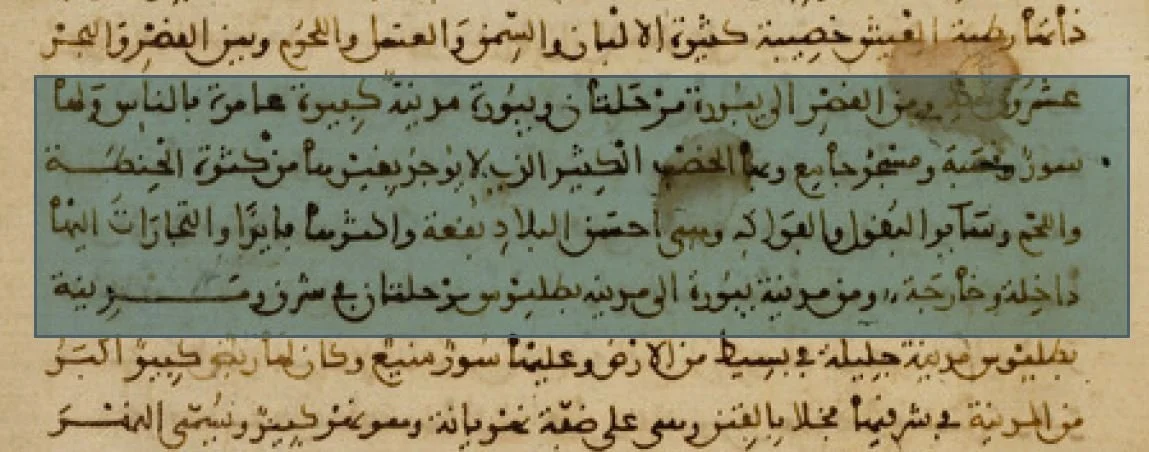
Adaptation of the text by the Idrisi in 1154 AD. Nuzhat al-Mushtaq fi Ikhtiraq al-Afaq, World Digital Library. Original manuscript held at the National Library of France.
Évora is in south-central Portugal and it is the capital of Alentejo region, positioned right between Lisbon to its west, Beja to its south, and Badajoz, Spain, to its east. This central location made Évora historically important as a strategic link between major cities. As a result, whenever major events or conflicts happened in Lisbon, Beja, or Badajoz, Évora was almost always caught in the middle or heavily involved.
Évora's Islamic chapter opened when it was conquered by Abd al-Aziz ibn Musa ibn Nusair. Sent by his father with a massive army to bring western Iberia under control, Abd al-Aziz first captured the regional stronghold of Beja. From there, he marched his forces directly toward Évora, successfully capturing the city and integrating it into the expanding Umayyad Caliphate, ruled from Damascus, in 714 CE (Ibn Idhārī, 2013).
Following its initial conquest, Évora rarely appeared in historical chronicles for nearly two centuries (Al-Fahdawi, 2024). However, by the early 10th century, booming agricultural development transformed the city into a highly desirable prize due to its immense wealth and fertile lands.
This prosperity coincided with major political shifts as Abdulrahman III (al-Nasir) ascended the throne to establish the Umayyad Caliphate of Córdoba and King Ordoño II of León launched a series of aggressive raids into Islamic territory. Targeting the western frontiers where Muslim defensive lines were weak, Ordoño II marched upon Évora in August 913 CE, leading a massive army of thirty thousand horsemen, infantry, and archers (Al-Ḥumaydī, 1966, Vol.1, translation by the author).
The governor of Évora, Marwan ibn Abd al-Malik, put up a resistance, but his efforts failed. Ordoño surrounded the city from all sides and launched his attack. The Muslims defended their city from behind the walls, but King Ordoño II’s forces managed to break through. A brutal battle erupted inside the city streets, leaving a massive number of Muslims dead, with only a few escaping. Ordoño’s forces took four thousand Muslim captives, including women and children. Along with the death of Governor Marwan, the Spanish troops destroyed the city before Ordoño finally led his army back to Galicia (Al-Ḥumaydī, 1966, Vol.1, translation by the author).
Afterward, the people of Évora rebuilt their city. Led by their new governor, Abd Allah ibn Muhammad al-Jaliqi (The Galician), they reconstructed the defensive walls, making them wider, longer, and higher than before. Soon, Muslims began arriving in Évora, choosing to settle down and bring the city back to life (Al-Ḥumaydī, 1966, Vol.1, translation by the author).
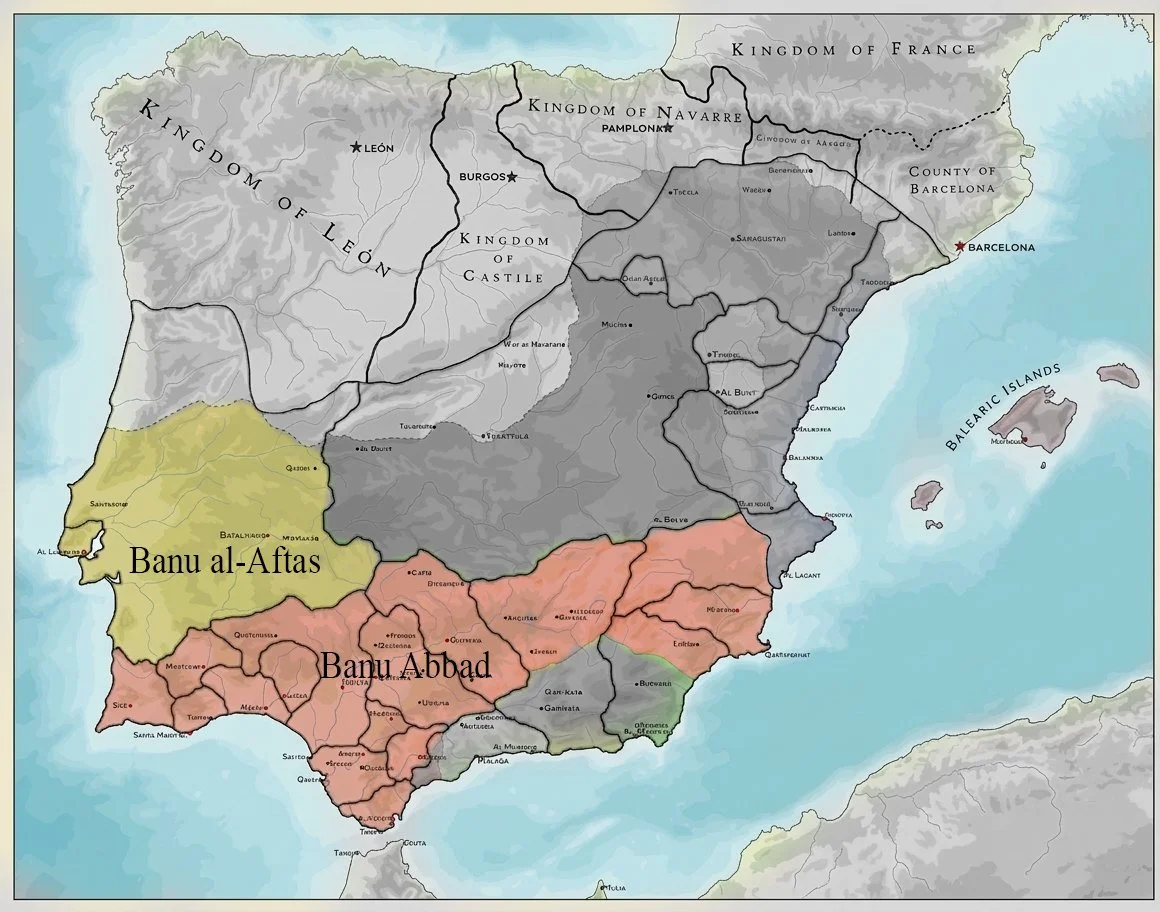
During the Taifa period, when al-Andalus fractured into independent, competing kingdoms, two major powers dominated the west (Gharb al-Andalus). The Banu al-Aftas of Badajoz controlled a vast territory encompassing cities like Mérida, Coimbra, Lisbon, Santarém, Évora, and Sintra. Meanwhile, Banu Abbad ruled over Seville, Silves, Faro, and surrounding areas.
Given their shared borders, a clash between these two regional powers over the wealthy city of Évora was fated. Therefore, a battle near Évora conducted in 1050 CE between the two forces, which resulted in the total defeat of Ibn al-Aftas's forces. As a result, Ibn Abbad successfully annexed Évora into the Taifa of Seville that same year (Al-Fahdawi, 2024).
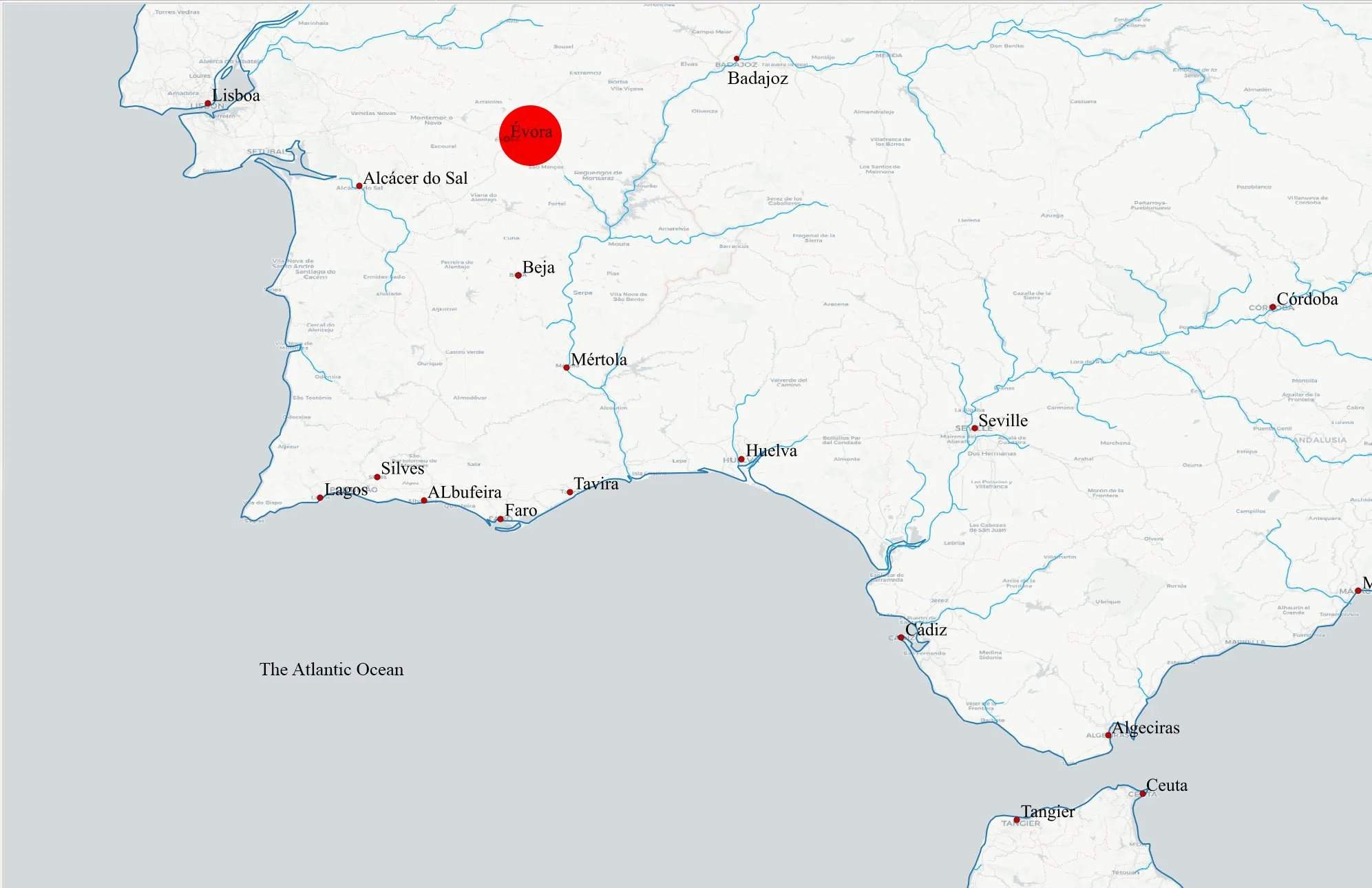
Location of Évora, QGIS, A.Nusair, 2026.
During the 12th century Almohad period, Évora reappeared in the historical record along with Beja. Ibn Idhārī indicates in his book Al-Bāyān that Ibn Wazir, the ruler of Beja and Évora, traveled to Marrakesh at the end of 1154 CE to seek aid and assistance in standing against the aggressive actions of the first King of Portugal, Afonso Henriques, whom Arabic sources refer to as Ibn al-Rink. This move came as the Portuguese king's attacks into Muslim-controlled territories escalated, alongside his systematic destruction of their lands and devastation of their crops.
In response, the Almohad Caliph promised Ibn Wazir of Évora full support and backing to secure victory over the King of Portugal, and he dispatched official letters to this effect to the people of Évora and Beja (Ibn Idhārī, 2013).
After the Almohad Caliph Abu Yusuf Yaqub al-Mansur consolidated his rule over Morocco, he looked toward al-Andalus to launch a military campaign. He was heavily influenced by messages from the local Andalusian Muslims, who begged him to save them. He answered their call and managed to win great victories over the Christian forces, successfully capturing back the cities of Trujillo and Évora (Al-Fahdawi, 2024).
By the autumn of 1165 CE, a warlord known as Geraldo launched a series of campaigns across the frontier with Christian volunteers and adventurers. Acting independently of King Afonso Henriques, he first raided and successfully captured the city of Trujillo, located near the Tagus River. Then, he immediately advanced toward Évora, successfully bringing that major stronghold under his control. Later, he gave it to the King of Portugal, Afonso Henriques (Anan, 1969).
Banu al-Aftas and Banu Abbad territories under Taifa period in 11th century,
Adapted from SalesWorlds, 2017.
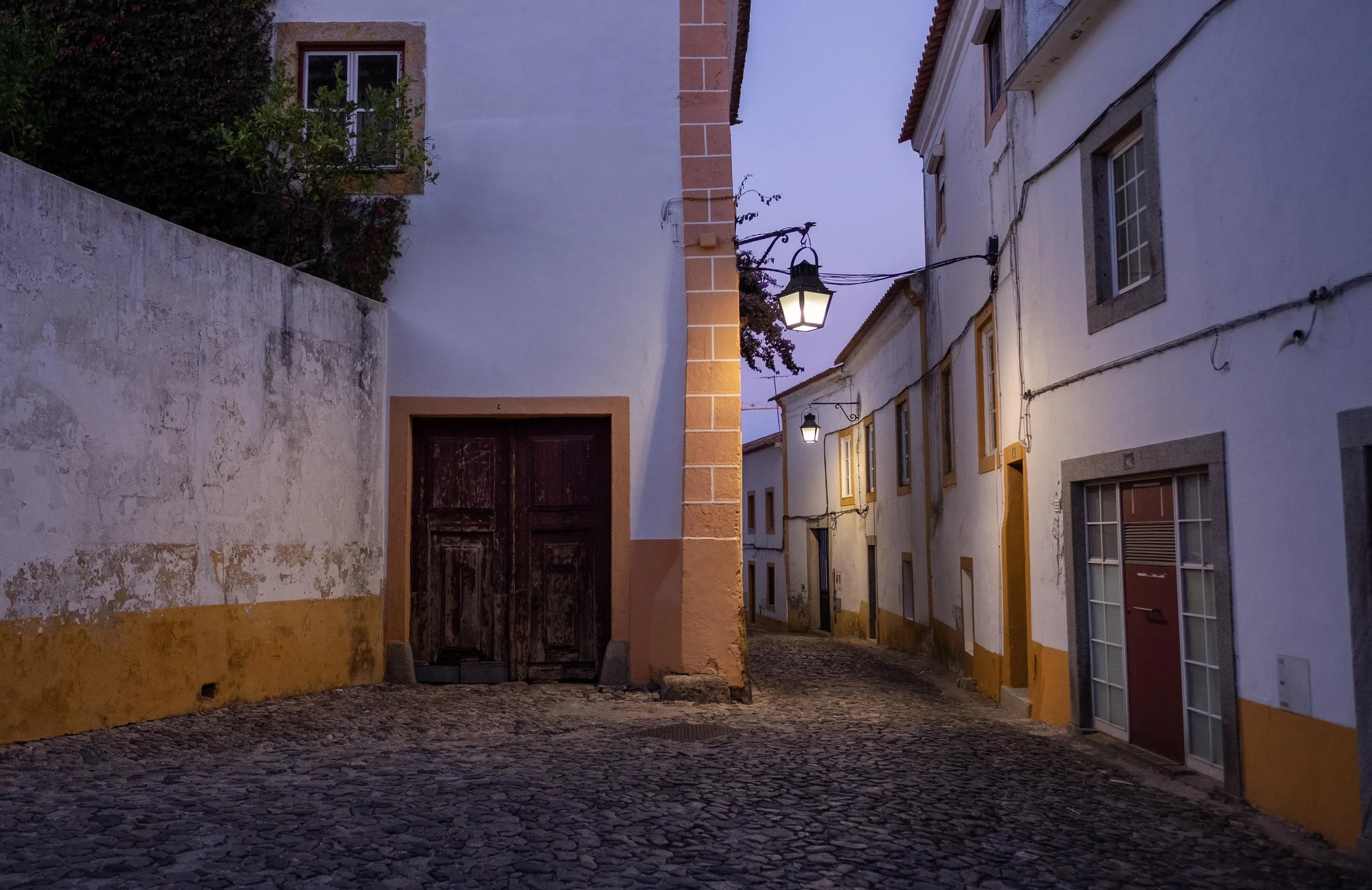
The old quarter in Évora, A. Nusair 2026.
These events reveal that independent warlords operating outside official royal armies were primarily motivated by wealth first rather than a specific ideological or religious agenda. These independent actors naturally targeted wealthy commercial hubs, which explains why Évora remained a constant target for competing factions.
Beyond this chaotic political landscape, the city preserved a rich Andalusian cultural legacy which was embodied by its famous native son, Abd al-Majīd ibn Abdūn al-Yāburī. Born, raised, and died in Évora, Ibn 'Abdūn was known as a brilliant poet and an influential minister during both the Taifa and Almoravid periods (Anan, 1969). His poetry survived the centuries and remains a staple in classical Arabic literary education today. His most famous lines poignantly reflect on time, loss, and the shortness of life:
لدَهرُ يُفجِعُ بَعدَ العَينِ بِالأَثَرِ — فَما البُكاءُ عَلى الأَشباحِ وَالصُوَرِ
فَلا تَغُرَّنكَ مِن دُنياكَ نَومَتُها — فَما صِناعَةُ عَينَيها سِوى السَهَرِ
Time tragically leaves us with only remnants where substance once stood
So why weep over empty shadows and forms?
Let not the world's peaceful slumber deceive you,
for its eyes never do anything but wakefully watch to betray.
(translation by the author).
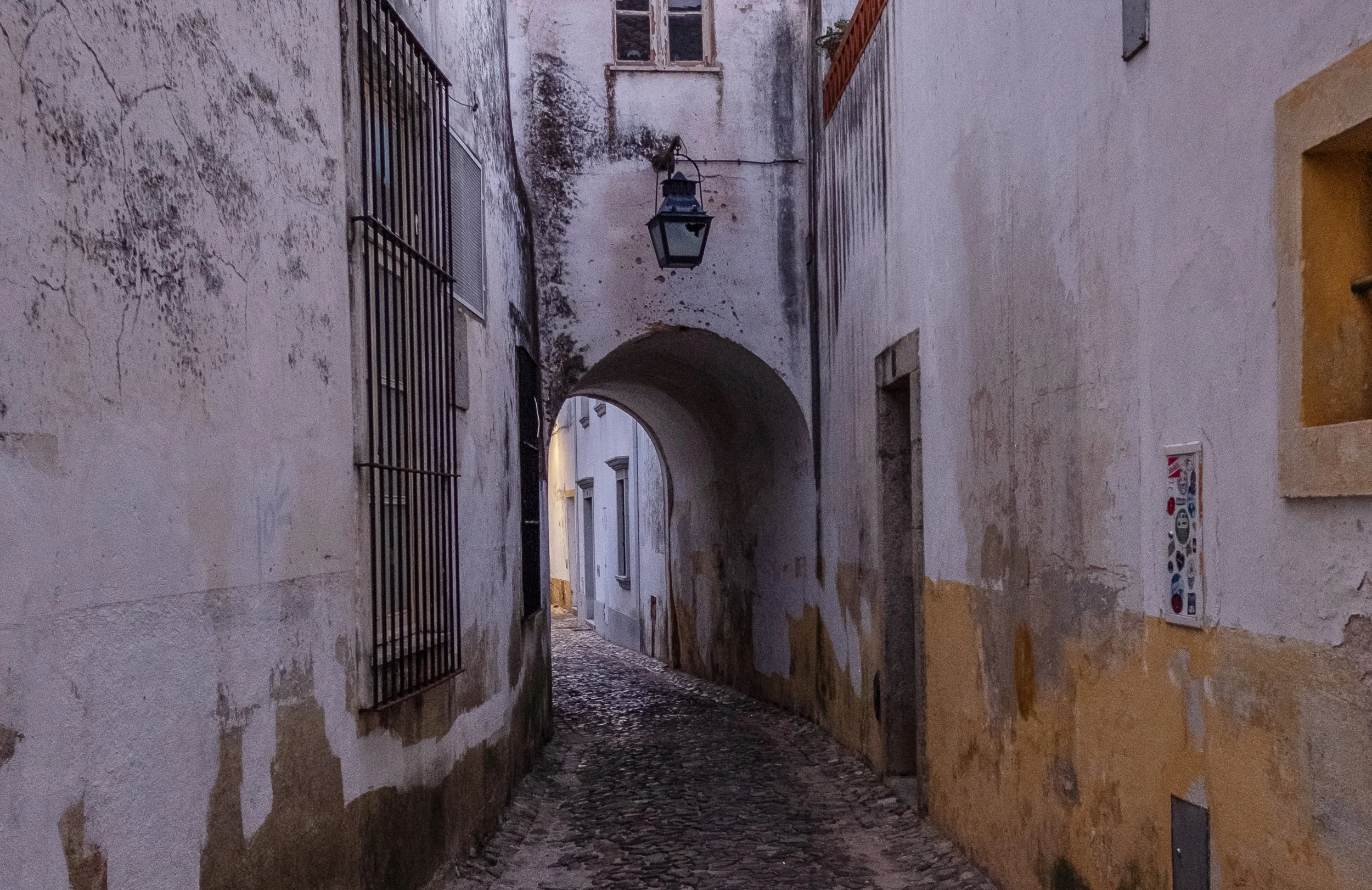
The Moorish quarter in Évora, A. Nusair 2026.
Évora’s historical landscape still carries the imprint of its Islamic past, visible in both its architecture and archaeological remains. Large sections of the city’s defensive walls were rebuilt during the Umayyad Caliphate, following the Christian raids led by King Ordoño II of León in 913 CE (Correia, 2026).
The main cathedral, located beside what was once the Moorish quarter, is widely believed to have been constructed directly over the site of the city’s central mosque. Additional traces of the Islamic period survive in the form of ancient stone tombs and epigraphic fragments bearing Qur’anic inscriptions from the Umayyad era, offering continuing testament to centuries of Andalusian life in Évora (Anan, 1969).
The modern capital of the Alentejo region in Portugal still reflects its ancient identity whose monumental past continues to bear witness to its time as the unique economic engine of the Andalusian west. Today, while the grand markets and medieval storehouses described by Al-Idrisi have given way to modern streets, Évora's historical legacy remains linked to this age of prosperity.
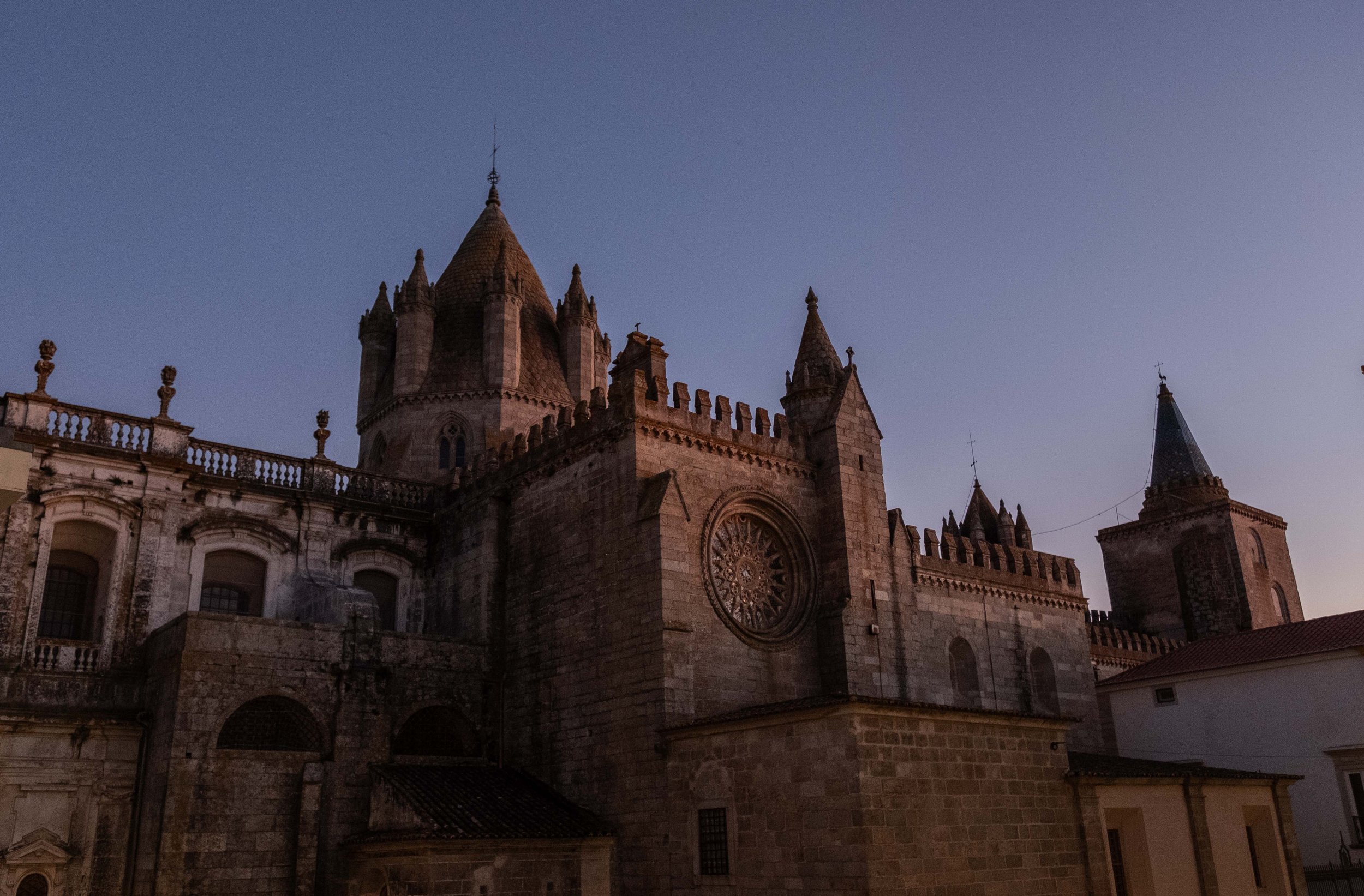
The cathedral of Évora, A. Nusair 2026.
References
Al-Fahdawi, H. M. J. H. (2024). Evora: A study of its political and scientific status (95 - 562 AH / 714 - 1166 AD). Arab Science Heritage Journal, 21(3).
Al-Ḥumaydī, M. F. (1966). Jadhwat al-muqtabis fi dhikr wulat al-Andalus. Al-Dar al-Misriyyah lil-Ta'lif wal-Tarjamah. (Original work written c. 1095).
Al-Idrīsī, M. ibn M. ibn ʿAbd Allāh. (2008). Nuzhat al-Mushtāq fī Ikhtirāq al-Āfāq [The Delight of Him Who Longs to Travel the Horizons] (Vol. 1). Cairo: Maktabat al-Thaqāfa al-Dīniyya. (Original work published c. 1154).
Correia, F. B. (2026). Évora city walls. Discover Islamic Art. Museum With No Frontiers. https://islamicart.museumwnf.org/database_item.php?id=monument;ISL;pt;Mon01;8;en.
Ibn 'Idhari al-Marrakushi. (2013). Al-Bayan al-mughrib fi akhbar wa-al-Maghrib [The amazing story of the history of the kings of al-Andalus and the Maghreb] (B. A. Maruf & M. B. 'Awwad, Eds.). Dar al-Gharb al-Islami. (Original work published c. 1312).
SalesWorlds. (2017, October 30). 1st Taifas period in Al-Andalus. DeviantArt. https://www.deviantart.com/salesworlds/art/1st-Taifas-period-in-Al-Andalus-712452795.