
Far from the Tunisian city of Béja, towards the west, lies its counterpart in the western Iberian Peninsula, the Portuguese city of Beja. Situated in the Alentejo region, it was historically distinguished as 'Kurat Beja'. In the administrative language of the time, a Kura refers to an administrative district that encompasses nearby villages or cities (Sourdel, 2012).
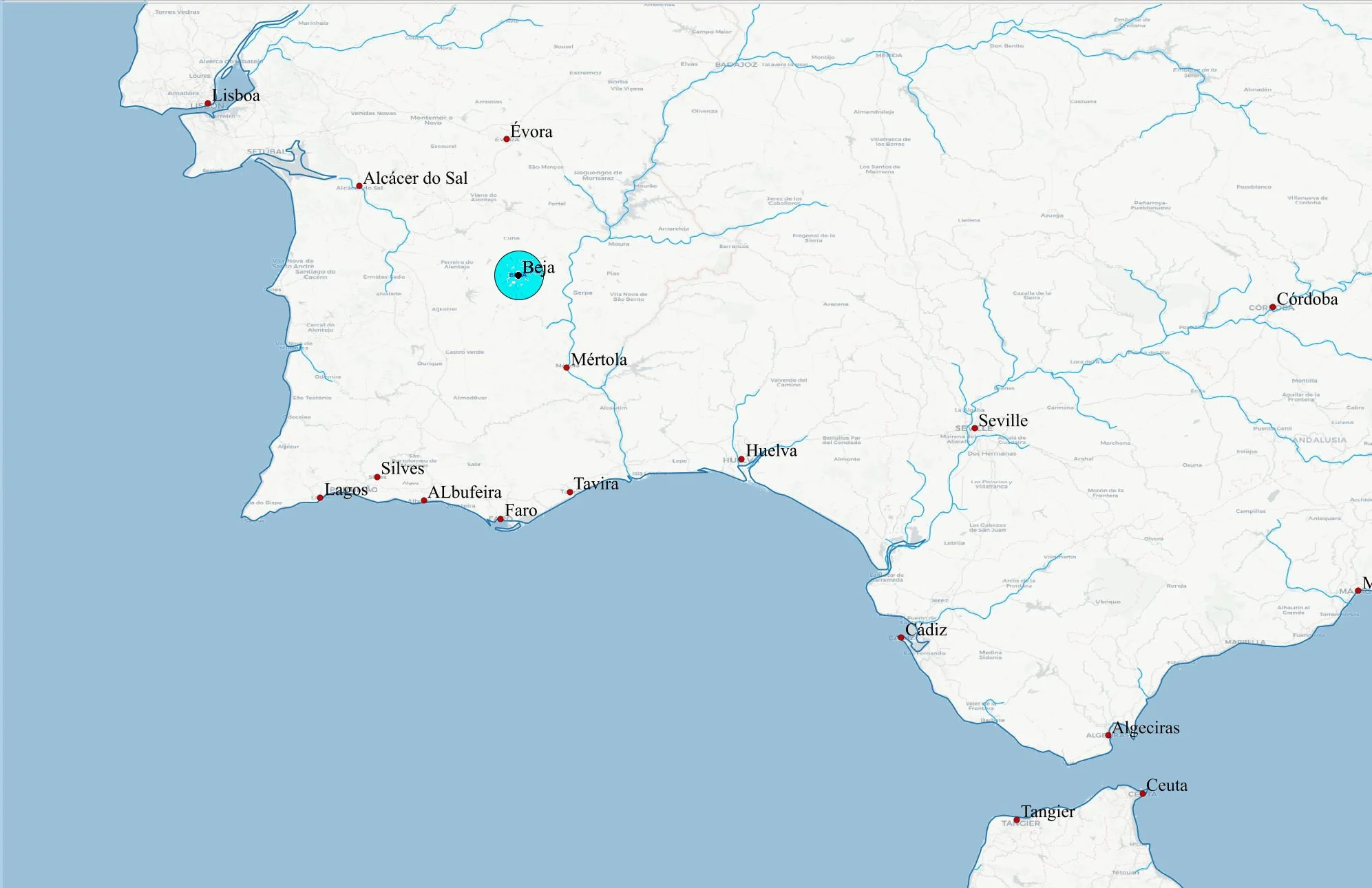
Location of Beja, generated in QGIS by A. Nusair (2026).
The city transitioned from Visigothic to Islamic Andalusian rule following the conquest of 711 CE. The commander Abd al-Aziz ibn Musa ibn Nusair secured the city as described by the historian Ibn Idhari (2013) in Al-Bayan al-Mughrib, Citing the campaign's progress across the landscape, he wrote: “Abd al-Aziz marched to Niebla and conquered it, then proceeded to Beja and conquered it, and he conquered Lisbon and Sintra, along with the rest of the cities of the West” (Ibn Idhari, 2013, translated by author).
Al‑Ḥimyarī, in his work Ṣifat Jazīrat al‑Andalus, describes the city of Beja as: “the oldest of the cities of al‑Andalus in its construction and the earliest to have been established…The district of Bāja and its surrounding territories are expansive, and it possesses fortresses renowned for their strength and impregnability” (Al‑Ḥimyarī, 1988, translation by the author).
Similarly, Al-Idrīsī described it as:
An ancient city, its construction goes back to earliest times. It lies on the slope of a mountain and is moderate in size. It possesses farms and abundant produce of wheat and barley, and it serves as a major provisioning center for the lands of al‑Andalus. In earlier times, the Arab troops were placed there. Its inhabitants are of mixed origins, and the city contains markets, trade activities, and extensive facilities. It also has a great mosque with a minaret (Al-Idrīsī, 2008, translation by the author).
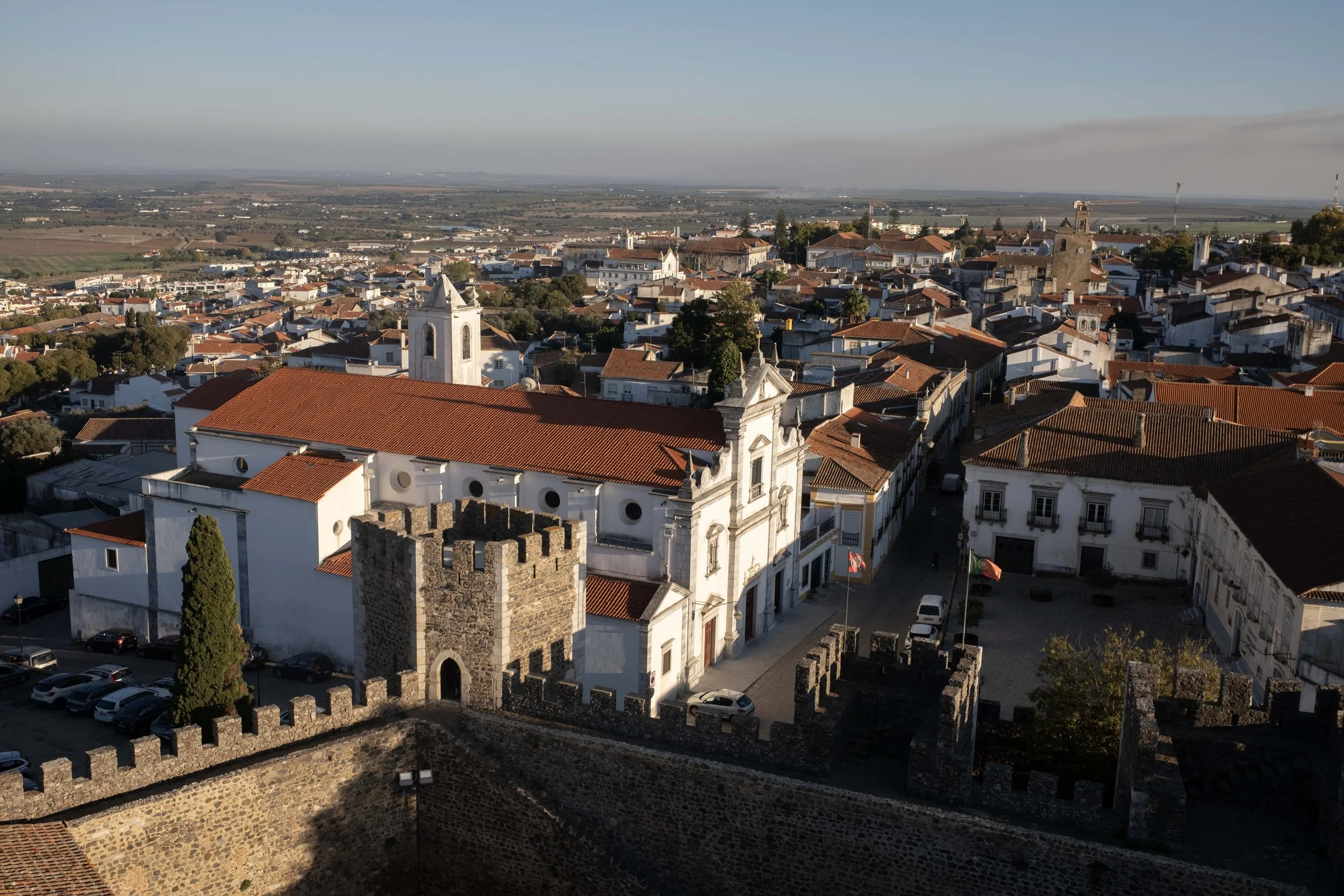
General view of the city of Beja. Photo by A. Nusair.
Throughout the different Andalusian periods, Beja was known as a city of rebels and military events, often influenced from events in the Islamic East. Its distance from the capital, Córdoba, along with its natural fortifications and its dense population made it a frequent center of uprisings that shook the pillars of the Andalusian state at various periods.
Demographically, the city was notably diverse, inhabited by Egyptian Arabs, Amazigh populations, Mozarabs (Christians under Muslim rule), and Muwalladun (Iberian converts to Islam) (Anan, 1969).
Beja, like the rest of al‑Andalus, was under the rule of the Umayyad Caliphate in Damascus from 711 AD and for about 42 years. During this period, Arabs held most political power and controlled the richest lands, while many Amazigh groups were pushed into less fertile and more remote areas. This unequal treatment contributed to the Amazigh revolution in the 8th century (Anan, 1969).
To restore order and regain control, a new governor, Abu al‑Khattar al‑Kalbi, was appointed in al‑Andalus. He decided to bring additional Arab troops to confront the ongoing revolt. These troops were distributed in order among the Andalusian cities, as described by Ibn alQūṭiyya in his book Taʾrīkh Iftitāḥ al‑Andalus (History of the Conquest of al‑Andalus):
Then he [al-Kalbi] distributed them among the districts (al‑kūr), making their settlements in al‑Andalus resemble their settlements in al‑Shām… He settled the army of Jordan (Jund al‑Urdunn) in Riyyah; he settled the army of Palestine in Shadhūnah; and he settled the Egyptian army in Bāja and Tudmīr. Egypt lies between the East and the West, so Bāja is to the West, and Tudmīr to the East (Ibn alQūṭiyya, 1989, translated by author).
We also find other testimony in Ibn Ghalib, who explains in Farḥat al‑Anfus that the Egyptian army divided itself between two districts, Tudmīr (Murcia) in the east and Beja in the west. He notes that Tudmīr resembled Upper Egypt, while Beja resembled the Egyptian countryside, as both were rich agricultural areas (Ibn Ghalib, 1994).
The fall of the Umayyad Caliphate in Damascus in 750 CE and the rise of the Abbasid Caliphate had a deep impact on both the eastern and western Islamic worlds. Umayyad prince ʿAbd al‑Raḥmān ibn Muʿāwiya known as “Saqr Quraish” escaped the Abbasid Umayyad massacres and went westward, where he eventually established an independent Umayyad emirate in al-Andalus. He became its sole ruler, under whose authority political order was restored (Ibn Idhari, 2013).
Seeking to challenge ʿAbd al‑Raḥmān’s rule in al‑Andalus, the Abbasids used the ambitions of his enemies, hoping to terminate the Umayyad presence there. They therefore turned to al‑ʿAlāʾ ibn Mughīth in Beja, driving him to raise the Abbasid banner in the region as described by Ibn Idhārī al‑Marrākushī:
In the year 146 AH (AD 764), al‑ʿAlāʾ ibn Mughīth al‑Judhāmī rebelled in Beja and called for obedience to Abū Jaʿfar al‑Manṣūr, the Abbasid caliph in the East. He unfolded the black banners (Abbasids banners) and the troops gathered behind him, as did many of the devout, until the Emir’s state (ʿAbd al‑Raḥmān ibn Muʿāwiya) was nearly gone… So, he marched out from Córdoba and reached Carmona… A long battle took place between the two sides… and al‑ʿAlāʾ was slain along with many of his followers (Ibn Idhārī, 2013, pp. 61–62, translated by author).
And by the 9th century a revolt under Omar ibn Hafsún led a major local revolution in al-Andalus against the Umayyad rulers. His movement was mainly supported by the Muwallads. His influence spread across many areas, attracting many followers and becoming a serious threat to the central government in Córdoba. Eventually, he embraced Christianity, the shift causing a major loss of support, and his revolt collapsed as followers drifted away.
This revolt was one of several uprisings by the Muwallads in al-Andalus, who were protesting their poor living conditions. Some of these Muwallads even established independent mini‑states separate from Córdoba. Among them were the Banu Qasi, who controlled the region of Zaragoza in northeastern Spain; the Banu Marwan al-Jilliqi, who ruled the province of Badajoz in western Spain; and their allies in Beja led by Abdulmalik ibn Abi Jwad. Therefore, and for many years, Beja ruled as a semi‑independent state. They refused to pay taxes and carried out raids against territories loyal to the Umayyads until the time of the first caliphate in al-Andalus, Abdulrhman III (Anan, 1969).
By the 12th century, the Sufi leader Abu al‑Qasim ibn Qasi emerged in the city of Silves, and Beja soon joined his Sufi revolution movement called “Murīdūn” (the followers of Ibn Qasi). Beja then transformed into a stronghold for ibn Qasi, who rebelled against the Almoravids, expelled their military base, and at times formed tactical alliances with the Portuguese and at other times with the Almohads. This uprising movement was both religious and political, as the people of Beja and the western regions of al-Andalus saw Ibn Qasi as a liberator from the oppression of the Almoravids (Anan, 1969).
The city of Beja’s participation in successive revolutions - whether driven by religious reasons, political ambition, or resistance to central authority - reinforced its reputation as a stronghold of unrest throughout al-Andalus. These events were part of a wider pattern of local behaviors that characterized Beja across different periods, setting the stage for later revolts and further instability.
Although Beja fell to the southward advancing Portuguese forces in 1162 CE (Castellinelmondo, 2016), bringing nearly 450 years of Islamic rule to an end, the city did not lose its Andalusian cultural and architectural legacy overnight.
Muslim presence persisted in the region until the late 15th century, allowing many elements of its Andalusian character to stand despite the political transition.
Today, Beja holds notable traces of its Islamic heritage, particularly visible in its defensive structures, urban fabric, and several architectural features. Although the surviving remains are fewer than those found in nearby cities like Mértola, they nonetheless provide essential insight into the cultural and architectural imprint of its Andalusian past.
The current castle of Beja is a medieval Christian structure, yet it rises atop the remains of an earlier Islamic and Roman fortification. Its original defensive walls underwent several phases of reconstruction, including significant works during the Islamic period. The torre de menagem preserves notable 11th century Islamic architectural features, most prominently an eight-pointed star vault pattern characteristic of Andalusian design (Patrimonio Islamico Project, 2016).
The narrow, winding streets of Beja’s historic center preserve the characteristic Andalusian urban fabric pattern designed to provide shade, enhance defense, and maintain community privacy. In addition, traces of the city’s historic gateways remain visible, such as the Porta Moura, a monumental arched entrance located in the northern part of the city, measuring approximately 10 meters in height and 6 meters in width. Moreover, the museum of Beja preserves an exceptionally rich epigraphic collection, consisting primarily of Arabic funerary tombstones bearing Qur’anic inscriptions and personal names (Anan, 1969, Vol. 7).
Archaeological discoveries in recent decades have further illuminated the depth of Beja’s Islamic presence. Among the most significant findings is one of the largest Islamic cemeteries in Portugal, uncovered during construction works at the Diogo de Gouveia Secondary School, where archaeologists excavated approximately 250 Islamic‑period burials, providing clear evidence of a substantial Muslim population in medieval Beja (RTP Noticias, 2011).
Beja stands as a complex and dynamic city in al-Andalus’ history. From its early incorporation into the Islamic world in 711 CE to its role as a stronghold of military, social, and religious movements, the city’s trajectory reflects the broader rhythms that shaped Iberian history.
Beja’s strategic location, fertile lands, and diverse population made it an asset and a frequent center of resistance. Egyptians, Amazigh, Mozarabs, and Muwalladun all contributed to its demographic fabric, transforming the city into a small-scale version of Andalusian multicultural identity.
Across the Umayyad, Abbasid, and later Almoravid and Almohad periods, Beja remained deeply entangled in regional conflicts and shifting political allegiances. Its repeated role in revolts reveals a society constantly negotiating power and identity. These cycles of rebellions shaped a local tradition of political activism that distinguished Beja from many other Andalusian cities.
Resources
Al‑Ḥimyarī, Muhammad Bin Abdel Moneim. (1988). Al-Rawd Al-Ma'tar in Khabar Al-Qatar. Research by Ihsan Abbas. Beirut: Dar Sader. (Original work published c. 1327).
Al-Idrīsī, M. ibn M. ibn ʿAbd Allāh. (2008). Nuzhat al-Mushtāq fī Ikhtirāq al-Āfāq [The Delight of Him Who Longs to Travel the Horizons] (Vol. 1). Cairo: Maktabat al-Thaqāfa al-Dīniyya. (Original work published c. 1154).
Anān, M. ʿA. A. (1969). Dawlat al-Islām fī al-Andalus (7 vols.). Muʾassasat al-Khanjī.
Castellinelmondo. (2016). BejaCastel. https://castellinelmondo.altervista.org/en/castle/portugal/beja-district/beja-castle/.
Ibn al-Qūṭiyya. (1989). Taʾrīkh Iftitāḥ al-Andalus (I. al-Abbās, Ed.). Dār al-Kutub al-ʿIlmiyya.
Ibn Ghalib, A. (1994). Farḥat al-anfus wa-l-munāẓarāt bayna al-jawāri wa-l-ʿanās. (M. al-Tūnisī, Ed.). Dār al-Gharb al-Islāmī.
Ibn 'Idhari al-Marrakushi. (2013). Al-Bayan al-mughrib fi akhbar al-Andalus wa-al-Maghrib [The amazing story of the history of the kings of al-Andalus and the Maghreb] (B. A. Maruf & M. B. 'Awwad, Eds.). Dar al-Gharb al-Islami. (Original work published c. 1312).
Patrimonio Islamico Project, Database of the Islamic Heritage of Portugal, (2015-2016), Sheet | Islamic Heritage in Portugal.
RTP Noticias. (2011). Descoberta em Beja uma das maiores necrópoles islâmicas em Portugal.
Sourdel, D. (2012). Kūra. In P. Bearman (ed.), Encyclopaedia of Islam New Edition Online (EI-2 English). Brill. https://doi.org/10.1163/1573-3912_islam_SIM_4528.
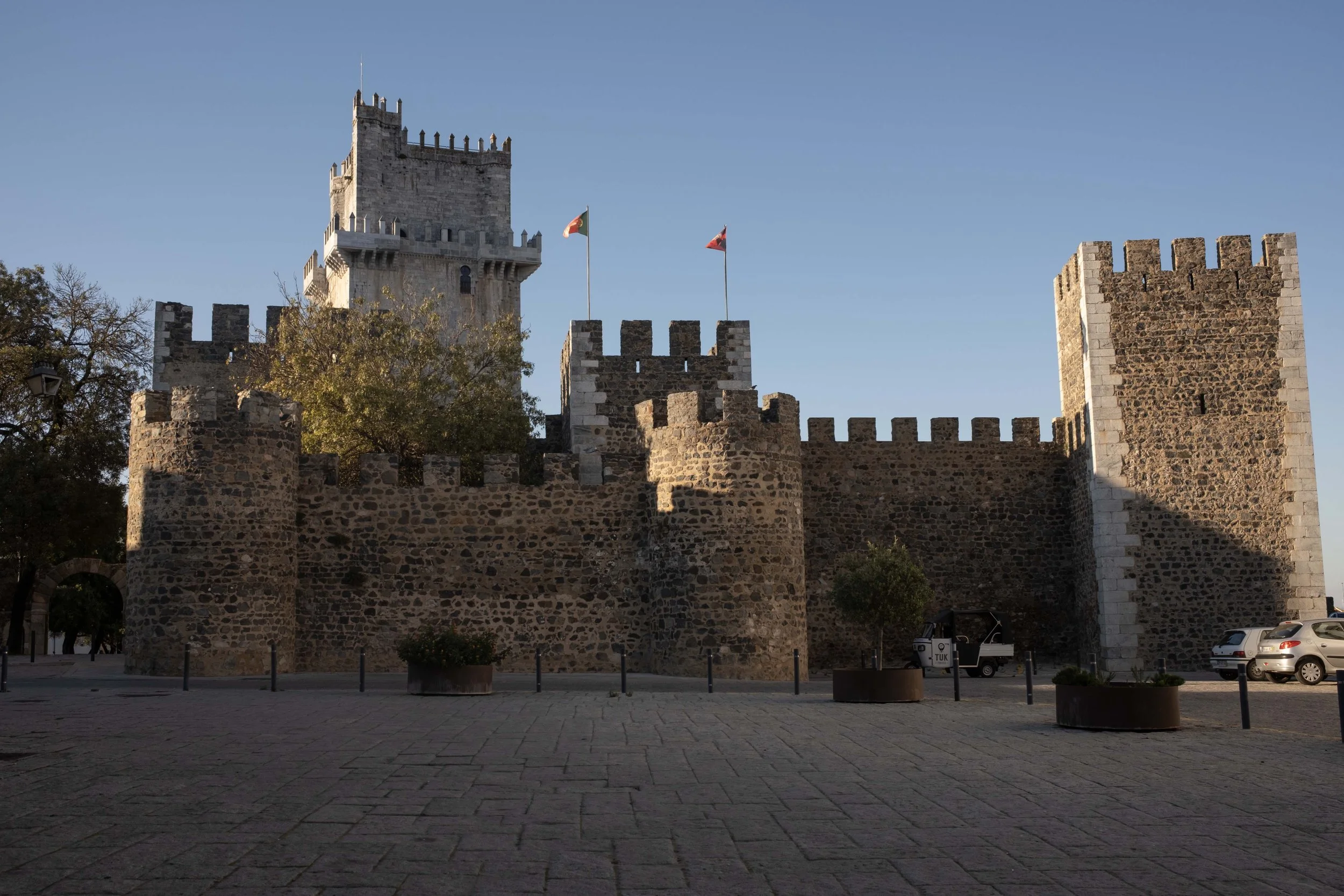
The castle of Beja. Photo by A. Nusair.
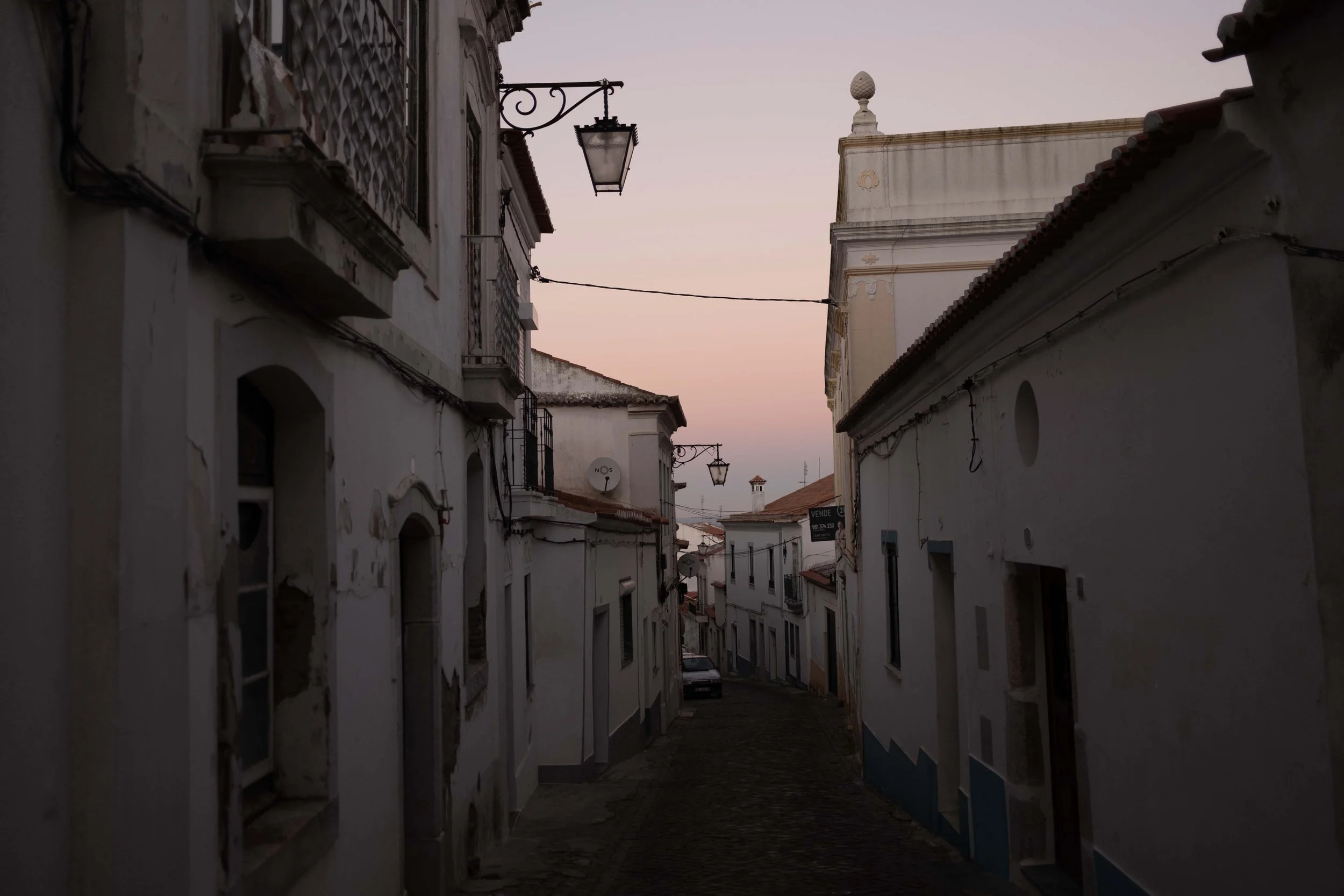
Urban fabric of Beja. Photo by A. Nusair.