
Sintra is loved today for its romantic palaces and its green, misty mountain, but long before the Pena palace was built, the city was a Muslim place called Shantara, one of the fortified towns of the Gharb al-Andalus. For more than four centuries it stood on the far western edge of the Islamic world, watching the Atlantic on behalf of the great city of Lisbon.
Sintra sits on and around a granite mountain - the Serra de Sintra - that rises out of the coastal plain northwest of Lisbon and runs down to the Atlantic at Cabo da Roca, the westernmost point of mainland Europe. The Romans called the mountain Mons Lunae, the Mountain of the Moon, a name still echoed in the Portuguese “Monte da Lua.” To the Arabs, however, the place was Shantara. It stands, in the words of the medieval sources, at the western extreme of al-Andalus, beside the “Sea of Darkness” - the ocean that marked the edge of the known world (Oliveira Borges, 2017).
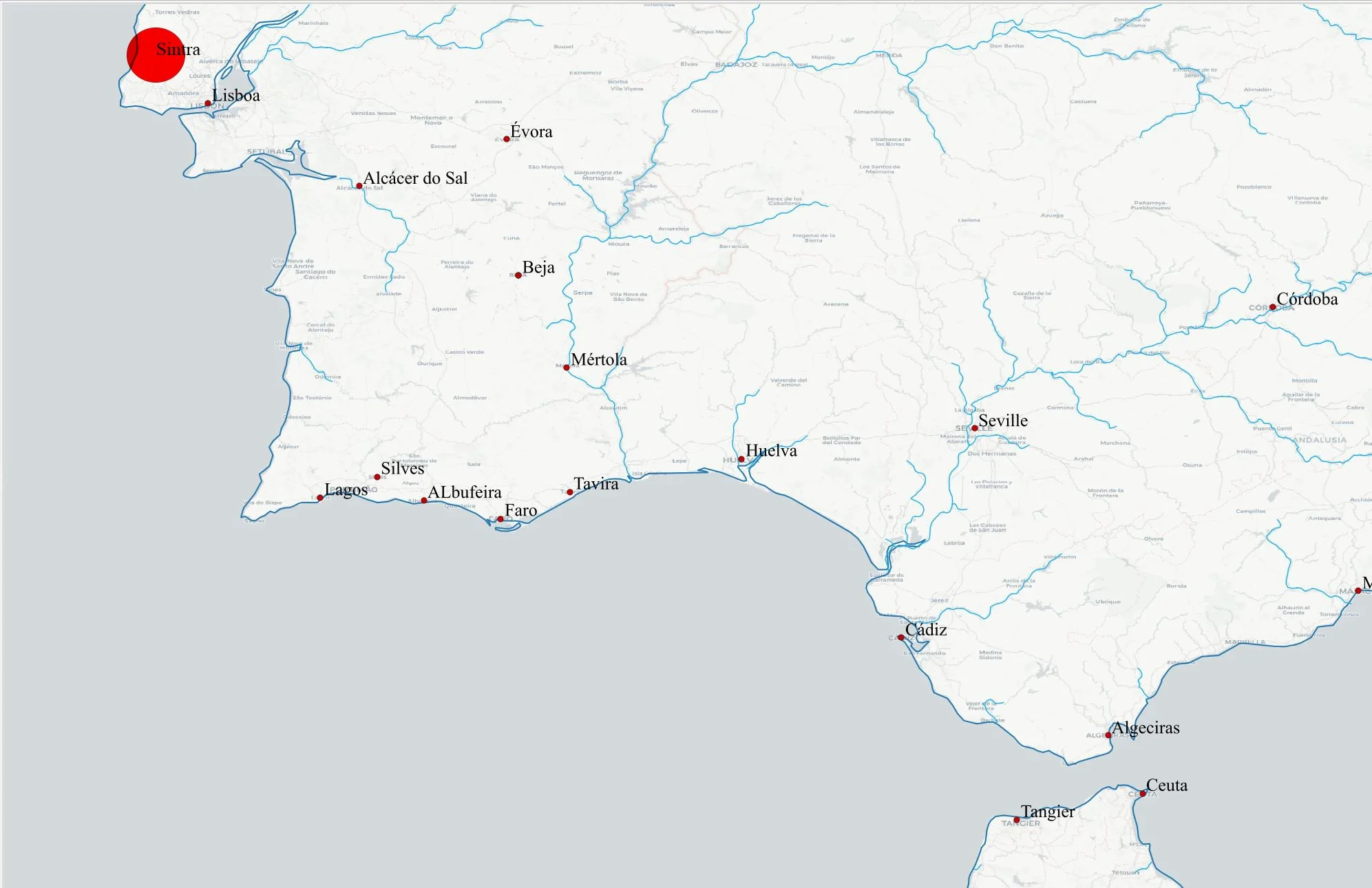
Location of Sintra, QGIS, A. Nusair, 2026.
Two strategic landscape features shaped everything that happened here. The first is height and the resulting mist. The serra catches the Atlantic weather and is famous for a fog that can settle for days, a detail the Muslim geographers noticed and that later mattered a great deal for a town whose job was to watch the sea. The second is water and the access it enables. To the north, the little Colares river once opened into sea navigation that let boats travel several kilometers inland to a river port (Oliveira Borges, 2017).
Above all, Sintra’s importance was dependent on its neighbor. It lay within the district, or kūra, of Lisbon (al-Ushbuna), and it served as that city’s western lookout. The historical, placename, and archaeological evidence together show Lisbon ringed by a system of coastal alert and defense, with Sintra, Cascais, and Oeiras to the west, Almada, Seixal, and Palmela to the south, and other posts to the east and north (Oliveira Borges, 2017).
The Muslim armies entered the Iberian Peninsula in 711 CE and spread across the south and west, holding the land through a mix of garrisons in strategic towns. Lisbon appears to have submitted peacefully, by a surrender, around 714 CE, and Sintra passed under Muslim power at about the same moment (Oliveira Marques, 1993). From the start it was folded into the military territory of the kūra of Lisbon rather than standing on its own. It is very likely that some defensive and lookout structures already existed on the serra before the Muslims arrived, given how obviously useful the high altitude was (Oliveira Borges, 2017).
Under the Caliphate of Córdoba, proclaimed in 929 CE, the western coast was governed more tightly, and Sintra became a real population center. The archaeology of the Castelo dos Mouros shows settled occupation, and the surrounding country was clearly lived in. Excavations at Colares carried out in 1989–1990 beside the Igreja Matriz (the parish church) uncovered Muslim silos full of 10th and 11th century pottery - evidence of a farming community (Oliveira Borges, 2017).
When the caliphate fell apart in the early 11th century, Lisbon and its district including Sintra were pulled into the control of the western taifa kingdoms - first the taifa of Badajoz and then the taifa of Seville - as the small Muslim states absorbed one another (Picard, 2000). The Christian north was now advancing, and the region changed hands. Around 1093 CE, Alfonso VI of León and Castile briefly seized Lisbon, Sintra, and Santarém, until the Almoravids recovered them the following year (Picard, 2000; Oliveira Marques, 1993).
Through the decades the coastal alert system of Sintra still functioned, though it was often blinded by the very mist that made Sintra famous on foggy days. The Castelo dos Mouros could see nothing of the coastline and the signal chain often fell silent, as it so happened in 1109 CE. The Norwegian king Sigurd, on his way to the Holy Land, was sailing east to join the crusade in the Holy Land with a large fleet, and along the way he stopped to fight the Muslims of the Iberian coast. The main source for this attack is the old Norse sagas, which say his ships came to a Muslim-held stronghold called "Sintre" (Sintra) and captured it, killing the defenders who refused to accept Christianity. From there the same fleet went on to strike Lisbon and other Muslim towns further south before continuing east (Pires, 2012).
Sigurd's raid was a shock but brief. He was on his way to Jerusalem, not there to stay, and once his ships sailed on, Sintra went back to being a Muslim town and stayed that way for almost forty years, held with the rest of the Lisbon district by the Almoravids, the North African rulers of al-Andalus. Their power, though, was fading. To the north a new Christian kingdom was taking shape under Afonso Henriques, recognized as the first king of Portugal in 1139 CE, who pushed his army south toward Lisbon (Oliveira Marques, 1993).
In 1142 CE, a fleet of Anglo-Norman crusaders bound for the Holy Land put in on the western coast of al-Andalus, and Afonso Henriques convinced them to help him take Lisbon and its surrounding towns, including Sintra. However, the force was too small to sustain a siege against such a large and well-supplied city as Lisbon, and the attack collapsed (Oliveira Marques, 1993).
In March 1147 CE, Afonso Henriques took Santarém in a surprise night assault, and through the summer and autumn he laid siege to Lisbon with crusader fleet of English, Flemish, and German ships. Lisbon held out for four months and fell in October 1147 CE. Once Lisbon was lost, the mountain town could not stand alone, and in the aftermath of the surrender Sintra - together with the towns of Almada, Palmela, and Setúbal - passed into Portuguese hands (Oliveira Marques, 1993).
The victors moved quickly to secure and settle it. The running of the town and its surroundings was delegated to Gualdim Pais, a master of the Knights Templar, and Sintra received a municipal charter in 1154 CE (Parques de Sintra, n.d.).
Christian settlers moved into the Moorish Castle and, over the following centuries, as the frontier moved south and the danger passed, the population drifted down off the hill and the old Islamic quarter inside the castle was gradually abandoned (Parques de Sintra, n.d.). The conquest did not erase the Muslim past so much as bury it under a medieval and then a romantic town, where it waited for archaeologists.
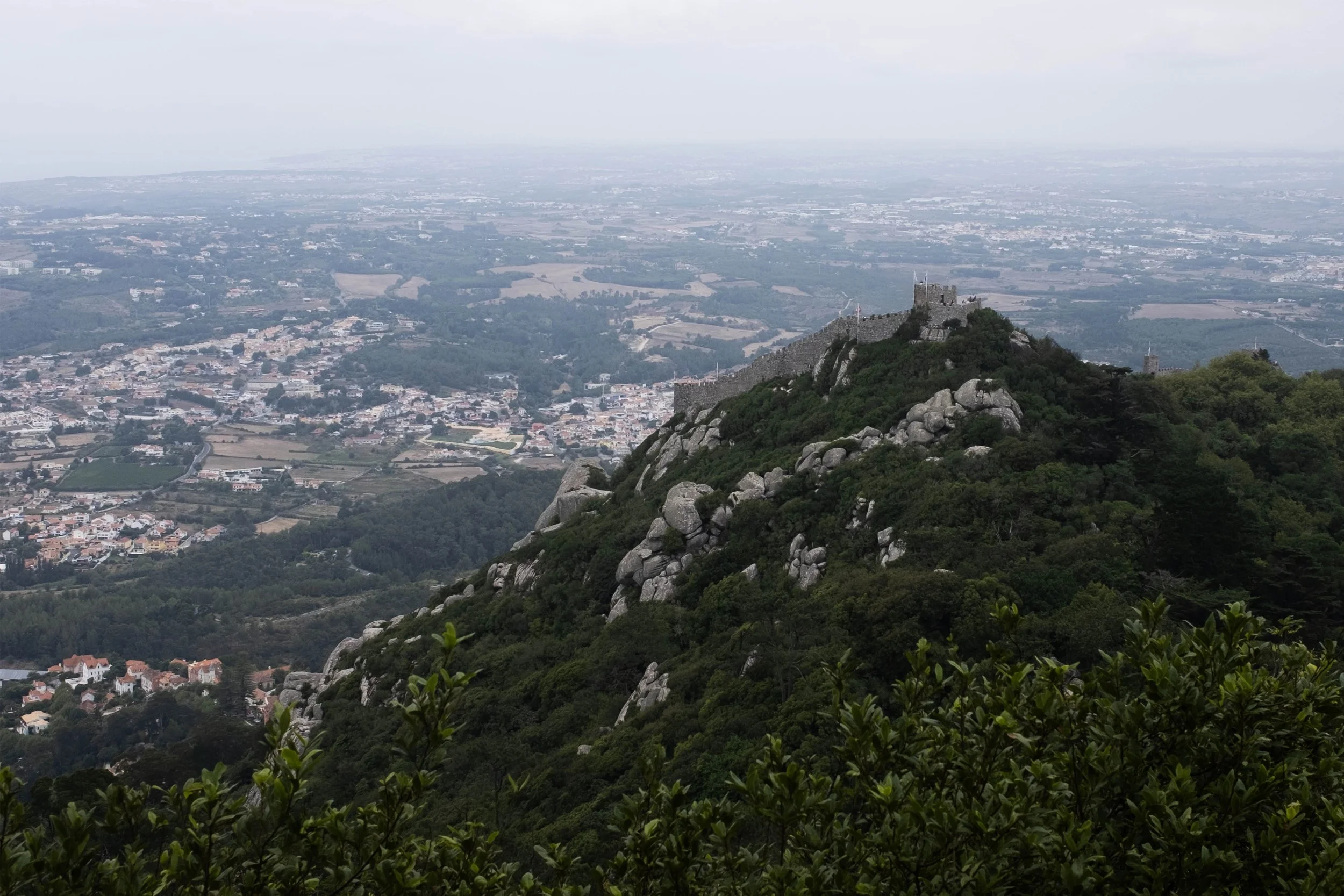
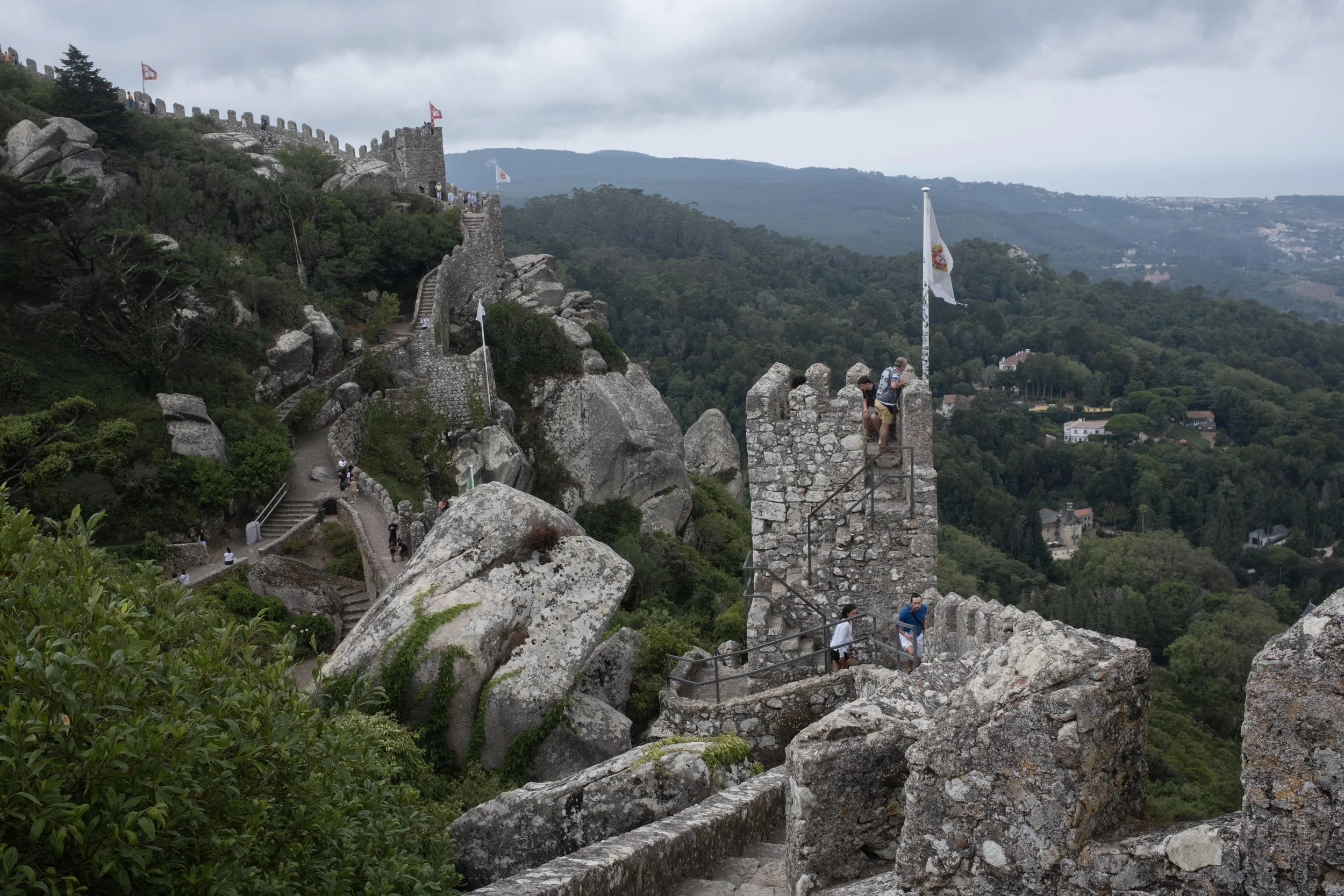
More of Islamic Sintra survived, and much of it has only come to light through excavation. The most obvious monument is the Castelo dos Mouros itself, founded under Islamic rule on a commanding peak of the serra to watch the land and the sea approaches to Lisbon (Coelho, 2000). Between and around its walls lay a small permanent settlement for soldiers, officers, and their families in an area now called the Islamic Quarter, where digging has revealed the foundations of houses, ovens, drainage channels, and, most characteristically, grain storage cut into the living rock (Parques de Sintra, n.d.).
Down at the coast lies the ribat (a fortified religious house of warriors guarding a coast) of the Alto da Vigia, still under excavation but already recognized as a rare survival of a type of frontier religious-military house otherwise known from only a couple of sites in the peninsula (Oliveira Borges, 2017; Coelho, 2000).
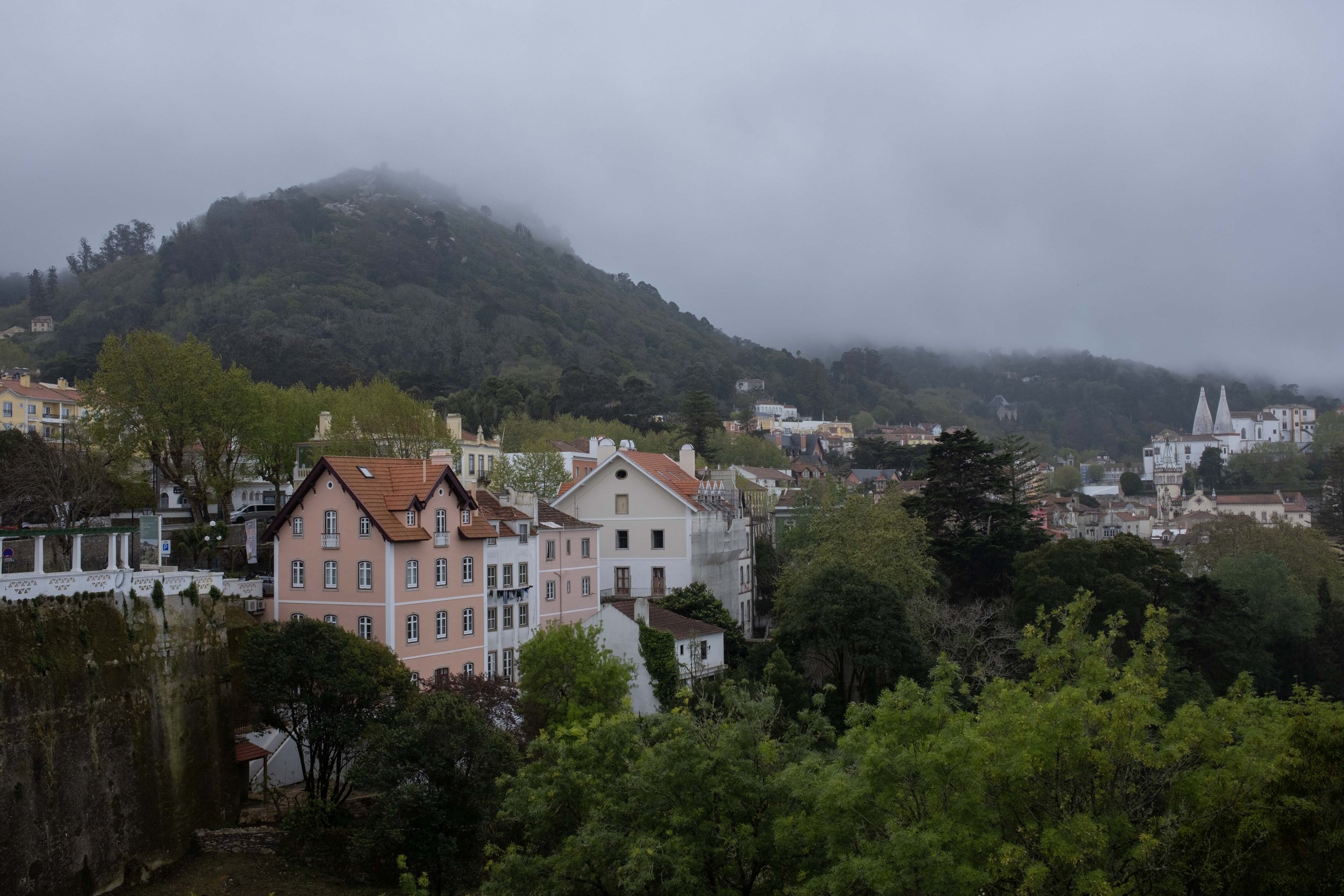
The Serra de Sintra wrapped in the fog as the medieval geographers described.
A. Nusair, 2026.
Sintra was well known to the geographers of al-Andalus. The fullest early description comes from al-Bakri, the 11th century Andalusian geographer whose Book of Routes and Realms (Al masalek wa Almamalek) surveyed the whole peninsula. He noted that it possessed castles “of extreme solidity,” one of them strategically placed on a peak of the serra which is the fortress we now call the Castelo dos Mouros (al-Bakrī, 1982, translated by author).
Al-Himyari described Sintra as
one of the cities of Lisbon in Al-Andalus, close to the sea, and enveloped by a constant, unbroken fog. Its air is pure, and its inhabitants enjoy long lives. It possesses two extremely secure fortresses, located about a mile from the sea. A river flows there whose water empties into the sea and irrigates its gardens. It is the land richest in apples, which grow so large that their circumference reaches four spans, as do its pears. On Mount Sintra, violets grow naturally, and fine ambergris is gathered from Sintra. (al-Ḥimyarī, 1938, translated by author).
This aligns with the current name of the beach at the river’s mouth, called Praia das Maçãs, the “beach of the apples” - a name that rings with what the geographers wrote about Sintra’s fruit.
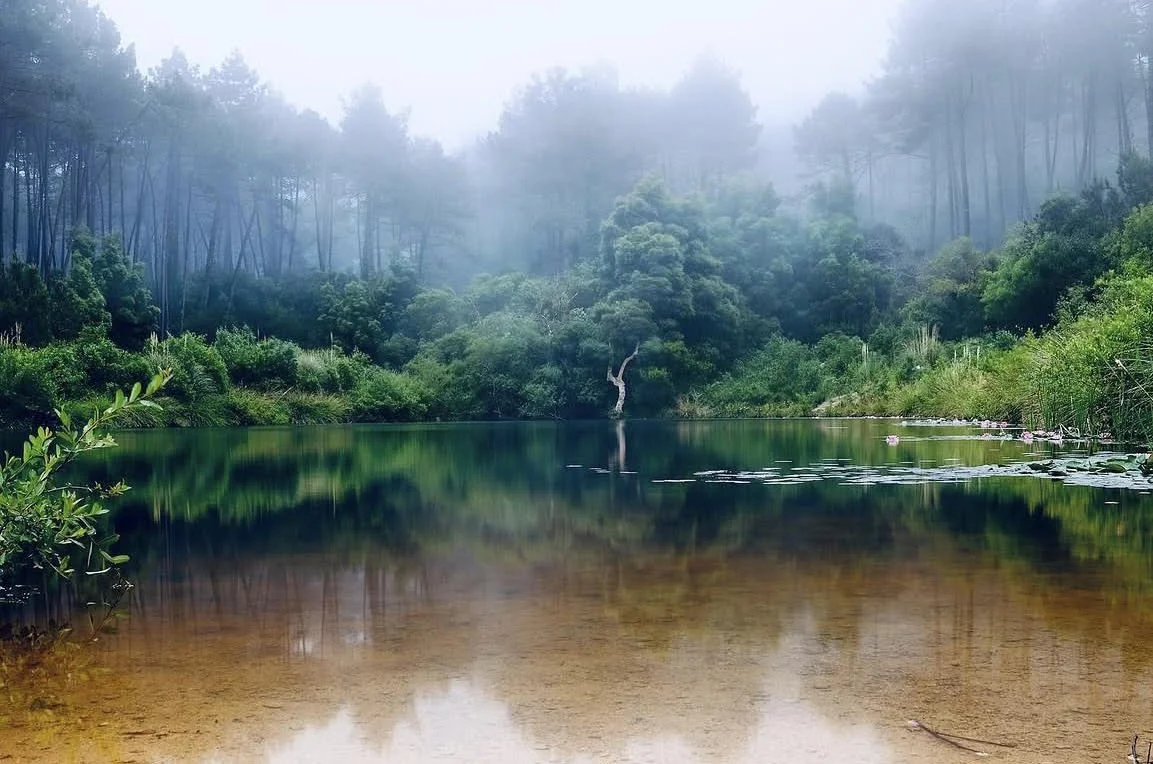
Inside a forest of Sintra on a foggy day, A. Nusair, 2026.
The walls of the Moorish Castle running along the mountain, A. Nusair, 2026.
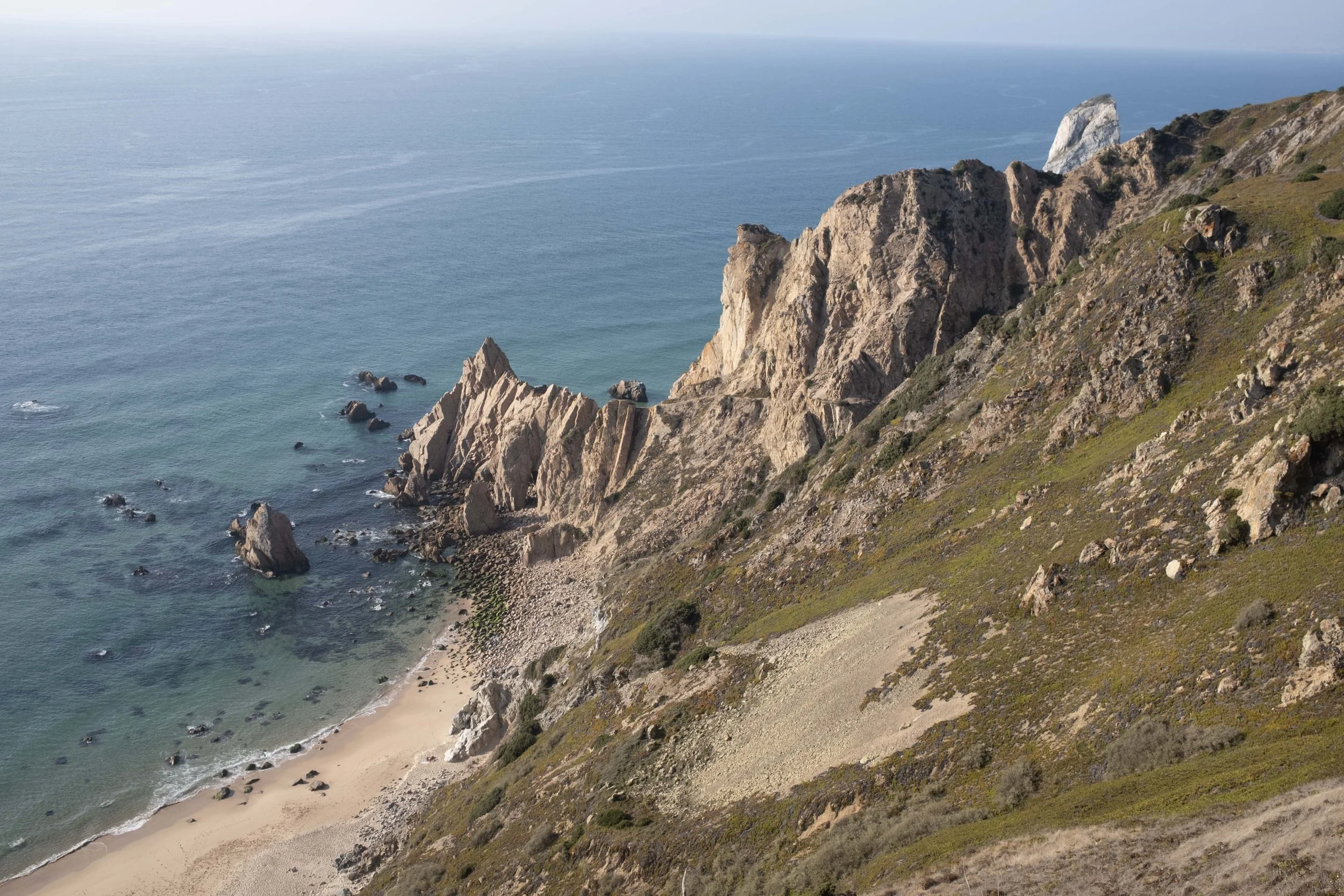
Cliffs along the coast of Sintra, near Cabo da Roca, the westernmost point of continental Europe.
A. Nusair, 2026.
Some of the clearest fingerprints are in the language of the map. The hills and villages around Sintra still carry Arabic names that record the Islamic centuries: Almoçageme, from al-masjid, “the mosque” beside which is Rua da Mesquita, “Mosque Street”; Azóia, from az-zāwiya, a religious house that doubled as a watch-post; and Nafarros, linked to nafar, “troops” (Oliveira Borges, 2017).
These are some of the traces of the Andalusian centuries pressed into Sintra. The romantic mountain that UNESCO named a World Heritage cultural landscape in 1995 has, beneath its palaces, the bones of a Muslim frontier town (Parques de Sintra, n.d.).
Sintra’s reputation today rests in the nineteenth century, but the shape of the place was set a thousand years earlier, when it was the Andalusi town of Shantara. The Muslims read the mountain correctly as a high, fog-wrapped serra that could watch the ocean, above a navigable water, close enough to Lisbon to serve as that city’s watchful eye. It stood as a fortified viewpoint on the western edge of al-Andalus, its castle, its ribat, and its chain of watchtowers all pointed at the sea (Oliveira Borges, 2017; Picard, 2000).
Modern scholarship has shown how this region was tied into the Islamic world for more than five centuries and how its coastal towns must be read through both these texts and the archaeology of the ground (Picard, 2000). Within that literature Sintra appears exactly as its geography dictated: a foggy, fertile, well-defended point on the ocean’s edge, dependent on Lisbon and watching the sea.
References and further reading:
al-Bakrī, A. ʿU. (1982). Geografía de España (Kitāb al-masālik wa-l-mamālik) (E. Vidal Beltrán, Trans.). Anúbar. (Original work composed 11th century).
Al-Ḥimyarī, M. (1938). Kitāb al-Rawḍ al-miʿṭār fī khabar al-aqṭār [The fragrant garden: News of the regions] (É. Lévi-Provençal, Ed. & Trans.). E. J. Brill.
Borges Coelho, A. (2008). Portugal na Espanha Árabe (3rd ed.). Editorial Caminho.
Coelho, C. (2000). A ocupação islâmica do Castelo dos Mouros (Sintra): Interpretação comparada. Revista Portuguesa de Arqueologia, 3(1), 207–225.
Oliveira Borges, M. (2017). A importância estratégica do conhecimento do território na formação de um sistema defensivo: O caso de Sintra (Portugal) durante o período islâmico. Anuario de Historia Regional y de las Fronteras, 22(2), 17–48. https://doi.org/10.18273/revanu.v22n2-2017001.
Oliveira Marques, A. H. de. (1993). O “Portugal” islâmico. In J. Serrão & A. H. de Oliveira Marques (Eds.), Nova História de Portugal: Vol. II. Portugal das Invasões Germânicas à Reconquista. Editorial Presença.
Parques de Sintra – Monte da Lua. (n.d.). The history of the Moorish Castle. Retrieved July 23, 2026, from https://www.parquesdesintra.pt/en/parks-monuments/the-moorish-castle/history/.
Picard, C. (2000). Le Portugal musulman (VIIIe–XIIIe siècle): L’Occident d’al-Andalus sous domination islamique. Maisonneuve et Larose.
Pires, H. (2012). Incursões nórdicas no Ocidente Ibérico (844–1147): Fontes, história e vestígios [Doctoral dissertation, Universidade Nova de Lisboa].
Rei, A. (2012). O Gharb al-Andalus al-Aqsâ na geografia árabe (séculos III h./IX d.C.–XI h./XVII d.C.). Instituto de Estudos Medievais.