
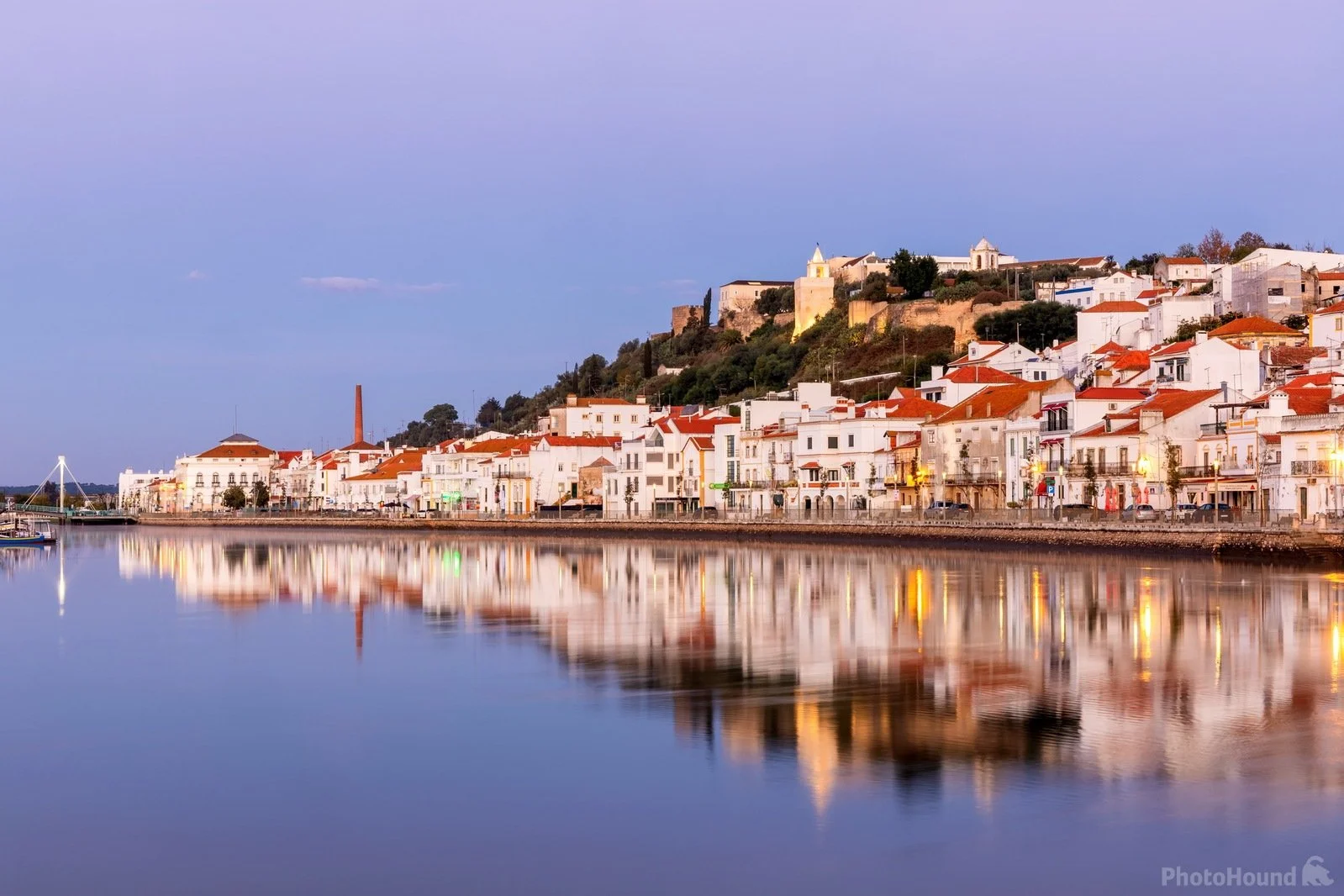
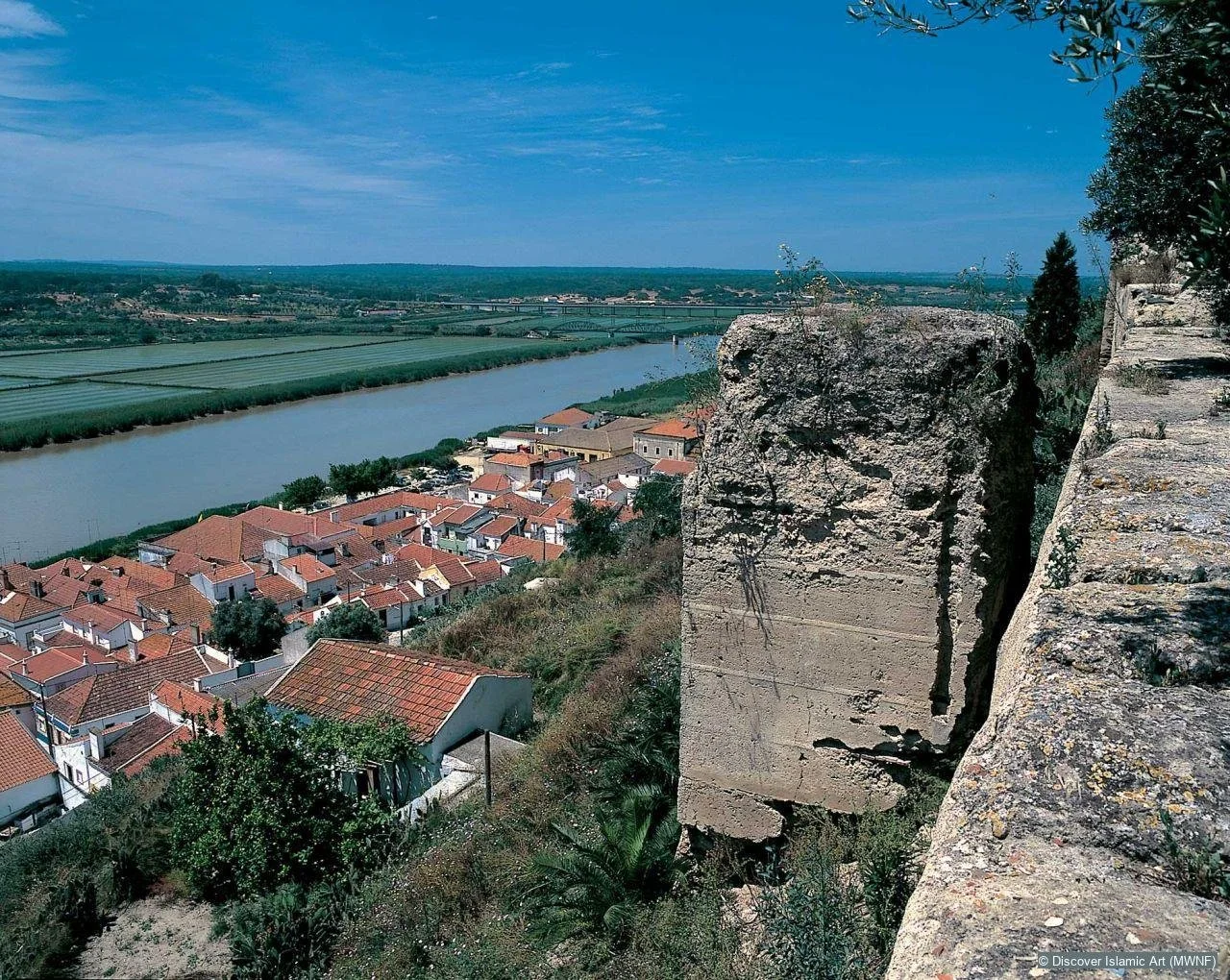
The town of Alcácer do Sal seen across the Sado, with the castle crowning the hill. The setting that made the site useful to every power that held it. Photo by Adelheid Smitt, 2022.
Alcácer do Sal, a city in southern Portugal, stands on one of the busiest pieces of ground in Iberia. Iron Age people lived here, Phoenician traders came, and the Romans called it Salacia. For a little over five hundred years, it was a Muslim town called Qaṣr Abī Dānis which was a port, a shipyard, and a frontier fortress of the Gharb al-Andalus. The story of this city is not quiet. Vikings raided its coast, and it was there that al-Manṣūr ibn Abī ʿĀmir built the fleet that carried him to Santiago de Compostela in the north. The city passed between Taifa kings, Almoravids, Almohads, and Portuguese crusaders.
Alcácer do Sal lies on the Atlantic side of al-Andalus, south of Lisbon, on the bank of the river the Arabs called Shaṭubar, the modern Sado roughly 40 kilometers upstream from the sea. The town grew on a hill about 62 metres high, with the river running at its feet (Al-Darweesh & Al-Ulayawi, 2022).
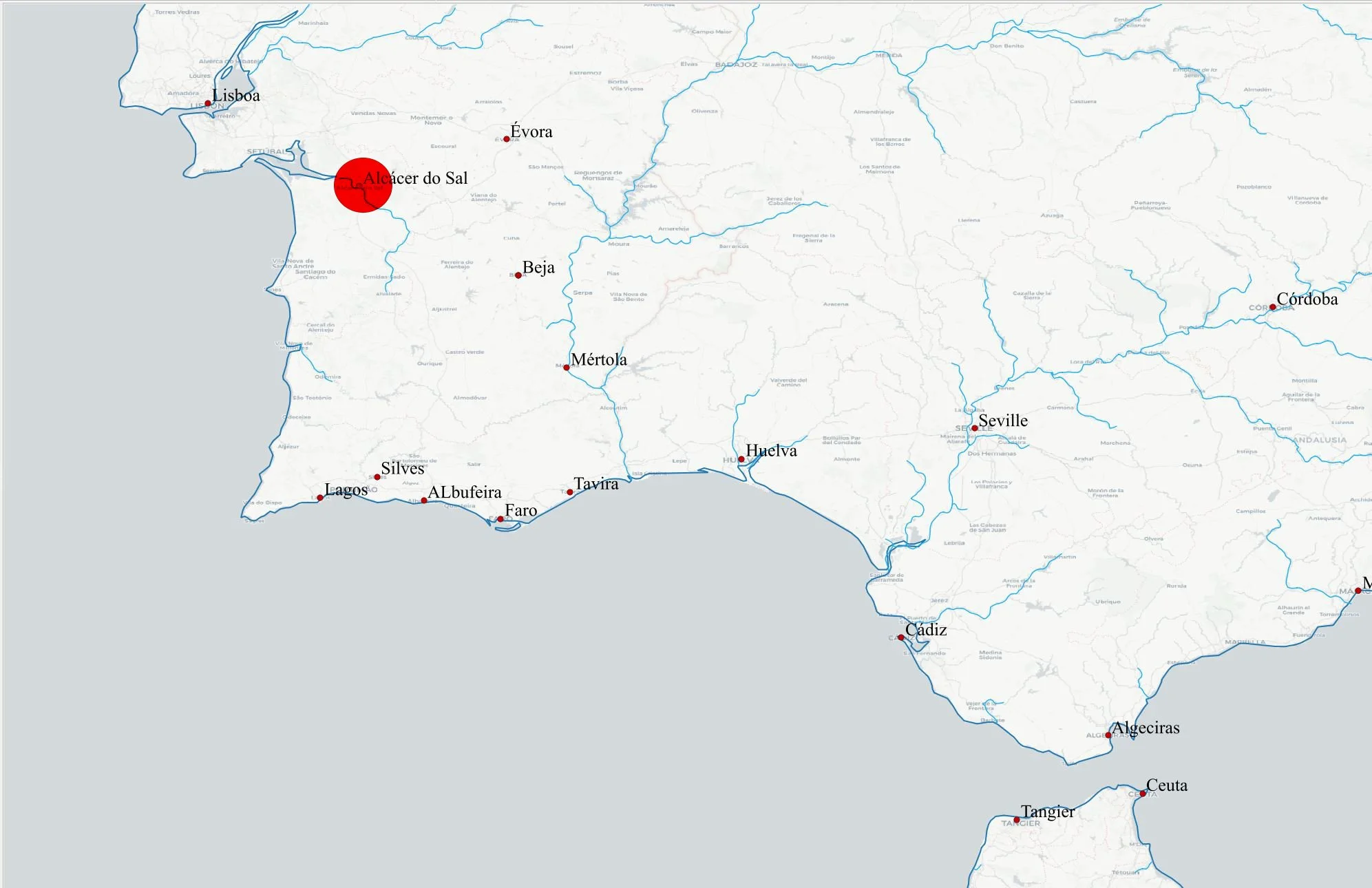
Location of Alcácer do Sal, QGIS, A. Nusair
The city’s importance came from its river. It is deep enough for seagoing ships to sail up from the bay of Setúbal to the docks, so Alcácer do Sal was a strategic port and an inland market. Al-Idrīsī called it “… a fine town on the bank of the river called Shaṭubar, a great river up which ships and large vessels sail,... All around it the land is entirely pine forest, and there is much timber for building. The town is moist and fertile, rich in milk, butter, honey and meat” (Al-Idrīsī, 2008, Vol.2, p.544, translation by the author).
Another reason for its importance was that pine meant timber, and timber meant ships, so the authority in Córdoba eventually placed a dār al-ṣināʿa (a naval dockyard) here. The same woods and fields made the district known for milk, butter, honey and meat, amber washed up on the shores, and salt was found in the estuary. That salt survives in the Portuguese name, Alcácer do Sal, “the castle of the salt” where alcácer in Arabic means the castle (Al-Darweesh & Al-Ulayawi, 2022).
After the Islamic conquest in 711 CE, the population was a mixture of Arabs, Amazigh, and Iberians. However, during the reign of Emir Abd al-Rahman I in 756 CE, the Amazigh tribe Banū Dānis originally settled around Coimbra supported Emir Abd al-Rahman I and fought alongside him to defeat Yūsuf al-Fihrī, the ruler of Córdoba at the time, driving him from the city. In reward for their loyalty, the Emir granted them land in the west, including Coimbra and Alcácer do Sal. The family established themselves as lords of the area, which is why the city is referred to in Arabic sources as Qaṣr Abī Dānis meaning "the Fortress of Abī Dānis" (Al-Darweesh & Al-Ulayawi, 2022).
One of the major events of Alcácer do Sal was the arrival of the Vikings, whom the Arabic sources like Al-Bayan called al-majūs (Ibn Idhārī, 2013) - not because they worshipped fire but because they burned their dead. Their targets were the open shorelines of the Andalusian west where until the 9th century there is no record that the Andalusian shores had any fleet at all.
The first shock came in 843 CE. According to Ibn al-Qūṭiyya (1989), the Vikings first seized the plain outside Lisbon before heading south to Cádiz and then up the river to Seville.
After intense fighting, the governor of Lisbon alerted the coastal defenses, prompting the raiders to withdraw. The Vikings then struck the territory of Beja, whose main access to the sea was Alcácer do Sal.
Following that event, Emir Abdulrhman II established frontier fortresses known as ribāṭs along the coast and organized a fleet, recruiting sailors from the shores of al‑Andalus and equipping them with the necessary arms and supplies, making Qaṣr Abī Dānis (Alcácer do Sal) a center of this effort (Ibn al-Qūṭiyya, 1989).
These efforts paid off when the Vikings returned to the western shores of al-Andalus in 859 CE. The squadron based at Qaṣr Abī Dānis met two of their ships the maritime waters of the Beja region, specifically the estuary controlled by Alcácer do Sal, which served as the Beja province's main gateway to the sea. The Andalusi fleet captured both vessels along with their entire crew and cargo (Al-Darweesh & Al-Ulayawi, 2022).
The Andalusian naval fleet and the fortifications at Qaṣr Abī Dānis effectively converted the western Iberian coast into a defended frontier, securing the area against Viking attacks for several decades (Al-Darweesh & Al-Ulayawi, 2022).
Smaller details survive too, like the two funerary headstones carved with Kufic inscriptions that were found at the foot of the castle hill, dating from the 11th century (Fernandes, 2026).
However, the more obvious cultural inheritance from the Islamic period is linguistic, where the Arabic al-Qasr endures in the name Alcácer itself, eight centuries after the last Muslim governor walked out of the gate.
Qaṣr Abī Dānis was never one of the famous cities of al-Andalus. It had no great mosque that travelers came to see, no court of poets. What it had was a river, a hill, and a pine forest, and those three things made it useful to every power that held it.
The city became a naval station because the Vikings forced al-Andalus to establish its naval power and under the caliphate it built the fleet that carried al-Manṣūr to Santiago de Compostela.
The hill, the river, and the salt are still there in Alcácer do Sal, standing as a legible part of a living Portuguese city sharing its Islamic heritage that lay between salt and shores.
Reference and Further Readings
Al-Idrīsī, M. ibn M. ibn ʿAbd Allāh. (2008). Nuzhat al-Mushtāq fī Ikhtirāq al-Āfāq [The Delight of Him Who Longs to Travel the Horizons] (Vol. 1). Cairo: Maktabat al-Thaqāfa al-Dīniyya. (Original work published c. 1154).
Al-Darweesh, J. Y., & Al-Ulayawi, H. J. (2022). Madīnat Qaṣr Abī Dānis (Alcácer do Sal) al-Andalusiyya, 93–614 AH / 711–1217 AD. Journal of Basrah Researches for Human Sciences, 47(2), 494–518.
Ibn al-Qūṭiyya, M. ibn ʿU. (2009). Early Islamic Spain: The history of Ibn al-Qūṭiya (D. James, Trans.). Routledge. (Original work composed c. 960).
Ibn al-Qūṭiyya. (1989). Taʾrīkh Iftitāḥ al-Andalus (I. al-Abbās, Ed.). Dār al-Kutub al-ʿIlmiyya.
Ibn al-Athīr, ʿA. (1987). Al-Kāmil fī al-tārīkh. Dār al-Kutub al-ʿIlmiyya.
Ibn al-Abbār, A. A. M. (1995). Al-ḥulla al-siyarā’ [The silken garment] (H. Mu’nis, Ed.; Vol. 2). Dār al-Ma‘ārif.
Ibn 'Idhari al-Marrakushi. (2013). Al-Bayan al-mughrib fi akhbar al-Andalus wa-al-Maghrib [The amazing story of the history of the kings of al-Andalus and the Maghreb] (B. A. Maruf & M. B. 'Awwad, Eds.). Dar al-Gharb al-Islami. (Original work published c. 1312).
Isabel Cristina Ferreira Fernandes "Castle of Alcácer do Sal" in Discover Islamic Art, Museum with No Frontiers, 2026. Retrieved July 21, 2026, from https://islamicart.museumwnf.org/database_item.php?id=monument;ISL;pt;Mon01;34;en.
Leitão, M. I. C. (2026). The Islamic Watchtower of Murta (Alcácer do Sal): Results of Archaeological Work (2020-2022). Journal of Islamic Archaeology, 12(2), 147-164. https://doi.org/10.1558/jia.27713.
Villegas-Aristizábal, L. (2019). Was the Portuguese led military campaign against Alcácer do Sal in the autumn of 1217 part of the Fifth Crusade? Al-Masāq, 31(1), 50–67. https://doi.org/10.1080/09503110.2018.1542573.
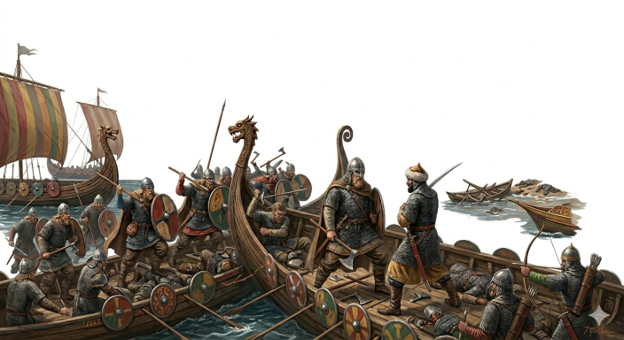
Battle between Vikings and Andalusians along the shore. illustration generated using Nano Banana by A. Nusair, 2026.
In 997 CE, the ḥājib (chamberlain) al-Manṣūr ibn Abī ʿĀmir launched his campaign against Santiago de Compostela by land and sea at once, for which he used Alcácer do Sal as a base for his naval preparations and ordered the building of more ships to transfer troops. Ibn ʿIdhārī (2013) referred to this by saying: “Al‑Manṣūr had previously undertaken the construction of a large fleet at the site known as Qaṣr Abī Dānis on the western coast of al‑Andalus. He equipped it with his naval forces and various infantry units, and provisions, food supplies, equipment, and weapons were loaded onto it to reinforce the resolve of the campaign. He then advanced to the place called Burtuqāl on the Duero (Douro) River” (Vol. 2, p. 295, translation by author).
By 1030 CE the Umayyad caliphate collapsed and al-Andalus broke into many emirates. The contest in the west lay between the Banū ʿAbbād of rulers of Seville and the Banū al-Afṭas ruler of Badajoz. Ibn al-Athīr records that Abū al-Qāsim Muḥammad b. ʿAbbād, the ruler of Sevilla, sent his son Ismāʿīl, who took Lisbon from Banū al-Afṭas around 1038 CE where, Qaṣr Abī Dānis passed into Abbād’s hands with it (Ibn al-Athīr as cited in Al-Darweesh & Al-Ulayawi, 2022).
In the mid-11th century, the Almoravids who came from North Africa swept away the taifa and reunited the west, including Alcácer do Sal, under one ruler. However, when the Almoravids lost the Maghrib to the Almohads in 1147 CE, al-Andalus revolted. In the west the leader was Sidrāy b. Wahb al-Qaysī, who took the coastal cities including Qaṣr Abī Dānis, then clashed with another rebel, Aḥmad b. Qasī, at Silves. Both ended up joining the Almohads, and Alcácer do Sal fell under Almohad authority with Sidrāy Ibn Wazīr as governor (Ibn ʿIdhārī, 2013).
Qaṣr Abī Dānis (Alcácer do Sal) remained under the Almohads until 1160 CE, when the Portuguese under Afonso Henriques took it after a siege of two months by land and sea, whereupon it became the base for raiding everything else by the new Portuguese Kingdom. The city stayed Portuguese for 35 years, until the Almohad caliph al-Manṣūr in 1191 CE managed to take it back under another siege. Al-Manṣūr then reinforced the fortress, and appointed Abū Bakr Muḥammad b. Sidrāy (son of the man who had ruled it before it fell) as the new governor (Al-Darweesh & Al-Ulayawi, 2022).
Later, though the king of Portugal Afonso II (1211CE–1223CE) had long seen Qaṣr Abī Dānis (Alcácer do Sal) as the obstacle blocking his advance south, an opportunity arrived by sea. A crusader fleet of many ships carrying German fighters put into Lisbon on its way to the Holy Land. Afonso invited them to fight the Muslims first, and most agreed, drawn by the promise of stolen goods. Some of the ships refused and sailed on, while the Templars and Hospitallers joined in and established a siege in 1217 CE (Villegas-Aristizábal, 2019).
The governor of Alcácer do Sal locked himself in the inner castle. The attackers built two siege towers. With no help coming, ʿAbd Allāh b. Wazīr ruler of the city and son of Abū Bakr Muḥammad b. Sidrāy negotiated that the people could leave alive, but with nothing in their hands. They refused at first, then accepted, and the city surrendered two and a half months after the siege began. Ibn Wazīr handed it over and apparently adopted Christianity to save himself, escaping days later to Seville (Al-Darweesh & Al-Ulayawi, 2022).
Ibn al-Abbār (1995) calls the fall of Alcácer do Sal “one of the warning calamities, given what the affair of al-Andalus has now come to” (Vol.2, p.295, translation by author). This statement reflects the strategic shock felt across the Islamic West following the city's fall as the loss of Alcácer do Sal marked the collapse of Islamic defenses along the southwestern Atlantic maritime frontier.
The Islamic heritage of the city didn’t vanish completely after 1217 CE; it was simply built over. Most of what remains sits on and under the castle hill, anchored by an extended fortress whose origins likely date to an early ribāṭ (frontier fortress) before Banū Dānis construction in the early 10th century. Its most visible remains belong to the Almohads, who made the site their frontier headquarters, expanding the enclosure to about 3.6 hectares. They introduced new techniques like ṭābiya (rammed earth mixed with stone) alongside an octagonal northeast tower. Today, traces of that octagonal structure and one southern ṭābiya tower survive (Fernandes, 2026).
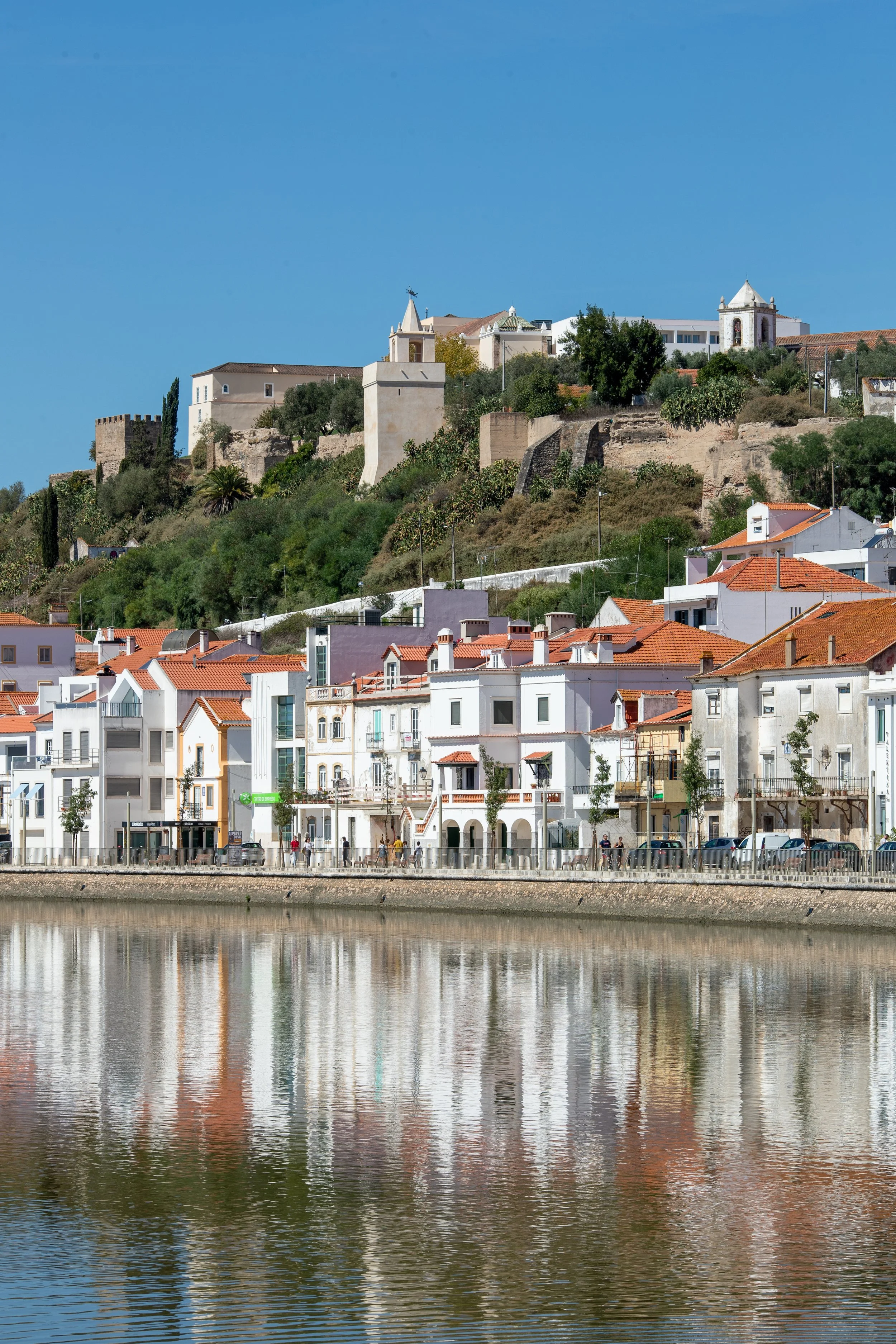
What remains is layered on the castle hill. The most visible walls and towers are Almohad, raised in ṭābiya (rammed earth mixed with stone) after the recovery of 1191 Left: Alexandre Hertzog, Right: António Cunha.
.jpg)