
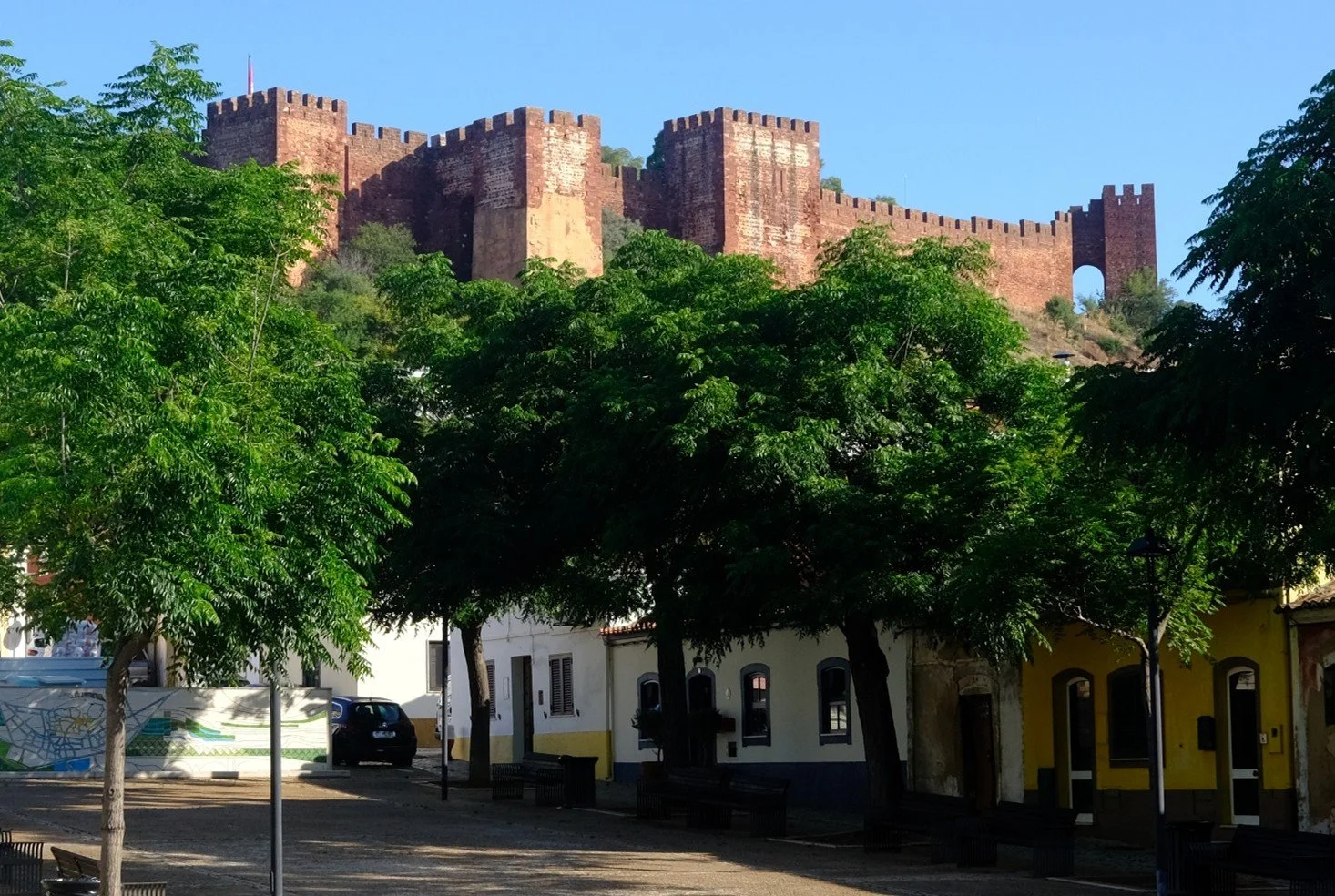
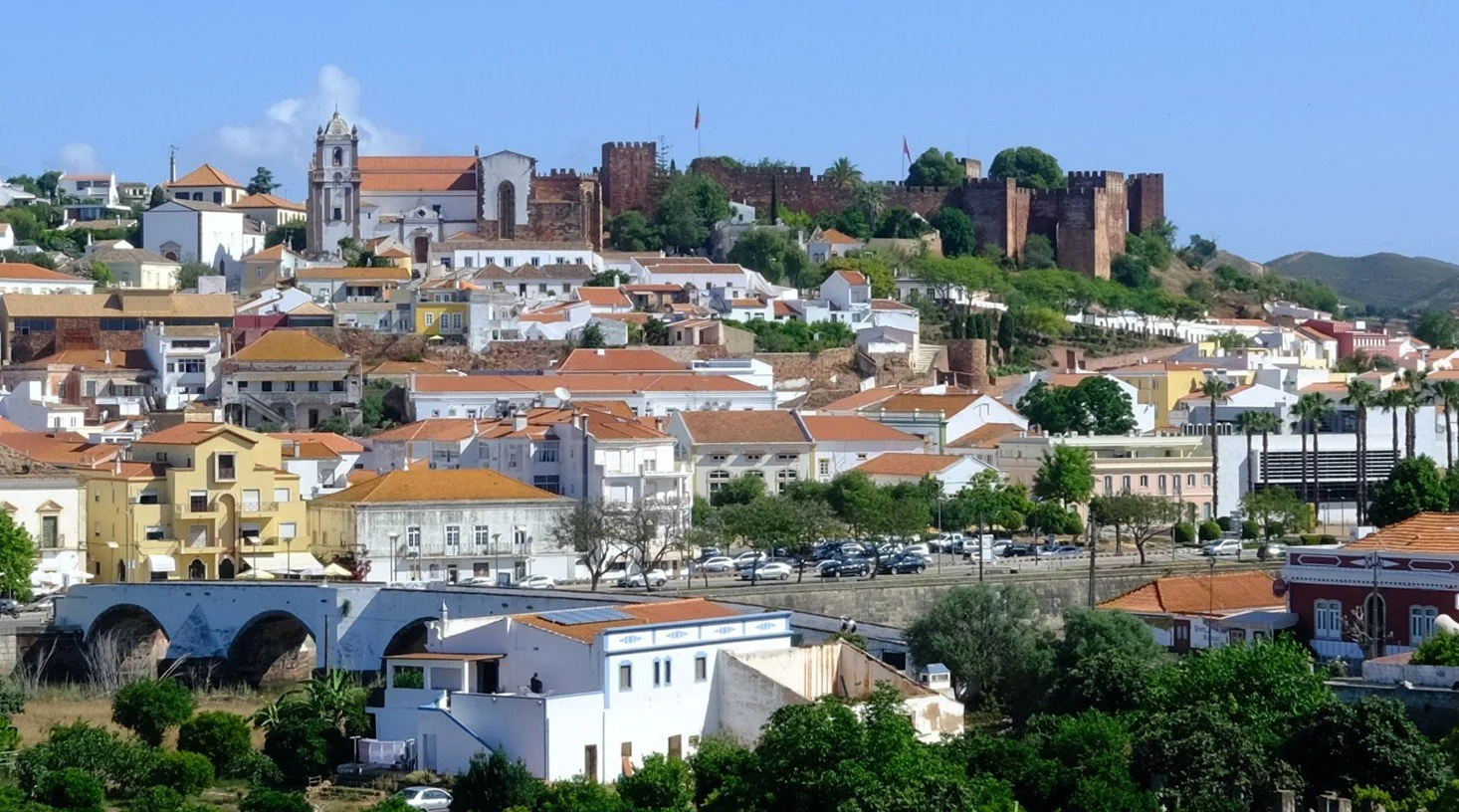
The city of Silves.
A. Nusair 2026.
Few cities in Portugal preserve their Andalusian soul as vibrantly as Silves. Known during the Islamic era as Xelb (Shelb), it was a legendary center of culture. It is even called the “Poetic Shelb” because of the fluency of its inhabitants compared to other people of al‑Andalus.
The city’s location on the River Arade, which was navigable at the time, along with the pomegranate and fig orchards surrounding it, made it a paradise and hub for poets. Al‑Idrīsī described Silves by highlighting the eloquence of its people and the beauty of its urban design. He mentioned that it was a center of literature and poetry to the extent that ordinary people there, even the farmers, composed poetry. In his book, Nuzhat al Mushtaq, he described it as:
[…] beautiful, situated on a vast plain and surrounded by a fortified wall. It has abundant crops and orchards, and its people drink from the river that flows to its south, the same river that powers the city's mills. The sea lies three miles to the west, and the city maintains a harbor within the river. It possesses a shipyard, and the surrounding mountains produce an abundance of timber (aloes/wood) exported to all directions. The city itself is handsomely built, featuring beautiful buildings and well-organized markets. Its inhabitants, as well as the residents of the surrounding villages, are Arabs from Yemen and elsewhere. They speak pure, fluent Arabic. They are fond of poetry and are characterized by their nobility and sophistication among both the elite and the common folk. The people of the rural areas in this region are exceptionally generous, distinguished by their exceptional hospitality. Silves belongs to the district of al-Shanshin, a region famous for its fig harvests. These figs are exported to all corners of the West; they are sweet, chewy, delicious, and highly prized (Al-Idrīsī, 2008, translation by the author).
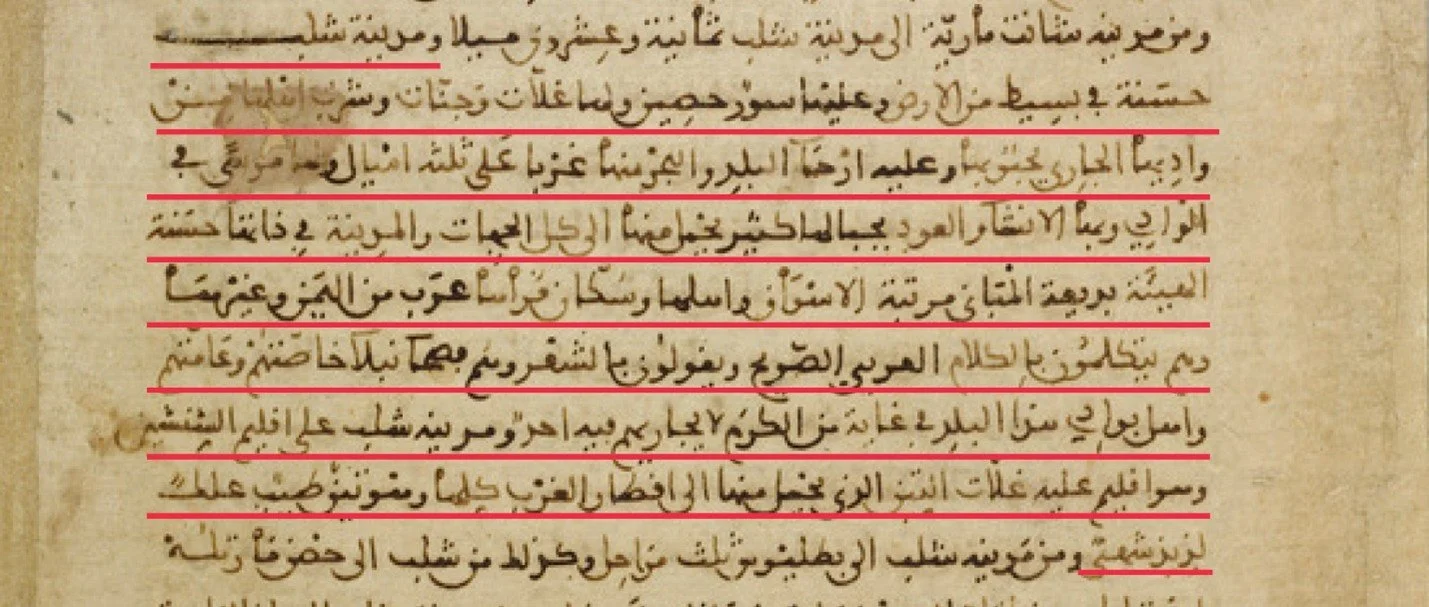
Adaptation of the text by the Idrisi in 1154 AD. Nuzhat al-Mushtaq fi Ikhtiraq al-Afaq, World Digital Library. Original manuscript held at the National Library of France.
The stability that followed the Islamic conquest contributed to transforming Silves into an urban city with clear Islamic features; mosques were built, markets were consolidated, and Arab and Yemeni migrants flowed in, as al‑Idrisi noted. When the independent Umayyad Emirate was established under Abd al‑Rahman I in 756 CE, Silves became part of the administrative structure of al‑Andalus, joining the district of Ukshunuba, which covered much of today’s southern Portugal.
Most of the historical sources do not mention the name of Silves during the period between the year the Muslims entered al‑Andalus in 711 CE and 844 CE, when the Vikings raided the western coasts of al‑Andalus during the rule of Emir ʿAbd al‑Rahman II (822–852 CE). This silence is largely because Silves was a small town belonging to the district (kūra) of Ukshunuba and had not yet risen to the level of an important city, which it would only achieve later under the Almohads in the 12th and 13th centuries (Al-ʿUqaydī, 2009).
The importance of Silves as a naval base in western Al-Andalus grew significantly during the Umayyad Caliphate. Its shipyard contributed to the production of a vast number of ships that joined the Andalusian navy. Most units of that fleet were stationed either at the primary base in Almeria in the east to counter the Fatimid threat, or in Seville in the west to confront the Viking threat (Al-ʿUqaydī, 2009).
In this regard, the historian Ibn 'Idhari mentions:
...They [the Vikings] reached the plains of Lisbon, where the Muslims marched out to meet them. A battle proceeded in which many Muslims fell in combat and many of the disbelievers were slain. The fleet of Seville then set sail, capturing them at the River of Silves. They took their positions, destroyed several of their vessels, rescued the Muslims held captive within them, and killed a great number of the polytheists. Consequently, the enemy fled in total defeat... (Ibn Idhārī, 2013, translated by author).
In the early 11th century, Silves was not spared from the political earthquake in al-Andalus, when the Umayyad Caliphate collapsed and fragmented into a small independent emirate known as the Taifa kingdoms (mulūk al-ṭawāʾif).
By the early Taifa decades, Silves passed through different rulers. It first came under the control of the Banu Muzayn, a local dynasty that briefly declared independence over the Andalusian west, before the expansionist ambitions of the Abbadis of Seville (Banū ʿAbbād) drew it into their growing western Andalusian domain (Anan, 1969).
The Abbadis, who ruled from Seville under the leadership of al-Muʿtaḍid and later his son al-Muʿtamid, were among the most powerful and culturally ambitious of all the Taifa rulers, and their absorption of Silves into their territories would produce one of the most remarkable and personal connections in the city’s entire history.
That was reflected when al-Muʿtamid ibn ʿAbbād, the poet Emir, became a governor of Silves. Having stayed there most of his youth, it was on the banks of the River Arade that al-Muʿtamid met Ibn ʿAmmār (Abū Bakr Muḥammad ibn ʿAmmār), a poet who would become his closest companion, his court poet (Anan, 1969).
Under al-Mu‘tamid’s governance and Ibn ‘Ammār’s influence, poetry in Silves was a language of diplomacy and administration. Even after al-Mu‘tamid left for Seville to be the ruler of the Abbadis Taifa, al-Mu‘tamid wrote some of the most famous poems about his nostalgia for Silves and the Palace of the Verandas (Qasr al-Sharajib) where this city was the heartbeat of Andalusian culture, driven by the friendship of two men who lived their lives like the poems they wrote.
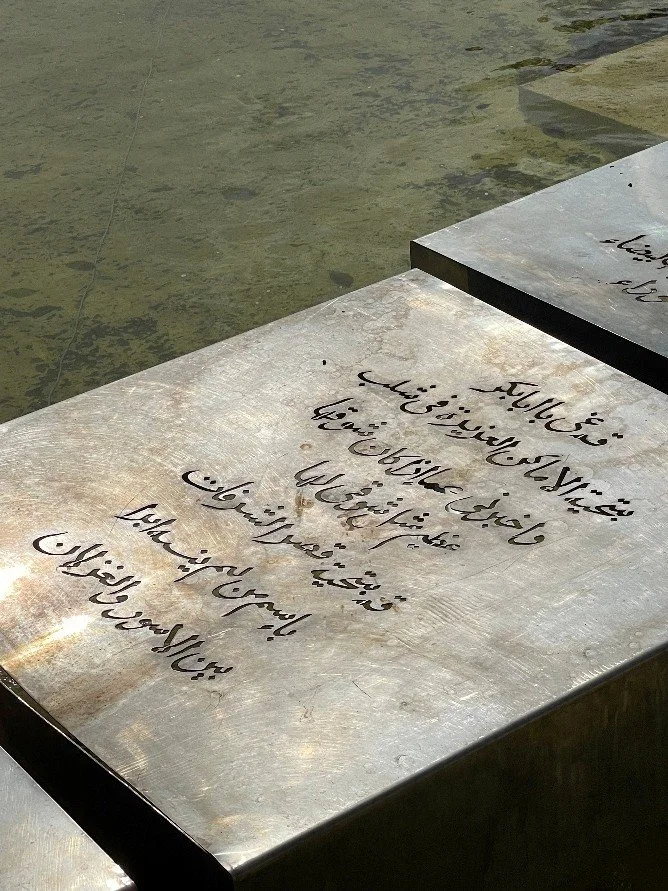
This legacy is most visible in the city’s primary square, Praça al-Mu‘tamid. In a spectacular display of cultural bridge building, the poetry is exhibited in the center of the square in both Arabic and Portuguese.
The arrival of the Almohads (al-Muwaḥḥidūn) from North Africa in 1147 CE marked the beginning of what would prove to be Silves’ final and most architecturally magnificent chapter under Islamic rule. The Almohads, who replaced the Almoravids across both the Maghreb (Morocco) and al-Andalus, invested significantly in the fortifications.
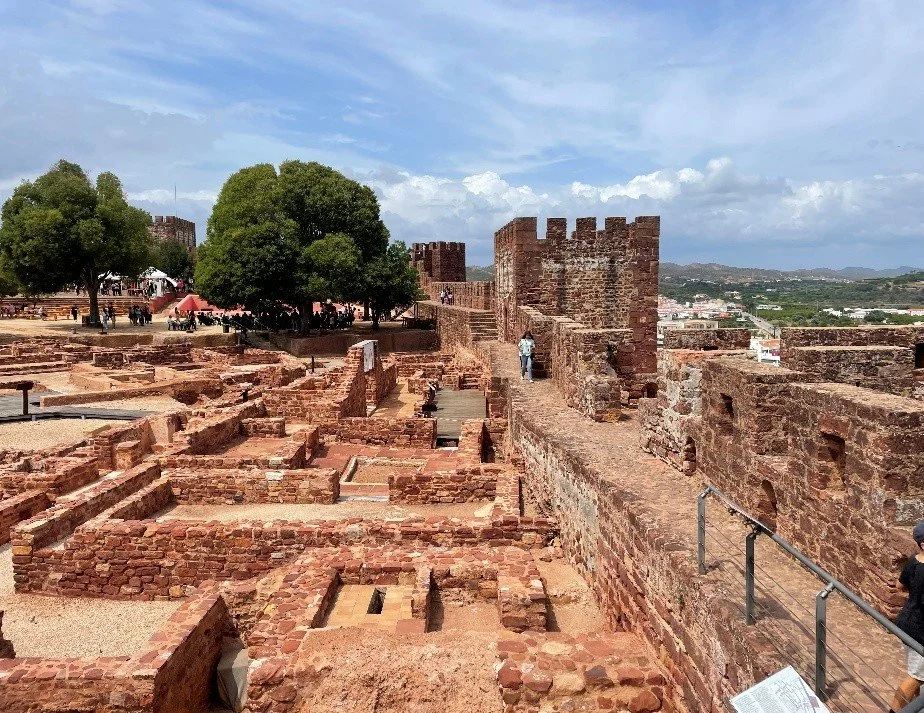
It was under the Almohads that the great castle of Silves took its most imposing form: its massive red sandstone walls rising above the River Arade, a monument so enduring that it still dominates the city’s skyline today, its warm red color echoing the rich iron soil of the Algarve region’s hills. During this period, Silves served as a major regional capital of Gharb al-Andalus. Its port continued to channel goods between the interior and the Atlantic (Ibn Idhari, 2013).
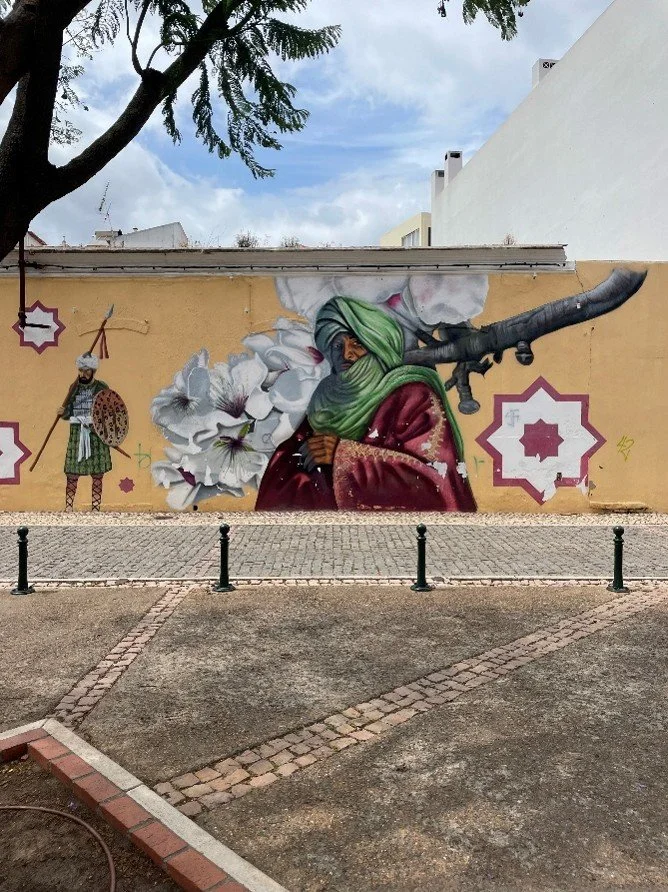
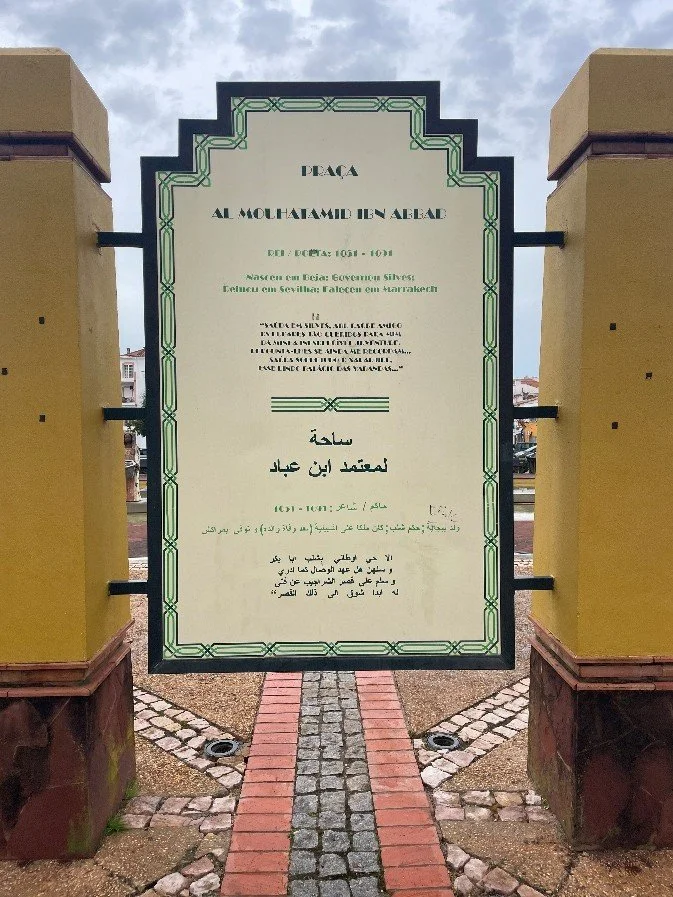
The main square of Silves al-Mu‘tamid Square.
A.Nusair, 2026.
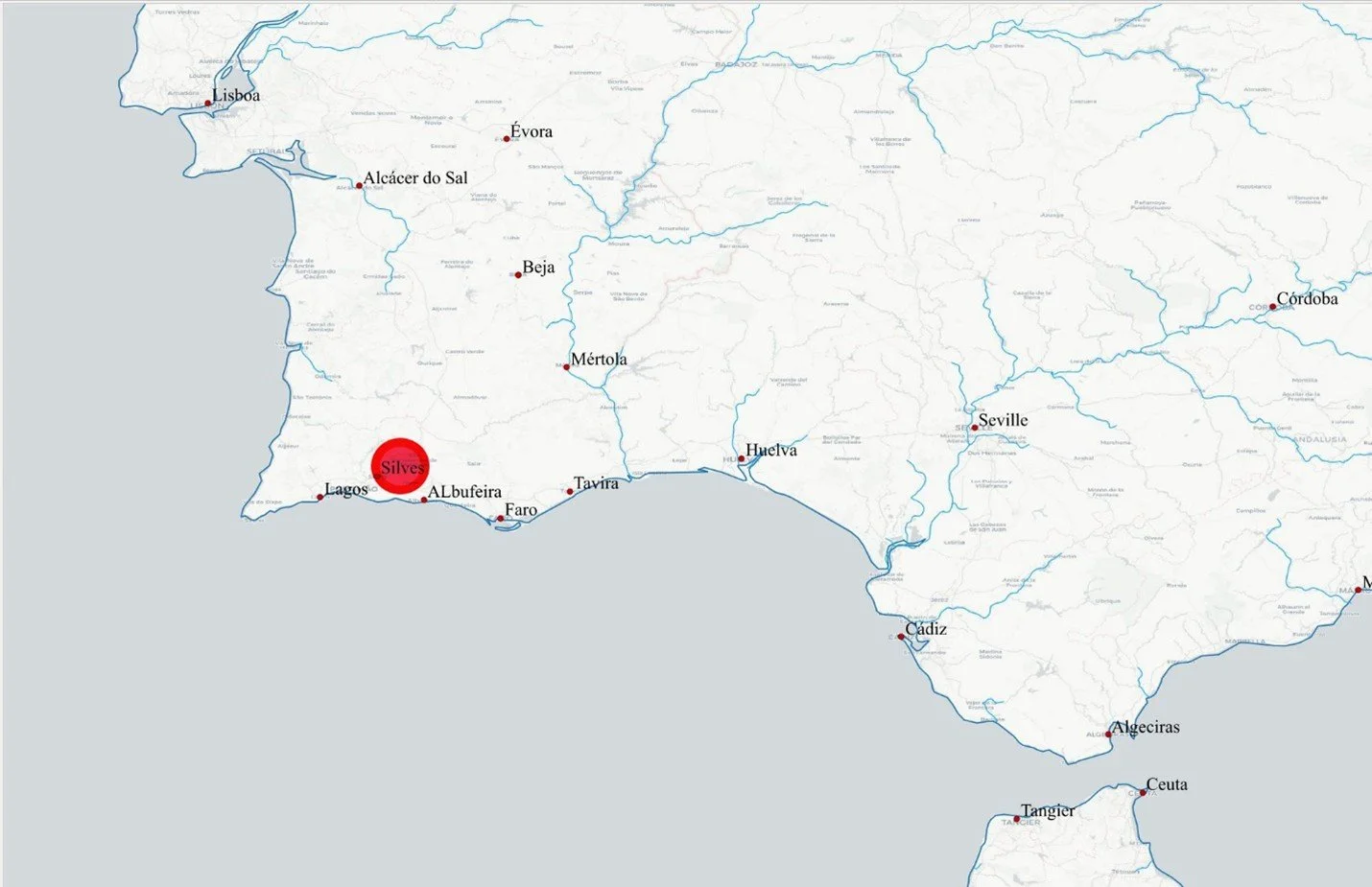
Location of Silves, QGIS.
A.Nusair, 2026.
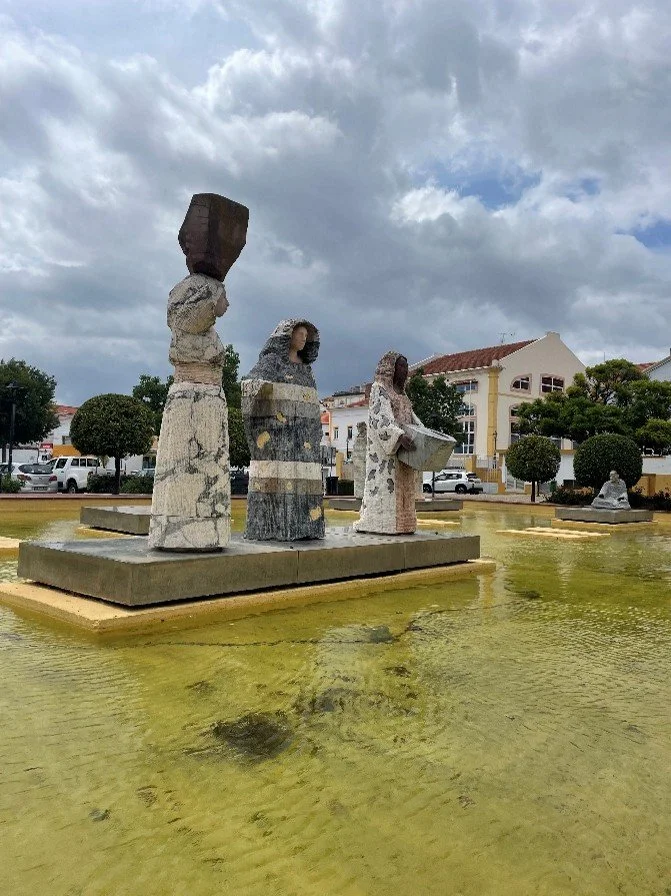
Also, Silves played a significant political and military role during the Almohad era. It became the forward line of defense for the cities of western and central al-Andalus. Its shipyard became very famous because it was essential to the Almohad navy, building many different types of ships for their fleet (Ibn Idhārī, 2013).
Silves, despite its fortified walls, strategic port, and long-standing role as a military strategic location, found itself increasingly isolated. It was first captured by Portuguese forces under King Sancho I in 1189 CE with the support of crusader fleets, but the Almohads retook it in 1191 CE and restored their authority (Al-ʿUqaydī, 2009).
After the Almohad defeat at Las Navas de Tolosa in 1212 CE, the balance of power shifted decisively, and the Algarve became one of the most contested regions of the peninsula. In 1249 CE, King Afonso III launched the campaign that completed the Portuguese conquest of the Andalusian west (Algarve) marking the end of nearly five centuries of Islamic rule in the city (Al-ʿUqaydī, 2009).
The Islamic rulers are long gone, but Silves has never fully shed its Andalusian soul. Walk through its narrow streets today, run your hand along the warm red stone of its walls.
Al-Idrīsī wrote of a city where even the farmers composed poetry. That image of people deeply rooted in language and beauty is perhaps the most powerful legacy that Islamic Silves left behind. Not in conquest or in borders, but in the idea that a city could be defined not by its armies, but by the eloquence of its people.
The city council of Silves, by honoring figures like al-Muʿtamid and Ibn ʿAmmār, does more than just remember its past; it celebrates a golden age where the arts and governance were intimately linked, ensuring the echoes of the red earth of Xelb remain a permanent part of modern Portuguese cultural identity.
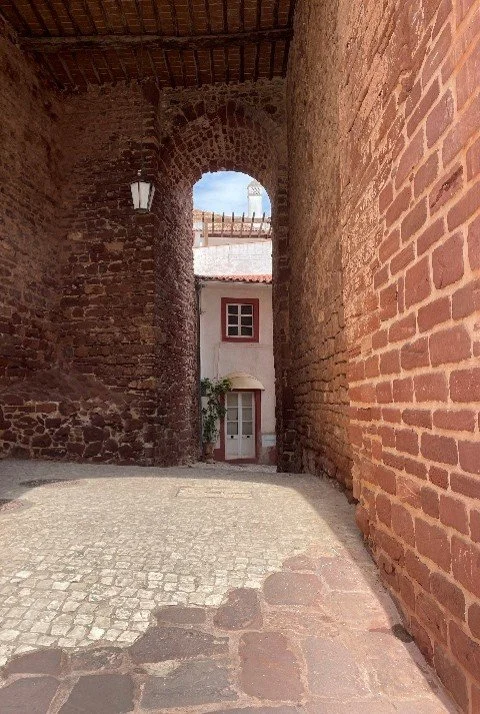
The city door and the castle of Silves, where the Andalusian palace is located.
A.Nusair, 2026.
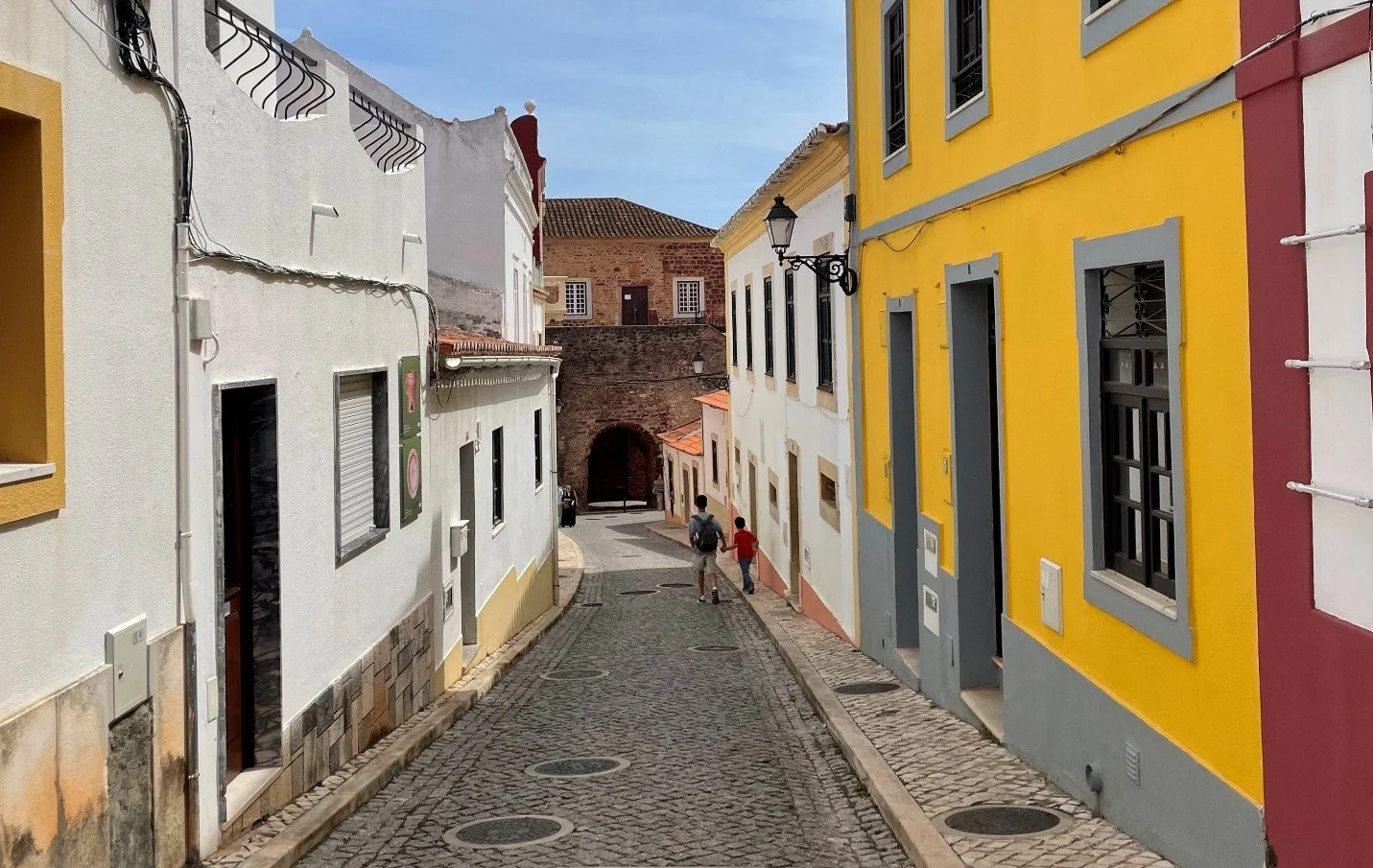
Street at the historic center of Silves.
A.Nusair, 2026.
References
Al-ʿUqaydī, B. M. H. A. (2009). Tārīkh madīnat Shilb al-Andalusiyyah: 93–640H / 712–1242CE, University of Mosul.
Anān, M. ʿA. A. (1969). Dawlat al-Islām fī al-Andalus (7 vols.). Muʾassasat al-Khanjī
Al-Idrīsī, M. ibn M. ibn ʿAbd Allāh. (2008). Nuzhat al-Mushtāq fī Ikhtirāq al-Āfāq [The Delight of Him Who Longs to Travel the Horizons] (Vol. 1). Cairo: Maktabat al-Thaqāfa al-Dīniyya. (Original work published c. 1154).
Ibn 'Idhari al-Marrakushi. (2013). Al-Bayan al-mughrib fi akhbar al-Andalus wa-al-Maghrib [The amazing story of the history of the kings of al-Andalus and the Maghreb] (B. A. Maruf & M. B. 'Awwad, Eds.). Dar al-Gharb al-Islami. (Original work published c. 1312).