Could 2026 Be a Turning Point in the Art Restitution Debate?
Twenty years ago, when French President Jacques Chirac inaugurated the Musée du Quai Branly, a museum dedicated to the arts and civilizations of Africa, Asia, Oceania, and the Americas, the main concerns were primarily cultural: could these objects be recognised as belonging to the universal art world rather than merely as ethnographic artefacts? Undoubtedly, over the last twenty years, the museum has significantly contributed to reshaping Western perceptions and recognising the artistic value of these collections, despite continuing to attract criticism and controversy. However, two decades later, the terms of the debate have changed profoundly. The artistic status of these objects is no longer contested; instead, attention has shifted to their provenance. How did they enter European collections? Under what circumstances of colonial domination, war, or dispossession were they acquired? And who, today, has the moral and political legitimacy to possess and display them? (Huffpost 2026).
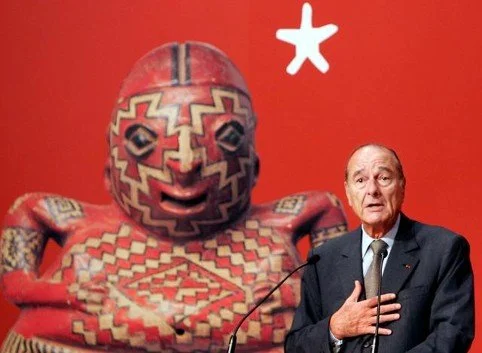
Former French President Jacques Chirac at the inauguration of the Musée du Quai Branly, June 2006.
Source: https://www.courrierinternational.com/article/vu-des-etats-unis-jacques-chirac-et-le-musee-du-quai-branly-un-heritage-controverse.
At the same time, this perspective is reflected in the international conference on reparative justice that took place in Accra in June. After having championed the pivotal UN General Assembly Resolution which declared the “Trafficking of Enslaved Africans and Racialized Chattel Enslavement of Africans as the Gravest Crime against Humanity”, Ghana hosted the High-Level “Next Steps” Conference on Reparatory Justice from 17 to 19 June, under the leadership of President John Dramani Mahama, who affirmed himself as the African Union’s champion for reparations. Bringing together representatives from more than eighty countries, alongside international organizations such as UNESCO, discussed the legacies of slavery and colonialism, including the restitution of cultural property (The Guardian 2026, UNESCO 2026a).
The topic of restitution in the cultural field itself is not new. The return of the Benin Bronzes to Nigeria, Greece's continued claims for the Parthenon Marbles, and debates over African collections in French and Belgian museums have been unfolding for years. What appears new in 2026 is their growing apparent institutionalisation: across Europe, governments are beginning to create permanent mechanisms (such as new laws, dedicated commissions, and administrative procedures) to address restitution claims. The twentieth anniversary of the Quai Branly is therefore highly symbolic and a good opportunity to return to such a delicate and important topic.
France
One of the most significant recent developments comes from France. In May 2026, Parliament approved a law establishing a permanent mechanism for the restitution of cultural objects acquired in colonial contexts, removing the need for ad hoc legislation in each individual case. While this may sound like a technical adjustment, its implications are significant: for decades, the principle of the inalienability of French public collections has been the main legal obstacle to the return of artefacts to their countries of origin, forcing lawmakers to rely on exceptional measures every time a restitution was approved. The 2026 reform marks a clear shift in approach: the return of cultural property is no longer treated as an extraordinary gesture, but as a normal instrument of French cultural policy (Le Monde 2026).
To understand better this change, it is necessary to go back in the years. A key turning point can be observed in November 2017, when French President Emmanuel Macron, speaking at the University of Ouagadougou in Burkina Faso, stated that
the first remedy is culture. In this area, I cannot accept that a large share of several African countries’ cultural heritage be kept in France. There are historical explanations for it, but there is no valid, lasting and unconditional justification. African heritage cannot solely exist in private collections and European museums. African heritage must be showcased in Paris but also in Dakar, Lagos and Cotonou; this will be one of my priorities. Within five years I want the conditions to exist for temporary or permanent returns of African heritage to Africa.[1]
Momentum grew in 2018 with the Savoy-Sarr report, commissioned by Macron himself, which estimated that 90-95% of Africa’s cultural heritage is held outside the continent.[2] The report became a key reference in the global debate and helped accelerate restitutions to countries such as Benin, Senegal, and Côte d’Ivoire. More recently, in 2024, France and Germany launched a €2.1 million research programme into the provenance of African artefacts held in their national museums.
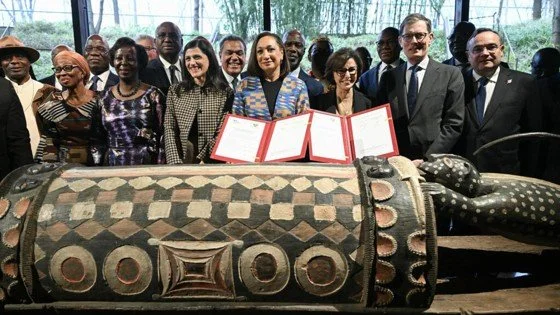
A ceremony in Paris celebrating the return of the "talking drum" to Côte d'Ivoire, more than a century after it was confiscated by French colonial authorities in 1916. Source: https://www.france24.com/en/africa/20260413-french-parliament-debates-bill-return-artworks-looted-during-colonial-era.
Until now, however, each restitution required a specific parliamentary act. The 2026 law removes this constraint by creating a permanent framework for objects removed during the colonial period, particularly those acquired between 1815 and 1972, the year the 1970 UNESCO “Convention on the Means of Prohibiting and Preventing the Illicit Import, Export and Transfer of Ownership of Cultural Property”entered into force. Nearly a decade after Ouagadougou, France has effectively turned a political promise into public policy (The Art Newspaper 2026a).
However, the law remains controversial. It deliberately avoids any direct reference to “colonialism” in order to limit political opposition from the far right, while critics on the left argue that it does not go far enough. These debates show a broader ambiguity: restitution is being presented less as a way of addressing the colonial past and more as an administrative reform of cultural governance (Benslama-Dabdoub 2026).
Germany
Other countries are moving in a similar direction. Also in 2026, Germany decided to establish a national body dedicated to coordinating the restitution of cultural objects and human remains originating from colonial contexts. The planned Coordination Council for Returns of Cultural Property and Human Remains from Colonial Contexts will bring together representatives from the federal government, the country’s 16 states, and several municipalities. As stated by the German Federal Foreign Office, its aim is to make restitution processes as transparent as possible and to improve coordination with international partners. Here too, the key point is not a single high-profile return, but the creation of a lasting institutional framework (The Art Newspaper 2026b).
This June, Germany, together with the Netherlands, announced the return to Ghana of more than two thousand cultural objects taken during the colonial era and the transatlantic slave trade. It is one of the largest restitution initiatives ever undertaken in Europe, not only because of the number of artefacts involved, but also because it represents a coordinated effort among several European states and has been presented as the beginning of a long-term cultural partnership (Xinhua 2026).
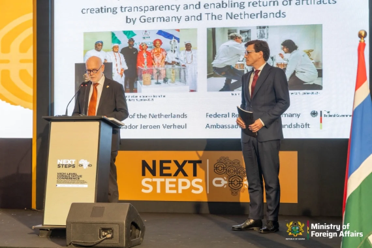
Dutch Ambassador Jeroen Verheul (L) and German Ambassador Frederik Landshoeft (R) in Accra, Ghana, June 2026. Source: https://bantugazette.com/ghana-welcomes-planned-return-of-2000-artifacts-from-the-netherlands-germany/.
And the UK?
As the official website of the British Museum acknowledges, "The British Museum was founded in 1753: its history and collection are shaped by empire and the colonial exploitation of people and resources."[3] It is therefore no surprise that whenever the restitution of cultural artefacts is discussed, London's most famous museum, and more generally the whole UK museal scene, is almost always at the center of the debate.
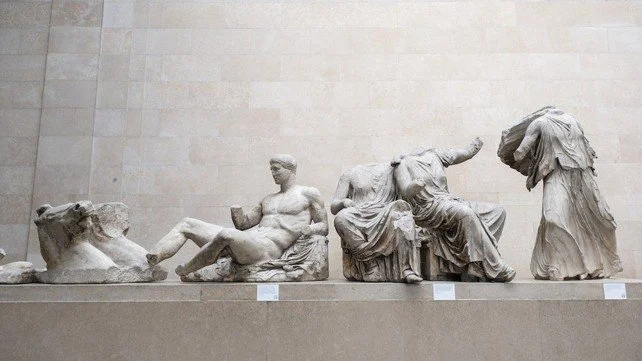
The Elgin Marbles are among the most controversial objects in the British Museum's collection. The sculptures were brought to London in 1803 by Lord Elgin, who removed them from Athens while Greece was under Ottoman rule. Since then, they have become one of the world's best-known and most contested cases of cultural restitution. Source: https://www.bbc.com/news/entertainment-arts-30342462.
In the United Kingdom, the pace of change has been considerably slower, mainly due to entrenched legal constraints. The British Museum Act 1963 effectively prevents the British Museum’s trustees from permanently removing objects from its collection, except in narrowly defined cases. This legal framework remains at the heart of ongoing disputes, including the Parthenon Sculptures claimed by Greece, the Benin Bronzes, and many other contested items.
A limited opening emerged with the Charities Act 2022, which may allow certain restitutions where trustees judge there to be a clear moral duty. However, its actual scope remains unclear and uneven in practice. Recently, at the political level, Prime Minister Keir Starmer has stated that his government has “no plans to change the law” on the Parthenon Sculptures, underscoring a continued preference for maintaining the existing legal settlement (Benslama-Dabdoub 2026).
From Exception to Policy?
These developments suggest that Europe is gradually moving away from a model of exceptional, case-by-case restitutions toward a more institutionalised framework, even if one still shaped by political compromises and legal constraints. Increasingly, however, the language has shifted toward broader concepts such as historical justice, shared memory, museum partnerships, and cultural diplomacy.
This evolution is also reflected at the UNESCO level. In particular, the MONDIACULT 2022 Declaration, unanimously adopted in September 2022, calls for
an open and inclusive international dialogue for the return and restitution of cultural property to the countries of origin, including illegally exported property, under the auspices of UNESCO, as well as that which does not fall within the scope of the 1970 UNESCO Convention, as an ethical imperative to promote the right of peoples and communities to enjoy their cultural heritage, and in light of the growing demands of the countries concerned, with a view to strengthening social cohesion and the intergenerational transmission of cultural heritage (UNESCO 2025).
In this new phase, the return of an object doesn’t represent just the conclusion of a dispute, but aspires to be the beginning of something deeper. Restitution opens the door to cooperation through research, lending agreements, educational initiatives, and shared projects in conservation and heritage development. Ernesto Ottone Ramirez, Assistant Director-General for Culture at UNESCO, stated: “Return and restitution are not the end of a process, but the beginning of a relationship based on broader, forward-looking cooperation. The issue of return and restitution should therefore help to support ambitious cultural and scientific cooperation projects” (UNESCO 2025).
Naturally, restitution remains a highly contested issue. Supporters of universal museums such as the British Museum, the Louvre, and the Musée du Quai Branly argue that these institutions have been essential in preserving and showcasing world heritage, enabling cultural dialogue by bringing together objects from different civilizations in a single space. Advocates of restitution, however, emphasise that many of these collections were formed in contexts shaped by colonial domination, unequal power relations, and wartime looting. From this perspective, returning objects is not only a question of legal ownership, but also an act of historical recognition and a necessary step toward rebalancing global cultural relationships.
What makes 2026 stand out is not simply the number of restitutions, but the way the debate is changing. Restitution is no longer driven only by symbolic gestures or one-off negotiations. Increasingly, it is becoming part of public policy, backed by new laws, institutions, and procedures designed to handle claims more systematically. If this trend continues, it could reshape the role of museums, giving countries-of-origin a stronger voice in preserving and interpreting their own cultural heritage. However, it is still too early to call 2026 a turning point. More likely, it will be remembered as one step in a broader transformation. Many claims remain unresolved, and political resistance has not disappeared. Yet one thing is becoming clear: the idea that cultural heritage can, and often should, return to its communities of origin is no longer a fringe position. It is steadily becoming part of the mainstream, with restitution evolving from an exceptional gesture into a regular feature of cultural policy.
References
Emmanuel Macron. “Emmanuel Macron’s Speech at the University of Ouagadougou.” Presidency of the French Republic, November 28, 2017. https://www.elysee.fr/en/emmanuel-macron/2017/11/28/emmanuel-macrons-speech-at-the-university-of-ouagadougou.
HuffPost Italia. “Il caso del museo Quai Branly: il post colonialismo lo ha privato di senso.” June 22, 2026. https://www.huffingtonpost.it/esteri/2026/06/22/news/da_orgoglio_della_francia_multiculturale_a_simbolo_del_dibattito_post-coloniale_il_caso_quai_branly-22191481.
Le Monde. “France Passes Law on the Restitution of Cultural Artifacts Looted during Colonial Rule.” May 8, 2026. https://www.lemonde.fr/en/culture/article/2026/05/08/france-passes-law-on-the-restitution-of-cultural-artifacts-looted-during-colonial-rule_6753247_30.html.
Oxford Human Rights Hub. “Decolonising the Museum: Why Britain Should Follow France in Returning Colonial Artefacts.” Accessed June 29, 2026. https://ohrh.law.ox.ac.uk/decolonising-the-museum-why-britain-should-follow-france-in-returning-colonial-artefacts/.
The Art Newspaper. “France’s New Restitution Law Passes Final Vote.” April 14, 2026a. https://www.theartnewspaper.com/2026/04/14/frances-new-restitution-law-passes-final-vote.
The Art Newspaper. “Germany to Create Council to Oversee Restitution of Colonial-Era Acquisitions.” March 31, 2026b. https://www.theartnewspaper.com/2026/03/31/germany-to-create-council-to-oversee-restitution-of-colonial-era-acquisitions.
The Guardian. “Ghana to Advance Reparatory Justice at First Major Gathering Since Landmark UN Resolution.” June 17, 2026. https://www.theguardian.com/news/2026/jun/17/ghana-to-advance-reparatory-justice-at-first-major-gathering-since-landmark-un-resolution.
Savoy, Bénédicte, and Felwine Sarr. „The Restitution of African Cultural Heritage: Toward a New Relational Ethics.“ Paris: French Ministry of Culture, 2018. https://www.about-africa.de/images/sonstiges/2018/sarr_savoy_en.pdf.
UNESCO. “A Watershed Moment for Global Dialogue on Reparatory Justice.” June 19, 2026. https://www.unesco.org/en/articles/watershed-moment-global-dialogue-reparatory-justice.
UNESCO. “The Return and Restitution of Cultural Property.” December 18, 2025 https://www.unesco.org/en/node/200483.
Notes
[1] The whole speech can be found on the official website of the Elysèe: https://www.elysee.fr/en/emmanuel-macron/2017/11/28/emmanuel-macrons-speech-at-the-university-of-ouagadougou.
[2] Savoy-Sarr report, 2018: https://www.about-africa.de/images/sonstiges/2018/sarr_savoy_en.pdf.
[3]https://www.britishmuseum.org/visit/object-trails/collecting-and-empire-trail.