
When Culture is not for Everyone:
Cultural Capital, Inequality, and the Reproduction of Social Hierarchies
5 June 2026
Article 27 of the Universal Declaration of Human Rights states that “everyone has the right freely to participate in the cultural life of the community, to enjoy the arts and to share in scientific advancement and its benefits.” Culture is often portrayed as an open and accessible space, inherently democratic. Museums, cinemas, books, and performances are commonly seen as goods available to all, serving as tools for both individual and collective enrichment. However, this view conceals a more complex reality: access to culture is deeply unequal and often reflects, and even amplifies, existing social divides. This leads to a fundamental realization: the existence of formal rights does not necessarily imply the existence of substantive rights, meaning their actual implementation and realization in everyday life.
Access depends not only on cultural supply, but also on economic, social, and territorial factors such as income, education, cultural capital, and the availability of time. Over the past decades, a vast body of literature has shown that cultural participation is not the result of fully free choices, but rather the outcome of structural conditions that shape both opportunities and preferences (Bordieu 1979; DiMaggio 1982). In this sense, culture is not only a space of expression, but also a field in which inequalities are reproduced. Recognizing the tension between formal rights and real access is a crucial first step toward designing more inclusive cultural policies. This paper aims to provide a literature review on this topic, also taking into account the most recent data, particularly in the European context.
Culture and Capital: A Theoretical Framework
To understand the link between culture and inequality, it is useful to start from the concept of cultural capital developed by the French sociologist Pierre Bourdieu. In his work Distinction: A Social Critique of the Judgement of Taste (1979), Bourdieu argues that culture is not a neutral set of practices, but a resource that is unevenly distributed and plays a key role in structuring and legitimizing social hierarchies. Cultural capital is therefore central to understanding how social stratification and inequality are reproduced. It refers to a range of non-economic resources such as education, knowledge, skills, and cultural experiences that individuals acquire through processes of socialization. This concept includes both an embodied dimension, meaning habits, tastes, and internalized dispositions, and an objectified one, consisting of material goods such as books, artworks, or musical instruments.
These resources are not equally distributed across social groups, and they have a profound impact on opportunities for social mobility. Individuals from more privileged backgrounds tend to possess higher levels of cultural capital, which gives them advantages in education, career opportunities, and social networks. In this way, cultural capital contributes to the reproduction of social classes over time, as children inherit or internalize the cultural advantages of their parents. Educational and cultural institutions play a crucial role in this process. Schools, in particular, do not simply transmit knowledge; they tend to value and reward forms of cultural capital that are closer to those of dominant social groups, thereby reinforcing existing inequalities. At the same time, cultural institutions such as museums, theatres, and libraries contribute to shaping cultural capital by influencing tastes, preferences, and forms of social recognition. From this perspective, activities like visiting museums, reading books, or attending cultural events are not merely individual choices, but the result of a broader process of socialization that is deeply connected to individuals’ social position.
Evidence of Cultural Inequality Across Income and Education in the European Union
Empirical evidence confirms that cultural participation is highly stratified. Data consistently show that individuals from higher socioeconomic backgrounds tend to possess greater cultural capital, both through family transmission and through more active engagement in cultural activities.
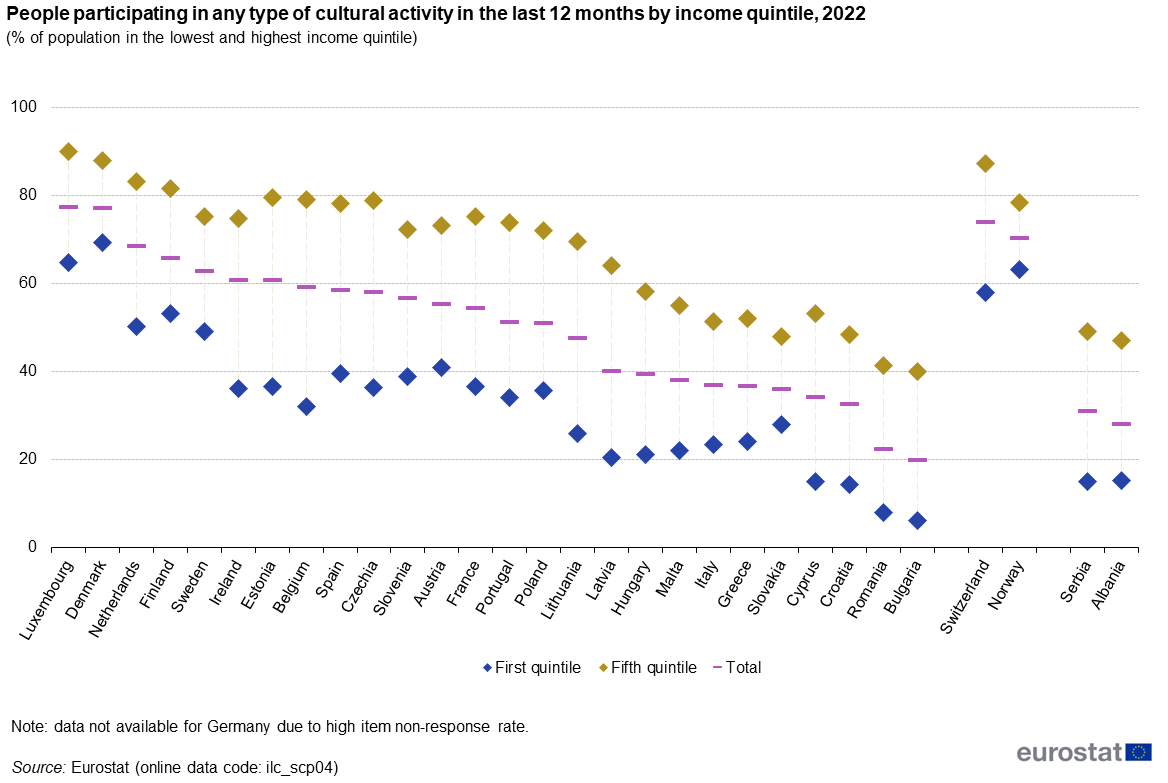
Across the European Union, cultural participation is consistently higher among top income groups than among those with the lowest incomes. According to Eurostat, in 2022 the participation rates among the richest quintile were highest in Luxembourg (90.1%), Denmark (87.9%), and Netherlands (83.1%). By contrast, in countries such as Slovakia, Croatia, Romania, and Bulgaria, fewer than half of high-income individuals reported taking part in cultural activities. Among the lowest income groups, participation levels were significantly lower. The highest rates were recorded in Denmark (69.4%), Luxembourg (64.7%), Finland (53.3%), and the Netherlands (50.2%). In contrast, in Cyprus, Croatia, Romania, and Bulgaria, participation fell below 20 percent. Income based disparities are substantial. In 17 EU countries, individuals in the highest income group were at least twice as likely to participate in cultural activities as those in the lowest income group. These gaps tend to be smaller in Nordic countries and in Luxembourg, but they are particularly pronounced in countries such as Bulgaria, where high income individuals are more than six times as likely to participate as those with the lowest incomes.
These trends are clear also in the link between education levels and cultural participation. In 2022, individuals with tertiary education reported significantly higher participation rates in all countries. In 15 EU member states, at least two-thirds of highly educated individuals took part in cultural activities. The highest rates were recorded in Luxembourg (88.7%), followed by Denmark, Portugal, and Netherlands. At the opposite end, Bulgaria recorded the lowest rate at 39.5%, the only country below 50%. The gap between education groups is particularly striking. In many countries, participation among those with tertiary education was at least 40 percentage points higher than among individuals with lower secondary education or less. In 19 EU countries, it was at least twice as high. Participation among lower educated groups remains limited. Only Denmark and Luxembourg reported rates above 50 percent, while in Romania and Bulgaria it fell below 10 percent. More broadly, most EU countries show differences of over 30 percentage points between the highest and lowest education levels, with the largest gaps observed in Portugal, France, Poland, and Romania.
These patterns highlight how educational attainment plays a crucial role in shaping access to and engagement with cultural activities.
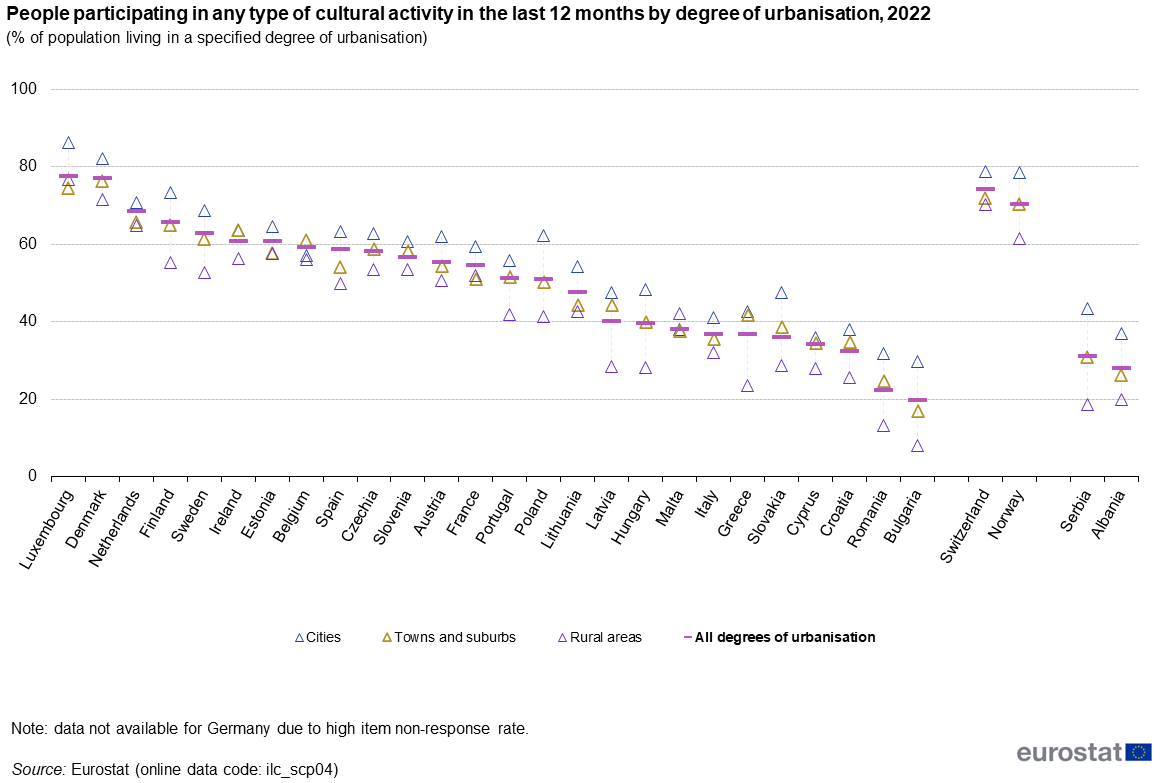
Beyond the most recent empirical data, the broader body of gray literature is clear: cultural consumption is deeply shaped by inequality. Research consistently converges on a central conclusion, namely that cultural value, as expressed through patterns of consumption, is highly uneven, with different forms of culture being consumed in different ways by different social groups. From this perspective, it is reasonable to suggest that who consumes culture can provide important insights into how cultural value is constructed. This idea has been developed across a range of disciplines, including economics (Hutter and Frey 2010), geography (Brook 2013), sociology (Bennett et al. 2009), and the arts and humanities more broadly (Connor 1992; Kieran 2010), all of which explore the processes through which value is assigned or withheld. At the same time, this does not mean that cultural value is entirely socially determined (Zangwill 2010). Rather, the key point is that patterns of consumption matter. Understanding who participates in cultural activities, and how these patterns can be explained, is essential for analysing the relationship between cultural value and inequality.
Cultural Participation and Social Inequality in Contemporary Societies
Since the publication of Distinction by Pierre Bourdieu, a vast body of literature has explored the role of cultural resources, or “cultural capital,” in the production and reproduction of social inequalities. Over time, however, the concept of cultural capital has been interpreted in different ways and associated with a variety of meanings. Bourdieu’s original perspective has been revisited by later studies that highlight important changes in patterns of cultural consumption. In particular, Richard A. Peterson (1992) introduced the concept of the “cultural omnivore,” arguing that contemporary elites are no longer limited to the consumption of specific forms of “high” culture. Instead, they tend to engage with a broader range of cultural products, including those traditionally considered “low” culture. This approach moves beyond Bourdieu’s strongly hierarchical framework and offers a more nuanced and fluid understanding of cultural participation. According to Bourdieu, each social class tends to be associated with specific cultural preferences, leading to a relatively rigid distinction between groups and reinforcing a clear cultural hierarchy. From this perspective, cultural consumption reflects and reproduces social stratification in a fairly structured way. However, Peterson’s argument, together with more recent research, suggests a more complex picture. Studies by Tak Wing Chan and John H. Goldthorpe (2007a; 2007b) show that contemporary societies are better understood in terms of a distinction between “omnivores” and “univores.” Omnivores, who are typically more educated and belong to more advantaged social groups, participate in a wide range of cultural activities across different genres. Univores, by contrast, have a much more limited cultural repertoire and are more often associated with lower socioeconomic groups. At this level of the social structure, we also find the majority of “inactive” individuals, who rarely or never engage in cultural consumption (Chan 2019).
Taking the UK case as example, the Warwick Commission on the Future of Cultural Value (2015) of the University of Warwick makes clear:
The wealthiest, better educated and least ethnically diverse 8% of the population forms the most culturally active segment of all: between 2012 and 2015 they accounted (in the most conservative estimate possible) for at least 28% of live attendance to theatre, thus benefiting directly from an estimated £85 per head of Arts Council England funding to theatre. The same 8% of the population also accounted for 44% of attendances to live music, benefiting from £94 per head of Arts Council music funding. For the visual arts, this highly engaged minority accounted for 28% of visits and £37 per head of public funding (p.33).
This distinction represents a crucial analytical shift. In Pierre Bourdieu’s classical perspective, cultural stratification was primarily expressed through the opposition between “legitimate” and “popular” tastes. In contemporary societies, however, the main line of division increasingly revolves around participation itself. In other words, the most significant difference is no longer between those who consume different types of culture, but between those who are broadly engaged in the cultural sphere and those who have limited access to it or are completely excluded.
In Bennett et al.’s (2009) major survey of British cultural consumption, engagement or disengagement is related very strongly to social class:
Class remains a central factor in the structuring of contemporary cultural practice in Britain: class matters. Whatever social advantage might arise from heavy engagement in cultural activities will accrue to those who are highly educated, who occupy higher occupational class positions, and who have backgrounds within higher social classes. Higher social class is associated with regular attendance at the theatre, museums, art galleries, stately homes, opera, cinema, musicals and rock concerts. It is also strongly associated with owning paintings and reading books. Belonging to the lowest social classes tends to be associated with never doing these things (p.52).
This exclusion cannot be understood as a simple matter of individual preferences or lack of interest. On the contrary, as discussed earlier, a large body of research shows that non-participation or limited participation is strongly linked to a combination of structural factors, including education levels, economic resources, family cultural capital, and the availability of time. In addition to these elements, there are more subtle but equally important factors, such as perceptions of cultural legitimacy and a sense of belonging within cultural spaces. Cultural institutions, in fact, may be perceived as environments that are “not for everyone,” thereby reinforcing not only material barriers but also symbolic ones.
Cultural Capital and the Reproduction of Social Inequality
Cultural capital does not simply reflect social inequalities; it actively contributes to their reproduction. As shown by Kraaykamp and Van Eijck (2010) in “The Intergenerational Reproduction of Cultural Capital: A Threefold Perspective”, family background plays a crucial role in the transmission of cultural capital, which is strongly shaped by parents and the broader family environment. This, in turn, translates into skills, dispositions, and educational credentials that significantly influence individuals’ career opportunities (Reeves and De Vries 2018).
The education system is one of the main arenas where this mechanism takes shape. Schools tend to value linguistic abilities, interpretative skills, and cultural codes that are more easily accessible to those from privileged social backgrounds. As a result, students with higher levels of cultural capital start from a more advantageous position and generally achieve better outcomes, while those from less advantaged contexts face obstacles that are often invisible but highly consequential, thereby reinforcing existing inequalities (DiMaggio 1982). In “The Inheritors: French Students and Their Relation to Culture” (1964), Pierre Bourdieu and Jean-Claude Passeron demonstrate the importance of cultural skills and knowledge acquired through family transmission in shaping students’ educational achievements, highlighting the role of cultural differences in social stratification. Schools are often seen as meritocratic institutions where individual ability is rewarded, yet research shows that they tend to be more conducive environments for students from dominant social groups, since they are built upon values and norms that reflect and reproduce those groups’ cultural capital.
At the same time, cultural participation also affects access to social networks and professional opportunities. Engaging in certain cultural environments means entering relational contexts that can provide information, connections, and opportunities for upward mobility. As Reeves and Devries (2018) point out, cultural capital continues to play a central role in contemporary processes of social stratification, even in societies that appear more formally open. Cultural consumption is also linked to future earnings: its convertibility into economic advantages helps explain the relationship between family background, which strongly shapes cultural participation, and life outcomes, making it one of the key mechanisms through which inequality is reproduced.
Social Cohesion and Democratic Engagement
The relationship between culture and inequality also has important implications for social cohesion and the functioning of democracy. Research promoted by the Council of Europe (2018) highlights a positive correlation between cultural participation and civic engagement, including political involvement, volunteering, and trust in institutions. This suggests that individuals who take part in cultural life are not only more exposed to diverse ideas and perspectives but are also more likely to develop the skills and motivations needed to participate actively in the public sphere. This, in turn, implies that lower socioeconomic groups, which are more often excluded from cultural participation, tend to be less involved in democratic processes. Such disparities may have concrete consequences for political representation and for the perceived legitimacy of institutions, as certain voices and experiences remain underrepresented. Similarly, UNESCO (2022) emphasizes that cultural participation is a key dimension of active citizenship and human development, as it enables individuals to express themselves, engage with others, and feel recognized within society. From this perspective, access to culture is not only a matter of individual enrichment, but also a collective resource that supports more inclusive and resilient societies. In line with this perspective, the literature on social capital developed by Putnam (2000) shows how participation in cultural and associative activities contributes to the creation of social networks, mutual trust, and cooperation, all of which are essential elements of democratic life: “People divorced from community, occupation, and association are first and foremost among the supporters of extremism”(p.338).
From Cultural Democratization to Cultural Democracy: Implications for Policy-Makers in a Changing Cultural Landscape
The relationship between culture and inequality is complex, making the design of effective cultural policies particularly challenging. For decades, discussions surrounding cultural policy in many Western countries were dominated by the concept of the “democratization of culture,” which, as Tony Bennett (2001) notes, primarily involved “striving to equalise conditions of access to an accepted standard of high culture,” particularly for social groups that historically participated less, or were excluded altogether, from cultural life. However, as underlined by Hanquinet (2017), a large body of empirical evidence has shown that participation in these forms of culture remains socially selective, calling into question the effectiveness of such policies. In response, the concept of “cultural democracy” has gained more attention, emphasizing the value of a wider range of cultural expressions, including popular and minority cultures, and promoting more participatory forms of engagement. As a result, the centrality of highbrow culture in public policy has gradually diminished. For example, writers such as Braden (1978) and Kelly (1984, 1985) did not argue that “ordinary” people were incapable of appreciating or accessing “high culture.” Rather, they challenged the assumption that the cultural expressions of a single social group could be universally defined as “Culture” itself. Reflecting on the notion of the “Great Tradition,” Braden provocatively argued that:
…the so-called cultural heritage which made Europe great – the Bachs and Beethovens, the Shakespeares and Dantes, the Constables and Titians - is no longer communicating anything to the vast majority of Europe’s population…. The greatest artistic deception of the twentieth century has been to insist to all people that this was their culture (p.153-154).
More recently, the debate has shifted further, with increasing attention to cultural participation itself rather than to distinctions between types of culture. Research highlights how engagement in both formal and everyday cultural activities plays a key role in wellbeing, social inclusion, and community life. At the same time, it reveals that a significant share of the population remains disengaged not only from traditional cultural institutions but also from ordinary social practices, pointing to broader patterns of social isolation.
Despite these developments, cultural inequalities have not disappeared but have instead taken new forms. Traditional distinctions still exist, but they now coexist with more flexible patterns of cultural consumption. In particular, individuals in higher social positions often display “omnivorous” cultural behaviors, engaging with a wide range of cultural forms, including both highbrow and popular culture. At first glance, this may suggest a more open and less hierarchical cultural landscape. However, this apparent openness does not mean that inequalities have vanished. As shown by Peterson and Kern (1996), omnivorous individuals do not consume culture randomly; rather, they make selective choices that remain socially advantageous. Their ability to navigate across different cultural forms is itself a resource, rooted in higher levels of education, cultural capital, and social confidence. In other words, engaging with popular culture does not replace high culture, but adds to it. This creates an important asymmetry. Individuals from more privileged backgrounds can combine different cultural forms without losing the advantages associated with high culture. By contrast, those from lower social backgrounds instead are “stuck” in popular culture, not having access to the same range of choices typically available to individuals from more resource-rich backgrounds due to a lack of access to the knowledge, credentials, and environments linked to high culture. The resemblance between these concepts and the work of Zygmunt Bauman is far from coincidental. In Globalization: The Human Consequences (1998), Bauman famously observed that “Some of us become fully and truly ‘global’; some are fixed in their locality,” emphasizing how socio-economic inequalities shape profoundly different lifestyles, opportunities, and forms of mobility. As a result, while cultural consumption may appear more diverse, the underlying structure of inequality remains, as the ability to move across cultural boundaries is itself unequally distributed.
For this reason, it would be misleading to assume that the tension between highbrow and popular culture has become irrelevant. Individuals of low social or economic status continue to display a relatively narrow cultural repertoire that generally excludes highbrow cultural goods and activities, meaning that the boundaries of distinction persist even as their form changes. Access to the forms of capital associated with high culture continues to shape life chances, and its role in processes of social stratification remains very much intact. Broadening the cultural agenda to include more diverse forms of expression and to encourage participation can certainly improve well-being and reduce social isolation, particularly among lower income groups. While both “democratization of culture” and “cultural democracy” approaches have value, neither fully confronts the underlying architecture of symbolic power. Cultural capital theory has had limited effects in terms of actual implementation of related cultural policies (Belfiore et al. 2023), and policies oriented towards participation tend to operate at the level of consumption and expression without disturbing the deeper mechanisms through which cultural capital is converted into credentials and economic advantage.
In short, the "cultural democracy" approach can enhance well-being and broaden participation, but it risks functioning as marginal inclusion: widening the tent of cultural life without dismantling the mechanisms by which culture continues to sort, rank, and exclude. For Bourdieu, cultural capital is irreducibly attached to class and other forms of stratification, which in turn are associated with various forms of benefit or advancement. For both approaches to serve as meaningful critiques of existing cultural policy, they must begin by recognizing how cultural institutions and practices are deeply embedded within broader socio-economic and political structures that reproduce inequality. Any cultural policy that fails to question these underlying dynamics risks, regardless of how inclusive it appears, preserving the symbolic hierarchies through which social class continues to be reproduced across generations. The issue, therefore, is not simply who is allowed to participate in culture, but also whose culture is considered legitimate, and who holds the institutional authority to define it.
References
Bauman, Zygmunt. 1998. Globalization: The Human Consequences. New York: Columbia University Press.
Belfiore, Eleonora, Steven Hadley, Brea M. Heidelberg, and Carole Rosenstein. 2023. "Cultural Democracy, Cultural Equity, and Cultural Policy: Perspectives from the UK and USA." The Journal of Arts Management, Law, and Society 53 (3): 157–168. https://doi.org/10.1080/10632921.2023.2223537.
Bennett, Tony. 2001. Cultural Policy and Cultural Diversity: Mapping the Policy Domain. Vol. 7. Strasbourg: Council of Europe. https://unesdoc.unesco.org/ark:/48223/pf0000187525.
Bennett, Tony, Mike Savage, Elizabeth Bortolaia Silva, Alan Warde, Modesto Gayo-Cal, and David Wright. 2009. Culture, Class, Distinction. London: Routledge. https://doi.org/10.4324/9780203930571.
Bourdieu, Pierre. 1979. La Distinction: Critique sociale du jugement. Paris: Les Éditions de Minuit.
Bourdieu, Pierre, and Jean-Claude Passeron. 1964. Les Héritiers: les étudiants et la culture. Paris: Éditions de Minuit. https://monoskop.org/images/e/e1/Bourdieu_Pierre_Passeron_Jean_Claude_Les_heritiers_Les_etudiants_et_la_culture_1966.pdf.
Braden, Su. 1978. Artists and People. London: Routledge and Kegan Paul. https://doi.org/10.4324/9781003617839.
Brook, Orian. 2013. "Reframing Models of Arts Attendance: Understanding the Role of Access to a Venue. The Case of Opera in London." Cultural Trends 22 (2): 97–107. https://doi.org/10.1080/09548963.2013.783175.
Chan, Tak Wing. 2019. "Understanding Cultural Omnivores: Social and Political Attitudes." The British Journal of Sociology 70 (3): 784–806. https://doi.org/10.1111/1468-4446.12613.
Chan, Tak Wing, and John H. Goldthorpe. 2007a. "Social Stratification and Cultural Consumption: The Visual Arts in England." Poetics 35: 168–190. https://doi.org/10.1016/j.poetic.2007.05.002.
Chan, Tak Wing, and John H. Goldthorpe. 2007b. "The Social Stratification of Cultural Consumption: Some Policy Implications of a Research Project." Cultural Trends 16: 373–384. https://doi.org/10.1080/09548960701692787.
Connor, Steven. 1992. Theory and Cultural Value. Oxford: Blackwell.
Council of Europe. 2018. "Indicator Framework on Culture and Democracy: Investigating the Link between Culture and a Democratic, Open and Trusting Society." https://rm.coe.int/CoERMPublicCommonSearchServices/DisplayDCTMContent?documentId=09000016806af0cb.
DiMaggio, Paul. 1982. "Cultural Capital and School Success: The Impact of Status Culture Participation on the Grades of US High School Students." American Sociological Review 47 (2): 189–201. https://doi.org/10.2307/2094962.
Eurostat. 2022. "Culture Statistics: Cultural Participation." https://ec.europa.eu/eurostat/statistics-explained/index.php?title=Culture_statistics_-_cultural_participation.
Hanquinet, Laurie. 2017. "Inequalities: When Culture Becomes a Capital." In The Routledge Handbook of Global Cultural Policy, edited by Victoria Durrer, Toby Miller, and Dave O'Brien, ch. 21. London: Routledge. https://doi.org/10.4324/9781315718408.
Hutter, Michael, and Bruno S. Frey. 2010. "On the Influence of Cultural Value on Economic Value." Revue d'économie politique 120 (1): 35–46. https://doi.org/10.3917/redp.201.0035.
Kelly, Owen. 1984. Community, Art and the State: Storming the Citadels. London: Comedia.
Kelly, Owen. 1985. "In Search of Cultural Democracy." Arts Express, October.
Kieran, Matthew. 2010. "The Vice of Snobbery: Aesthetic Knowledge, Justification and Virtue in Art Appreciation." Philosophical Quarterly 60: 243–263. https://doi.org/10.1111/j.1467-9213.2009.615.x.
Kraaykamp, Gerbert, and Koen van Eijck. 2010. "The Intergenerational Reproduction of Cultural Capital: A Threefold Perspective." Social Forces 89 (1): 209–231. https://doi.org/10.1353/sof.2010.0087.
Peterson, Richard A. 1992. "Understanding Audience Segmentation: From Elite and Mass to Omnivore and Univore." Poetics 21: 243–258. https://doi.org/10.1016/0304-422x(92)90008-q.
Peterson, Richard A., and Roger M. Kern. 1996. "Changing Highbrow Taste: From Snob to Omnivore." American Sociological Review 61 (5): 900–907. https://doi.org/10.2307/2096460.
Putnam, Robert D. 2000. Bowling Alone: The Collapse and Revival of American Community. New York: Simon and Schuster.
Reeves, Aaron, and Robert De Vries. 2018. "Can Cultural Consumption Increase Future Earnings? Exploring the Economic Returns to Cultural Capital." III Working Paper 20. London: International Inequalities Institute, London School of Economics and Political Science. https://doi.org/10.21953/lse.d9q74nye2mz0.
UNESCO. 2022. Re|Shaping Policies for Creativity: Addressing Culture as a Global Public Good. https://unesdoc.unesco.org/ark:/48223/pf0000380475.
Warwick Commission. 2015. Enriching Britain: Culture, Creativity and Growth. Coventry: University of Warwick. https://warwick.ac.uk/fac/cross_fac/warwickcreativeexchange/locateculture/warwick_commission_final_report.pdf.
Zangwill, Nick. 2010. "Against the Sociology of the Aesthetic." Cultural Values 6 (4): 443–452. https://doi.org/10.1080/1362517022000047352.