In Minor Keys, In Major Chaos: How Global Tensions Overtook the Venice Biennale
Venice went down in history as La Serenissima, “the most serene”, a title symbolizing the stability, institutional balance, and internal peace secured by its government for centuries. The atmosphere surrounding the city in recent weeks, however, could hardly feel more chaotic and confused.
The opening of the 61st edition of the Biennale, titled In Minor Keys and running from May 9 to November 22, 2026, was supposed to be, as always, the grand collective ritual of the contemporary art world: crowded vernissages, cocktails along the canals, collectors dressed in linen, curators rushing between the Giardini and the Arsenale, artists chased by journalists. This year, however, added a new ingredient to the Biennale’s usual formula of cocktails, collectors, and curators: tear gas. Even before it officially opened, the 2026 edition had already turned into a perfect storm of controversies, political tensions, protests, organizational chaos, and diplomatic incidents, making it one of the most turbulent Biennales in recent memory.
Venice is no stranger to events of this scale: the Biennale has been running since 1895, making it the world’s oldest contemporary art biennial, while every year the city of Saint Mark also hosts the renowned Film Festival. But this time, the widespread feeling was that each new day brought a new controversy. Even before the opening, the atmosphere was already tense: several national pavilions had become the subject of political debate before they were even completed; the conflicts in the Middle East and Ukraine inevitably spilled into the language of contemporary art. And the Biennale, which has always presented itself as a space for global dialogue, suddenly found itself overwhelmed by demands for increasingly explicit political positions.
The result was a constant short circuit between art and politics.
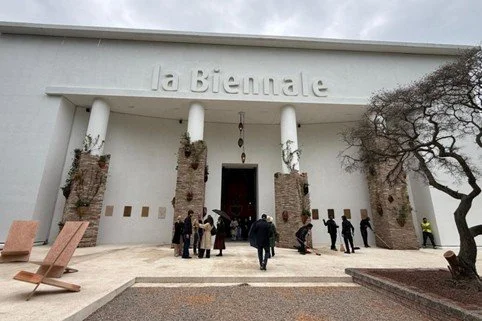
Source: https://www.agi.it/cultura/news/2026-05-07/biennale-arte-venezia-padiglioni-non-perdere-36935987/
The participation of Russia and Israel throws the Biennale into chaos
“In Venice we do not embrace weapons, we prepare peace,” declared Pietrangelo Buttafuoco, president of the Venice Biennale Foundation, during his opening speech at Teatro Piccolo dell'Arsenale, where he described the city as a “garden of peace.” In what was described as a sort of one-man show, he defended the controversial decision to include both Russia and Israel in the 61st edition of the exhibition, receiving a long standing ovation from the audience (Di Genova 2026).
Outside the theatre, however, the atmosphere was completely different. Helicopters flew over the lagoon while clashes erupted between police and protesters: the Art Not Genocide Alliance, demonstrating against Israel’s participation, and groups opposing the reopening of the Russian pavilion, led by the anti-Kremlin collective Pussy Riot.
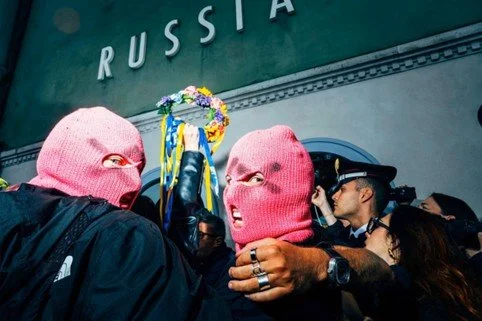
Pussy Riot, the Russian feminist activist collective known for its anti-Kremlin protests, was among the leading voices opposing the opening of the Russian pavilion.
Source: https://www.theartnewspaper.com/2026/05/06/major-protests-take-place-at-venice-biennale-previews.
The Russian pavilion quickly became the symbol of the Biennale’s geopolitical crisis. Moscow’s last participation was in 2019: in 2022, Russian artists withdrew after the invasion of Ukraine, declaring, “there is no place for art when civilians are dying under the fire of missiles, when citizens of Ukraine are hiding in shelters, when Russian protesters are getting silenced” (Marshall 2026). After skipping 2024, Russia decided to reclaim its pavilion this year, triggering fierce backlash. Critics argued that the pavilion should remain closed or be turned into a space denouncing the war, while others warned that excluding Russia entirely would also silence dissident voices. The controversy escalated further when EU foreign policy chief Kaja Kallas announced the suspension of two million euros in EU funding for the event. “While Russia bombs museums, destroys churches and seeks to erase Ukrainian culture, it should not be allowed to exhibit its own,” she said. “Russia’s return to the Venice Biennale is morally wrong, and the EU intends to cut its funding” (Sapio 2026).
At the same time, Art Not Genocide Alliance’s protests against Israel’s participation intensified, with activists accusing the Biennale of enabling “artwashing.” Demonstrations and clashes during the opening days led to the temporary closure of more than twenty national pavilions in solidarity (Monaghan-Coombs 2026).
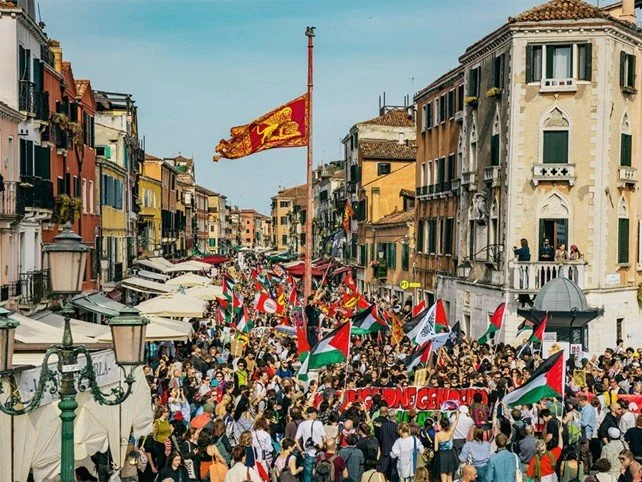
Protests regarding Israel's participation in Venice.
Source: https://monocle.com/culture/art-and-politics-collide-as-protests-reframe-the-venice-biennale/
Much of the criticism ultimately focused on the Biennale’s president Buttafuoco himself. Even Italian Minister of Culture Alessandro Giuli attacked his handling of the situation: “Buttafuoco made a mess. He wanted the UN of art, and ended up imagining he could do foreign policy” (Casula 2026). As if all of this was not enough, the crisis peaked just days before the opening, when part of the international jury resigned, transforming an artistic controversy into a full diplomatic and media crisis. The solution? Having the awards assigned directly through visitors’ votes, a sort of “People’s Lion.” An unprecedented move that many considered unfit for an exhibition of this level, and one that only fueled further controversy: fifty-two artists, nearly half of the main exhibition participants, announced that they did not want to be considered for the awards at all (Rainsford 2026).
And in the middle of all this, what about art?
Paradoxically, for an exhibition titled In Minor Keys, this may be the loudest Biennale the floating city has seen in decades. This year’s Biennale, curated by Koyo Kouoh, wanted to be an elegy to calm, reflection, and intimacy, embracing a quieter approach to contemporary art, giving space to overlooked voices and focusing on memory, identity, migration, and social change through a more introspective lens. This edition also became a tribute to its curator, Koyo Kouoh, the first African woman to hold the role for the Biennale, who unfortunately did not live long enough to see it, having passed away last year (Giaume 2025).
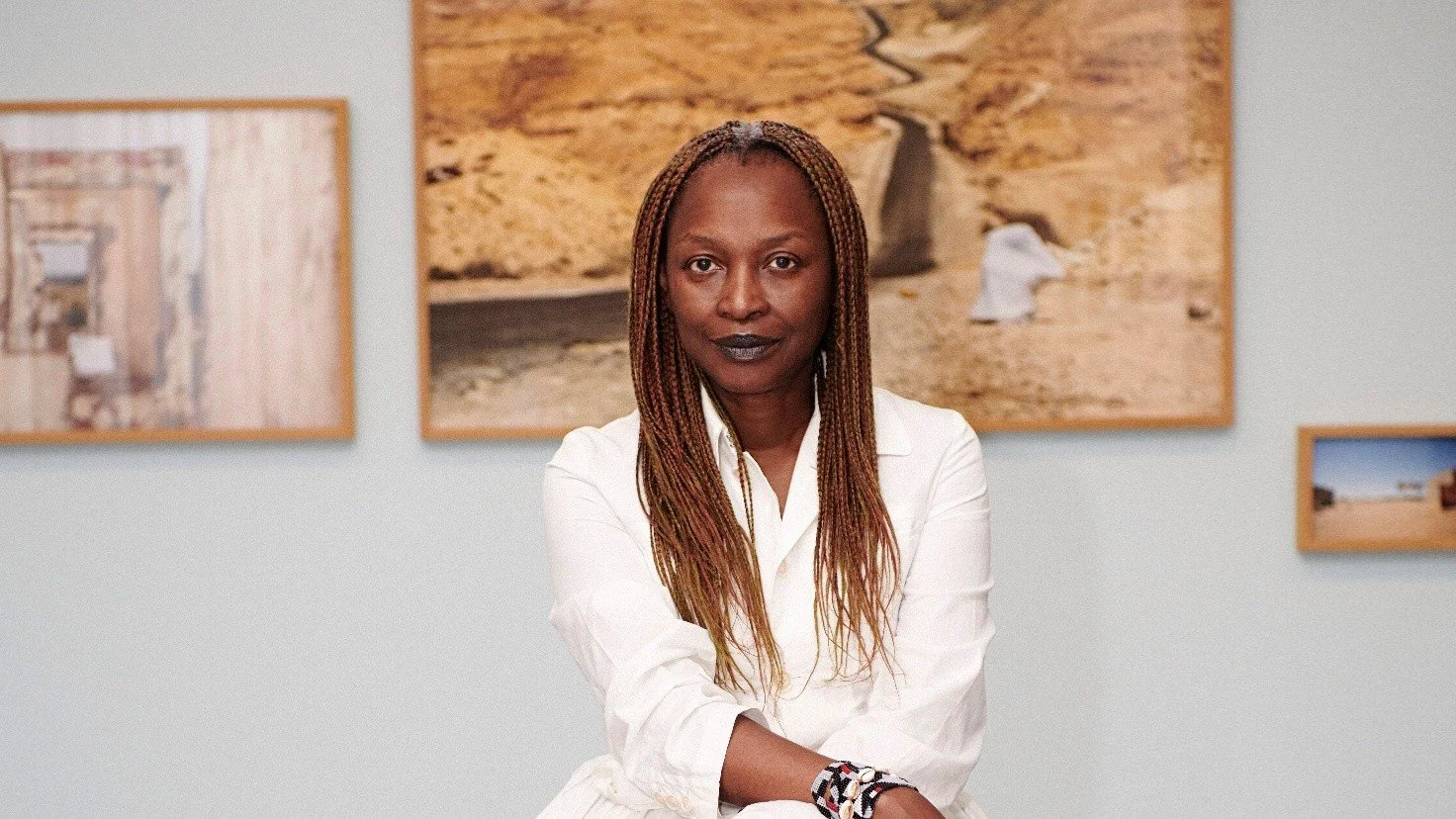
Koyo Kouoh was best known for her work supporting African artists and cultural institutions, as well as for curating several major international exhibitions Appointed curator of the 2026 Venice Biennale, she became the second African curator to lead the exhibition after Okwui Enwezor in 2015, and the first African woman to hold the role. Although she passed away last year at the age of 57, she remained the official curator of the Biennale, which was completed by her team.
Source: https://www.wallpaper.com/art/koyo-kouoh-cameroonian-curator-venice-biennale.
One of the undeniable protagonists of this edition is Marina Abramović who, as she celebrates her eightieth birthday, adds yet another milestone to her career by becoming the first living female artist to be honored with a major exhibition at the Gallerie dell’Accademia. In a first for the institution, the exhibition extends through both permanent galleries and temporary spaces, placing Abramović’s performances in dialogue with the Renaissance masterpieces housed inside the building (Downes 2026).
Still, despite the Biennale’s meditative tone, references to the world outside were impossible to avoid. Wandering through Venice, visitors may suddenly come across what looks like a typical Italian scene: laundry hanging out to dry between buildings. Except these are military uniforms and camouflage jackets belonging to Ukrainian soldiers, some of them artists themselves. The installation is part of Echoes, a project by Ukrainian artist Daria Koltsova, who intentionally decided to not include labels nor explanations, allowing residents to experience a sense of war intruding into what Buttafuoco would call a “garden of peace” (The Kyiv Independent 2026).
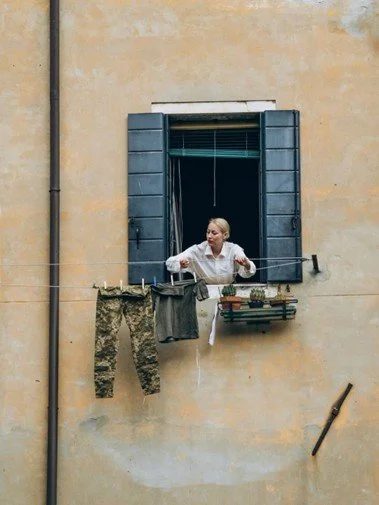
Daria Koltsova hanging the military uniforms in Venice as a part of her installation “Echoes.”
Source: https://www.instagram.com/p/DYFCc02CHET/.
Another pavilion attracting major attention is the Holy See’s, titled The Ear is the Eye of the Soul. Conceived almost as a sonic prayer, the exhibition invites visitors into a contemplative experience of listening, inspired by the medieval abbess, poet, healer, and composer Hildegard of Bingen. Much of the interest, however, comes from the musicians invited by the Vatican, with names ranging from Brian Eno to Patti Smith and FKA twigs (Dicastero per la Cultura e l’Educazione 2026).
An Impossible Neutrality
What happened at the 2026 Venice Biennale revealed a deeper crisis within the contemporary art world itself. For years, the Biennale managed to balance politics and ambiguity, presenting itself as a neutral global space for dialogue, avoiding taking clear institutional positions. This year, that balance collapsed. The participation of Russia and Israel turned the Biennale into a debate about legitimacy, morality, and the role of cultural institutions during wartime. Neutrality itself suddenly became political. And because the Biennale is built around national pavilions, global geopolitical tensions inevitably became part of the exhibition.
While it may be true that art can open forms of dialogue where politics and diplomacy often fail, it would be naïve to ignore how exhibitions like the Venice Biennale can also become instruments through which states seek to legitimize themselves and reinforce their influence on the international stage. So, how to solve this dilemma? Venice certainly did not provide any definitive answer this year. What the 61st Biennale did reveal, however, is that contemporary art can no longer pretend to exist outside the world’s conflicts and power struggles. The idea of the Biennale as a neutral cultural space collapsed under the weight of wars, protests, and geopolitical tensions. In the end, perhaps the real lesson of this edition is a simple one: all art is political, even the art that does not want to be.
Bibliography
Casula, Giulia. “Biennale Venezia, Giuli attacca Buttafuoco: ‘Sbagliato aprire il padiglione russo, ha fatto un pasticcio.’” Fanpage, May 3, 2026. https://www.fanpage.it/politica/biennale-venezia-giuli-attacca-buttafuoco-sbagliato-aprire-il-padiglione-russo-ha-fatto-un-pasticcio/
Dicastero per la Cultura e l’Educazione. “Padiglione della Santa Sede: L’orecchio è l’occhio dell’anima.” April 14, 2026. https://www.dce.va/it/news/2026/padiglione-della-santa-sede-a-venezia.html
Di Genova. “Al via la Biennale di Buttafuoco tra Ezra Pound e contestazioni.” Il Manifesto, May 7, 2026. https://ilmanifesto.it/al-via-la-biennale-di-buttafuoco-tra-ezra-pound-e-contestazioni
Downes, Annabel. “Seven of the Best Exhibitions to See at the Venice Biennale.” AnOther, May 12, 2026. https://www.anothermag.com/art-photography/17169/six-of-the-best-exhibitions-to-see-at-venice-biennale
Giaume, Giulia. “È morta a 57 anni Koyo Kouoh, curatrice della prossima Biennale Arte di Venezia.” Artribune, May 10, 2025. https://www.artribune.com/arti-visive/2025/05/morta-koyo-kouoh-prima-curatrice-africana-biennale-arte/
Marshall, Alex. “Russia Returns to Venice Biennale, in Latest Sign of Cultural Comeback.” The New York Times, March 5, 2026. https://www.nytimes.com/2026/03/05/arts/design/russia-ukraine-venice-biennale.html
Monaghan-Coombs, Sophie. “Art and Politics Collide as Protests Reframe the Venice Biennale.” Monocle, May 9, 2026. https://monocle.com/culture/art-and-politics-collide-as-protests-reframe-the-venice-biennale/
Rainsford, Sarah. “Venice Biennale Jury Resigns Days Before Start of Top Art Exhibition.” BBC, May 1, 2026. https://www.bbc.com/news/articles/c78qdg4g80eo
Sapio, Martina. “EU to Cut Venice Biennale Funding over Russia’s Participation, Kallas Says.” Politico, April 21, 2026. https://www.politico.eu/article/eu-cut-venice-biennale-funding-russia-participation-kaja-kallas/
The Kyiv Independent. LinkedIn post. Accessed May 18, 2026. https://www.linkedin.com/posts/ukrainian-artist-daria-koltsova-presented-ugcPost-7460669067935412224-WecN/