Reflecting on One Year of the UNESCO Virtual Museum of Stolen Cultural Objects

UNESCO Virtual Museum of Stolen Cultural Objects, Kere Architecture, n.d.
A Museum Without Halls or Walls
The 2022 relaunch of MONDIACULT, the world’s largest cultural policy conference, was a significant milestone in UNESCO’s ever-evolving remit as the world’s leading international organization for establishing norms and coordinating communication across the educational, scientific, and cultural sectors worldwide. On the stage in Mexico City, then Director-General of UNESCO Audrey Azoulay announced the creation of a new, one-of-a-kind, museum. Unlike the great museums of the world, the new museum’s galleries, collections, and visitors would be wholly digital. It was similarly unconventional in that it did not seek to acquire artefacts, but rather to completely empty its virtual halls.
Thanks to support from INTERPOL and the Kingdom of Saudi Arabia, the UNESCO Virtual Museum of Stolen Cultural Objects officially opened its doors to the public on September 29th of last year, during MONDIACULT’s 2025 edition. Its holdings are drawn from INTERPOL’s Stolen Works of Art Database, a collection of almost 57,000 stolen or missing cultural objects. One year after its launch, the museum has 278 3D-modelled artefacts on display, created with the help of artificial intelligence from photos uploaded to the database (makemepulse, 2025). These objects have been specifically chosen by the countries from which they were removed as items “whose disappearance and theft constitute an appreciable impoverishment of the national cultural heritage of the Submitting Country” (UNESCO, 2025).
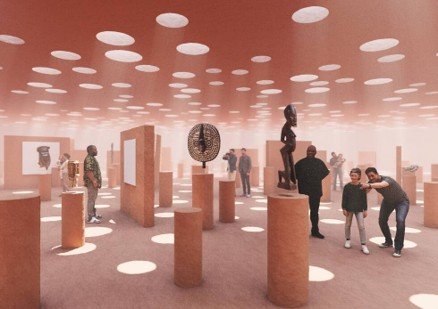
Model of the Stolen Cultural Objects Gallery (Kere Architecture, n.d.)
The museum’s virtual space – accessible by web browser or virtual reality – was designed by Burkinabé-German architect Francis Kéré, renowned for his work with sustainable buildings and use of locally sourced materials. He chose the baobab tree as the symbol for the new museum, metaphorically representing culture as the roots of identity and drawing a link between tangible cultural objects and their role in intangible cultural practices, mirroring the importance of the baobab as a social space in many West African communities. In the Virtual Museum, Kéré’s design philosophy emphasized light, space, and a feeling of limitlessness, allowing visitors to smoothly transition between and within different digital rooms.
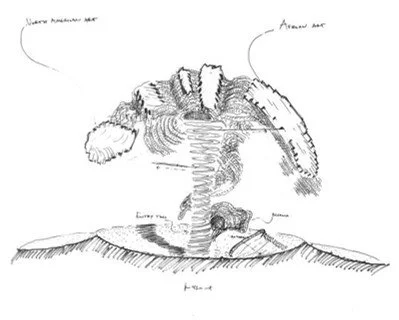
Sketch of the Virtual Museum (Kere Architecture, n.d.).
The Museum is divided into four rooms, a home landing page and three thematic galleries. The Stolen Cultural Objects Gallery organizes uploaded objects into randomized displays of five or six items, connected by an ‘infinite scroll’ feature, purposefully designed to attract and retain youth visitors (makemepulse, 2025). Crucially, item descriptions omit mention of any theft or looting, instead focusing on artefacts as objects which carry cultural significance to the communities that produced and used them. The Auditorium, modelled after a Classical Greek theatre, offers current news and information about UNESCO’s mission and achievements in the ongoing fight against the illicit trade in cultural property. The tree-lined Return and Restitution Room – whose arboreal setting evokes cultural reinvigoration related to possession of one’s own tangible heritage – highlights successful cases of repatriation and recovery.
UNESCO and the Illicit Trade in Cultural Objects
Across its galleries, the museum reiterates the role of cultural objects as tangible symbols of the beliefs, ideals, and practices of their source communities. The growing Return and Restitution Room and shrinking Stolen Cultural Objects Gallery reflect a wider commitment by UNESCO to combat the illicit trade in cultural objects by strengthening source communities, building capacity in cultural institutions, and facilitating international cooperation.
UNESCO has been responsible for creating several normative frameworks, soft and hard law instruments, and international treaties which attempt to prevent the illicit trade and support nation states. Foremost of these is the 1970 Convention on the Means of Prohibiting and Preventing the Illicit Import, Export and Transfer of Ownership of Cultural Property. Beyond establishing norms for the import and export of culturally significant objects and archaeological artefacts, its date of adoption – 1970 – is generally considered the terminus ante quem in the global art and antiquities market for items leaving their country of origin, as such items are excluded from the convention’s non-retroactive scope. The 1970 Convention largely lacks enforcement mechanisms, and relies upon signatories to enact supplementary national legislation, such as the 1983 Convention on Cultural Property Implementation Act in the United States, the 2002 Law Concerning Controls on the Illicit Export and Import of Cultural Property in Japan, the 2003 Dealing in Cultural Objects (Offences) Act in the United Kingdom, and the European Union-wide Regulation (EU) 2019/880. However, as “the effective functioning of the envisaged institutions requires a healthy economy, secure government control of territory and a strong jurisdiction”, national or regional instability has often caused disjunction between legal regimes and cultural property protection on the ground (Brodie, 2017).
To ameliorate this, UNESCO has been actively engaged in capacity-building efforts aimed at strengthening member states’ ability to identify and prevent the theft, illicit excavation, export, and import of cultural objects. Such efforts often comprise technical workshops, trainings, and financial support in times of crisis. One example, enacted under the aegis of the Virtual Museum itself, trained Togolese heritage professionals in inventory standards and use of the INTERPOL ID-Art mobile app and created an intersectional working group focused on drafting and implementing heritage protection legislation in Togo (UNESCO, 2025).
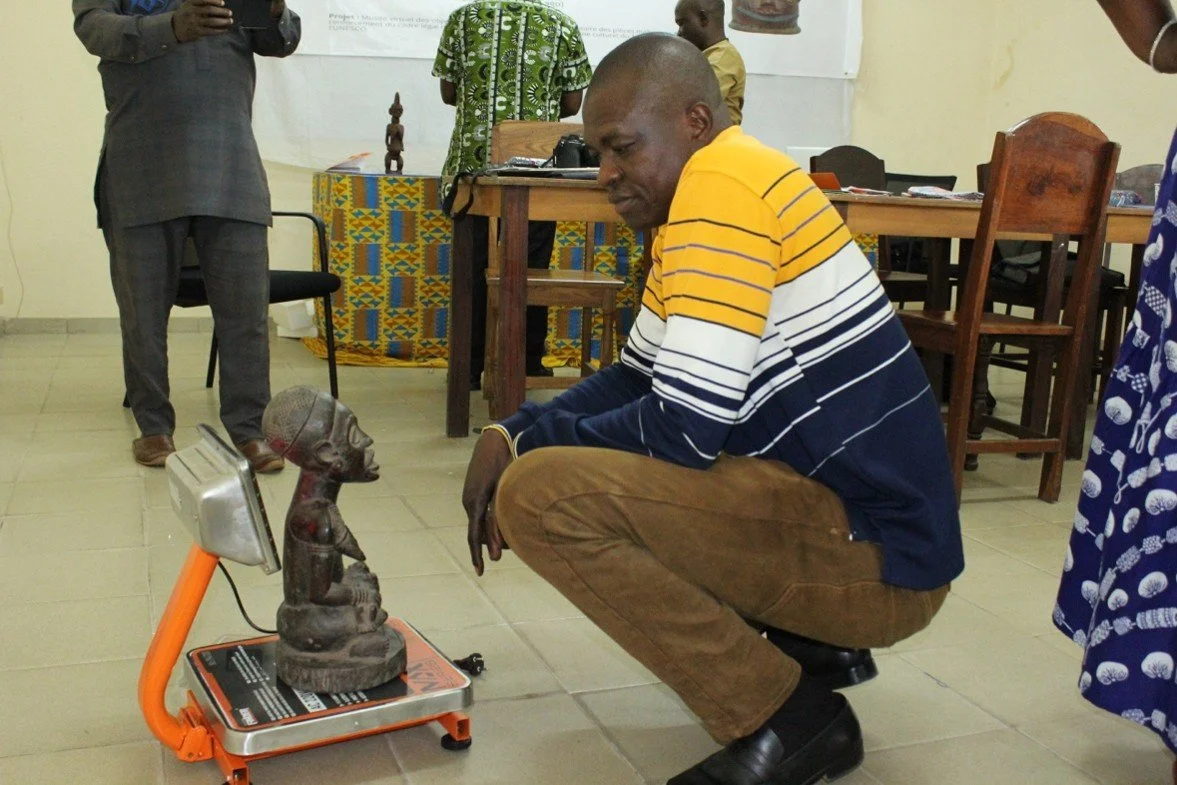
The Virtual Museum’s Capacity-Building Initiative in Togo (UNESCO, 2025).
Since the 2017 Council of Europe Convention on Offences relating to Cultural Property, or Nicosia Convention, public outreach has been an increasingly popular tool for combatting the illicit trade in cultural objects. Previous efforts employed written and audio-visual materials aimed at raising awareness about vulnerable cultural goods and sites, often targeted at regions experiencing conflict and instability (Minana, 2019). Historically, the 1970 Convention website has been “one of the Secretariat’s most important tools for awareness-raising”, although it has been suggested that many of its visitors are heritage professionals rather than the general public (Minana, 2019, p.3). The Virtual Museum reflects an innovative approach to this ongoing commitment, partially assimilating functions of the Convention website through the Auditorium while employing a new, visually appealing and artefact-focused strategy for publicizing the importance of cultural objects to source communities.
The Virtual Museum One Year On
In the year since its launch, three items from the Museum’s virtual collection have been ‘deaccessioned’, with another likely soon to follow. The Gold Helmet of Coțofenești and two golden bracelets were stolen from the Drents Museum in The Netherlands while on loan from National History Museum of Romania in 2025 (McGrath and Alexandru, 2026). The 5th century BCE artefacts, which belonged to the Dacian civilization centered in what is now Romania, were recovered in April 2026 by Dutch authorities and subsequently removed from the Virtual Museum (McGrath and Alexandru, 2026; UNESCO, 2026). A third bracelet taken in the 2025 theft is as of yet unrecovered and remains on digital display.
In July 2026, the Embassy of Spain in the United Kingdom announced the recovery of part of the 12th century CE Casket of San Valero (Embassy of Spain UK, 2026). The casket of the 3rd and 4th century CE bishop was stolen from the Romanesque Cathedral of Roda de Isábena in Huesca, Spain, in 1979 and has appeared in fragments on the international art market over the past decades (Embassy of Spain in the United Kingdom, 2026). The recently recovered fragment remains in the Stolen Cultural Objects Gallery (as of September 2026) but is likely to join the three Dacian artefacts in the near future.
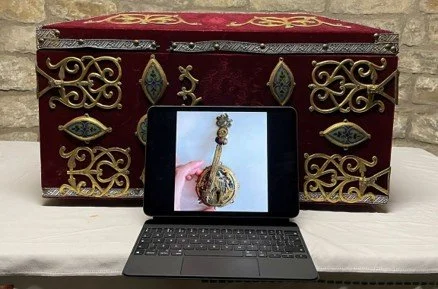
Recently Recovered Piece of the Casket of San Valero (Embassy of Spain in the United Kingdom, 2026).
Beyond these deaccessions and the aforementioned capacity-building work in Togo, the Virtual Museum evidently seeks to expand its digital infrastructure. A ‘curated exhibition’ feature is described on the home screen as ‘coming soon’ and will likely add further methods to appreciate the digital collections.
The Virtual Museum provides a dynamic, publicly accessible platform to exhibit the efforts of UNESCO, its partner institutions, and States Parties to the 1970 Convention in combatting the illicit trade in cultural objects. By framing stolen cultural objects in terms of their importance to source communities rather than the actions of individuals contributing to the illicit trade, the Museum conveys to visitors that the theft of cultural objects is not simply crime against distinct institutions or individuals, but one that threatens the self-actualization of communities both current and past.
While the Museum itself may only exist in cyberspace, its collections will hopefully be accompanied by further capacity-building efforts across the globe, fulfilling UNESCO’s mandate “to contribute to peace and security by promoting collaboration among nations through education, science and culture” (UNESCO, 1945).
References
Brodie, N. (2017). ‘Protection Not Prevention: The Failure of Public Policy to Prevent the Looting and Illegal Trade of Cultural Property from the Mena Region (1990-2015).’ In Anderson, J. and Geismar, H. (eds) Routledge Companion to Cultural Property. London: Routledge. https://doi.org/10.4324/9781315641034.
Embassy of Spain in the United Kingdom (2026). 21 August. Available at: https://lnkd.in/p/e_7EksfS (Accessed: 24 September 2026).
Embassy of Spain UK (2026). 29 July. Available at: https://x.com/EmbSpainUK/status/2082407130854760555?ct=1790265865279 (Accessed: 24 September 2026).
Kere Architecture (n.d.). UNESCO Virtual Museum of Stolen Cultural Objects. Available at: https://www.kerearchitecture.com/work/design/unesco-virtual-museum-of-stolen-cultural-objects.
makemepulse (2026). ‘UNESCO – Virtual Museum of Stolen Cultural Objects’, makemepulse, 25 March. Available at: https://www.awwwards.com/unesco-virtual-museum-of-stolen-cultural-objects.html?ct=1790286756462 (Accessed: 24 September 2026).
McGrath, S. and Alexandru, A. (2026). ‘Priceless 2,500-year-old golden helmet returned to Romania after Dutch museum raid’, The Associated Press, 22 April. Available at: https://apnews.com/article/romania-netherlands-museum-golden-helmet-94d78095bc410a3dd69d8bc0c490d0ff?utm_source=copy&utm_medium=share.
Minana, M. (2019). ‘Raising the awareness on the illicit trafficking of cultural property: UNESCO’s experience’, Act for Heritage! Conference: Promoting the Council of Europe Convention on Offences relating to Cultural Property, within governments and civil society. Nicosia, 24-26 October. UNESCO. https://rm.coe.int/raising-the-awareness-on-the-illicit-trafficking-of-cultural-property-/1680983428.
UNESCO (1945). Constitution of the United Nations Educational, Scientific and Cultural Organization. London: UNESCO. https://www.unesco.org/en/legal-affairs/constitution.
UNESCO (2025). UNESCO Virtual Museum of Stolen Cultural Objects. Available at: https://museum.unesco.org/ (Accessed: 24 September 2026).
UNESCO (2026). ‘Gold Helmet of Coțofenești and two bracelets (Romania) recovered after 2025 theft’, News, 3 April. Available at: https://unes.co/cvrobn.