Documenting Heritage Before It Is Lost
Heritage sites are vulnerable to gradual deterioration, natural disasters, human activity, and neglect. When a historic building or archaeological site is damaged or destroyed, we may lose not only the place itself but also the information needed to understand, restore, or recreate it. For this reason, heritage documentation should be treated as an essential part of conservation and emergency preparedness.
Gharissa is an ancient heritage village in northern Jordan, located about 30 km northeast of Amman. Covering approximately 4.5 hectares, the site contains architectural remains from several historical periods as well as traditional stone buildings. During my visit, I selected one historic stone building for closer observation and documentation. I produced a freehand architectural drawing to record some of its visible features. The drawing is not a technical survey and does not provide exact measurements, but it represents a personal attempt to document the building before further deterioration occurs.
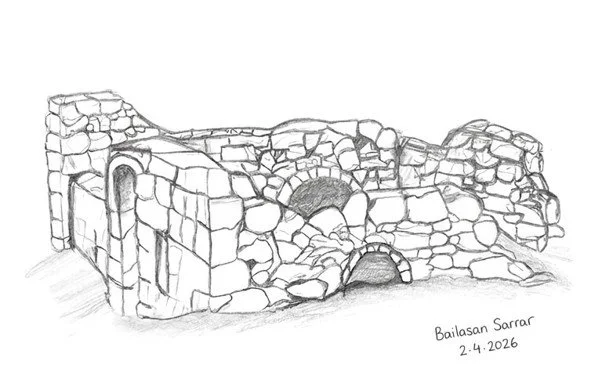
Drawing by the author: an attempt to document one of the stone houses in Gharissa, 2 April 2026.
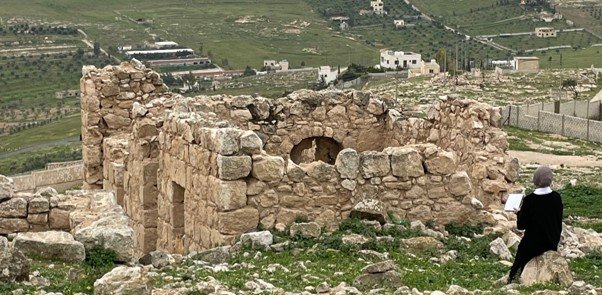
Photograph of the selected historic stone building in Gharissa, Jordan, which is the subject of the author’s drawing.
I also observed signs of recent human activity around the site, including food remains, discarded cans, other waste, and possible traces of open fires. Although these observations do not establish the exact nature or date of the activity, they suggest that the site may be exposed to uncontrolled use and disturbance. Such activity can damage fragile stone structures and increase the risk of fire and further deterioration. Regular monitoring and documentation could help record these changes before they become more serious.
A more advanced example is the documentation project carried out in Gharissa by Alshawabkeh et al. (2011). The researchers combined photogrammetry, laser scanning, and computer vision to record historic buildings. Their work produced two- and three-dimensional records, textured models, and true orthophotos that could support accurate measurements and the monitoring of changes over time.
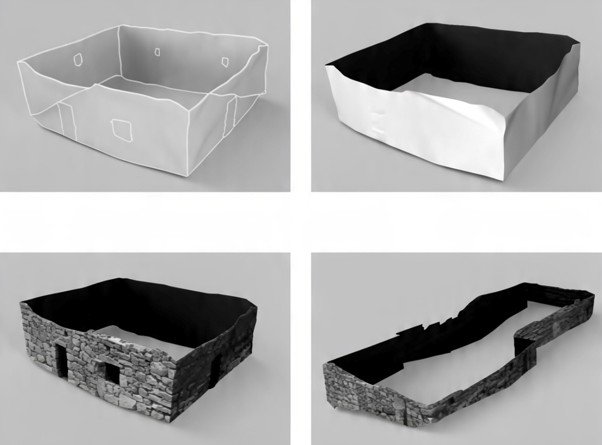
Two- and three-dimensional models and textured representations of historic buildings in Gharissa, Jordan. Source: Alshawabkeh et al. (2011).
Although my drawing is much simpler than these digital records, both approaches reflect the same basic idea: documenting heritage before it is lost. Small documentation efforts can preserve useful information about a building, while more advanced techniques can provide greater detail and accuracy. When combined with photographs, measurements, and future surveys, these records could contribute to a more comprehensive digital record of a heritage site.
This is where the concept of a digital twin becomes relevant. A digital twin is a dynamic digital representation of a real building, object, or site, connected to information that can be updated over time. In heritage conservation, it could bring together photographs, measurements, condition assessments, maintenance records, and new surveys to help specialists understand and monitor a site’s condition. The concept has also been discussed in relation to cultural heritage conservation (Ćosović & Maksimović, 2022).
I propose that digital twins, supported by artificial intelligence and other technologies, should be adopted as part of heritage conservation and emergency planning. They could help specialists assess damage, plan restoration, and monitor changes before and after a disaster. Digital technology could also protect the original while improving the visitor experience. Visitors could explore fragile buildings and objects through digital models or virtual environments without touching or overcrowding the originals.
The digital version cannot replace the cultural meaning of the original, but it can help protect it, explain it, and make it accessible to more people. My drawing was a small attempt to record one building, but it reminded me that every effort to document heritage may become valuable when the original is threatened.
References
Alshawabkeh, Y., Douglas, K., Matarya, M., & Khrisat, B. (2011). Combined photogrammetric techniques and computer vision: 2D–3D recording of Gharissa, Jordan. Journal of Architectural Conservation, 17(2), 77–92.
Ćosović, M., & Maksimović, M. (2022). Application of the digital twin concept in cultural heritage. CEUR Workshop Proceedings, 3266.