For the first time, the International Day for Underwater Cultural Heritage was observed on 21 August 2026. UNESCO proclaimed the day in November 2025 to provide a global platform for raising awareness, encouraging dialogue, and strengthening cooperation in the protection of humanity’s submerged cultural heritage (UNESCO 2025a). The establishment of this day is particularly significant because underwater cultural heritage remains one of the least visible parts of the archaeological record. Unlike much of the cultural heritage found on land, which can be visited, photographed, and experienced directly, underwater heritage remains beyond the reach of most people. Before discussing this challenge, it is important to define underwater cultural heritage. According to UNESCO, it comprises traces of human existence of a cultural, historical, or archaeological character that have been partially or totally underwater, periodically or continuously, for at least 100 years (UNESCO 2001).
Underwater cultural heritage presents a different situation from heritage found on land. Shipwrecks, submerged settlements, ancient harbour structures, aircraft, human remains, cargoes, and other archaeological traces may be preserved beneath seas, rivers, and lakes. Much of this heritage remains hidden beneath the surface. This creates a particular challenge, although underwater environments can preserve archeological remains, they can also make them diffuclt to access, study, and communicate to wider audiences. The condition of surbmerged remains varies according to the environment and the materials involved. However, underwater preservation should not be confused with permanent protection. Underwater cultural heritage is exposed to natural processes, climate change, coastal development, marine infrastructure, looting, and other forms of human activity (UNESCO 2025b). The challenge is not only how to preserve underwater archaeological remains, but also how to make this heritage meaningful to people who cannot experience it directly.
Should We Bring It to the Surface?
The UNESCO 2001 Convention established a different principle. According to Article 2.5,
the preservation of underwater cultural heritage in situ — on the seabed or in its original underwater context — should be considered the first option before intrusive activities are undertaken. Recovery can nevertheless be justified when it makes a significant contribution to the protection or knowledge of underwater cultural heritage“ (UNESCO 2001).
This principle is important because an archaeological site is more than the objects it contains. Its position, spatial relationships, surrounding environment, and archaeological context can all contribute to its interpretation. A shipwreck, for example, is not simply a collection of amphorae, timber, metal objects, or other artefacts. The relationship between these elements and the seabed can provide information about the vessel, its cargo, the circumstances of its sinking, and the historical environment in which it operated. However, preservation in situ therefore creates a particular challenge for public engagement. If the heritage remains underwater, how can people who cannot dive to the site understand what is there? This requires a separate approach.
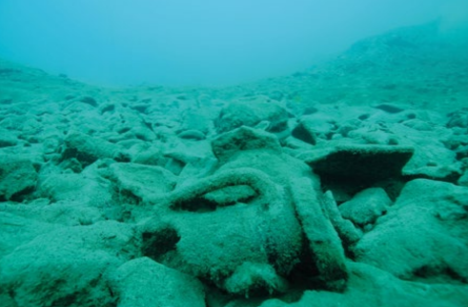
Desilo–Hutovo Blato, first phase of research: amphora fragments at the bottom of the lake.
Photo: I. Miholjek.
From Physical Access to Interpretive Access
A person may not be able to visit an underwater archaeological site physically, but this does not mean that the site must remain intellectually inaccessible. The ICOMOS Charter on the Interpretation and Presentation of Cultural Heritage Sites identifies interpretation and presentation as means of increasing public awareness and understanding of cultural heritage (ICOMOS 2008). This distinction is particularly relevant to underwater archaeology, where depth, environmental conditions, and conservation requirements may limit physical access. Interpretation can take many forms, including exhibitions, publications, lectures, documentaries, educational programmes, guided visits, multimedia presentations, websites and digital applications.
The ICOMOS Charter identifies several of these approaches as potential means of interpretation and presentation, while research on underwater cultural heritage demonstrates how virtual exploration and digital guides can extend access to submerged sites (ICOMOS 2008; Bruno et al. 2019). Other approaches, such as underwater archaeological parks and interactive maps, may also be appropriate depending on the site and the intended audience. The purpose of interpretation is not simply to provide information, but to explain the significance of a site and help people understand its historical and cultural context. The choice of interpretative approach depends on the character of the site, the intended audience, and the available means of presentation. Where physical access is possible, interpretation can complement the visitor experience. Where it is not, interpretive materials can provide an alternative way of engaging with the archaeological evidence.
Practical Examples: Cap del Vol and Cala Cativa
The cases of Cap del Vol and Cala Cativa in Catalonia, Spain, show how underwater archaeological research can be presented to the public. The Centre for Underwater Archaeology of Catalonia investigated the two commercial shipwrecks between 2012 and 2016. Both vessels were associated with the transport of wine in amphorae, providing evidence of maritime trade during the Roman period (Ministerio de Cultura 2017). The findings were presented through the Archaeological Museum of Catalonia, including the 2017 exhibition Navegants d'Aiguamolls. 2000 anys de secrets enfonsats. The exhibition explored ancient navigation, trade, and shipbuilding, and included a large reconstruction of a vessel dating to around 2,000 years ago (Government of Catalonia 2017). At Cap del Vol, parts of the ship's upper structure survived underwater, providing valuable evidence for the study of ancient shipbuilding.
Malta offers a different approach to public access. Since 2019, the country has implemented a regulated system for access to selected historic shipwrecks, intended to promote responsible diving and raise awareness of their cultural and historical significance (Gambin, Sausmekat, and Kovacevic 2021). The Catalan example presents archaeological findings through a museum exhibition, whereas the Maltese approach enables divers to encounter selected archaeological remains in their underwater setting. The distinction lies in whether the public encounters the results of archaeological research through museum interpretation or experiences the remains at the underwater site itself. Malta's approach also includes a virtual access, illustrating how digital presentation can complement physical access for people who do not dive (Gambin et al. 2021).
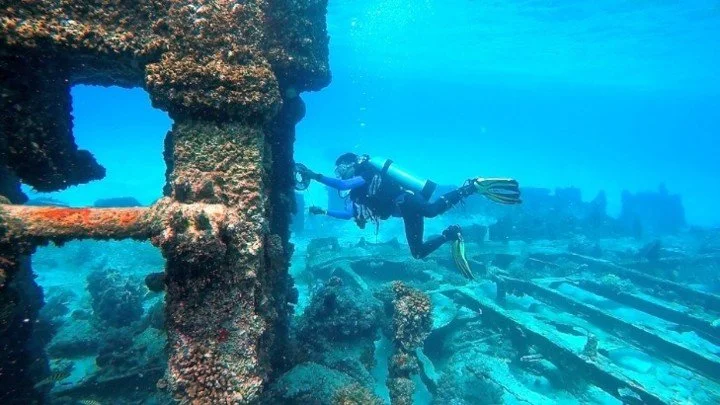
Underwater archaeological investigation of a shipwreck engine. Photo: Dwi Sumaiyyah Makmur.
Digital Technologies as Interpretive Tools
Digital technologies offer new ways to communicate archaeological information about sites that cannot easily be visited. Their potential has been demonstrated in underwater archaeology. The VISAS project, for example, developed digital applications for the Roman shipwreck site of Cala Minnola in Italy, including a virtual diving system and an underwater multimedia guide for divers (Bruno et al. 2019). The Underwater Malta project provides another example of how a virtual museum can present submerged cultural heritage to wider audiences (Gambin et. al. 2021). More broadly, photogrammetry and three-dimensional modelling can communicate the structure and spatial arrangement of a wreck, while geographic information systems (GIS) can place archaeological remains within their wider geographical and historical landscape.
Despite these applications, technology should not become an objective in itself. A three-dimensional model may be visually impressive, but it does not automatically constitute interpretation. Interpretation begins with questions about significance, context, audience, and meaning. Technology should serve interpretation by helping audiences engage with the evidence and understand its significance. This is especially important because digital representations can create an impression of completeness. A virtual reconstruction may appear precise even when the archaeological evidence is incomplete. Good interpretation therefore needs to distinguish between documented evidence, archaeological interpretation, and hypothetical reconstruction.
A Heritage for the Future
The challenge of underwater cultural heritage is not simply to make submerged sites visible, but to communicate their significance without compromising the archaeological evidence. Digital models, exhibitions, and regulated diving can all contribute, but their value depends on how well they explain the site, its context, and the limits of what is known. Interpretation should therefore be considered alongside archaeological research and conservation, rather than as an activity added only after the research is complete.
Recent approaches to underwater cultural heritage emphasise the relationship between preservation, responsible access, education, and public engagement (Gambin, Sausmekat, and Kovacevic 2021; Suárez Meana 2025). UNESCO’s work also highlights connections between underwater sites, cultural landscapes, local communities, and living traditions (UNESCO 2026). The first International Day for Underwater Cultural Heritage provides an opportunity to reflect on how these connections can be communicated to the public. Ultimately, the challenge is to make underwater heritage more understandable while respecting the archaeological evidence and ensuring its long-term protection. The future of underwater cultural heritage may therefore depend partly on our ability to make hidden heritage understandable without making it vulnerable.
References
Bruno, Fabio, Loris Barbieri, Maurizio Muzzupappa, Sebastiano Tusa, Alessandro Fresina, Francesco Oliveri, Antonio Lagudi, Alessandro Cozza, and Raffaele Peluso. 2019. “Enhancing Learning and Access to Underwater Cultural Heritage through Digital Technologies: The Case Study of the ‘Cala Minnola’ Shipwreck Site.” Digital Applications in Archaeology and Cultural Heritage 13: e00103. https://doi.org/10.1016/j.daach.2019.e00103.
Gambin, Timmy, Maja Sausmekat, and Darko Kovacevic. 2021. “The Innovative and State of the Art Public Access Management of Malta’s Underwater Cultural Heritage.” Heritage 4 (4): 3365–3381. https://doi.org/10.3390/heritage4040187.
Gambin, Timmy, Kari Hyttinen, Maja Sausmekat, and John Wood. 2021b. “Making the Invisible Visible: Underwater Malta—A Virtual Museum for Submerged Cultural Heritage.” Remote Sensing 13 (8): 1558. https://doi.org/10.3390/rs13081558.
Government of Catalonia. 2017. “La navegación de hace 2000 años a través de la arqueología subacuática.” Patrimoni Cultural, April 6, 2017. https://patrimoni.gencat.cat/es/articulo/la-navegacion-de-hace-2000-anos-traves-de-la-arqueologia-subacuatica.
ICOMOS. 2008. The ICOMOS Charter on the Interpretation and Presentation of Cultural Heritage Sites. Ratified October 4, 2008. https://www.icomos.org/images/DOCUMENTS/Charters/interpretation_e_1.pdf.
Ministerio de Cultura. 2017. “Investigación arqueológica en los pecios Cala Cativa I y Cap de Vol (Cataluña).” Registro de Buenas Prácticas del Patrimonio Cultural Subacuático. https://www.cultura.gob.es/cultura/areas/patrimonio/mc/patrimonio-subacuatico/registro-buenas-practicas/espana/pecios-cala-cativa-y-cap-de-vol.html.
Suárez Meana, Alberto. 2025. “Arqueología subacuática y acceso público: equilibrio entre preservación y divulgación.” PH 115. https://doi.org/10.33349/2025.115.5863.
UNESCO. 2001. Convention on the Protection of the Underwater Cultural Heritage. Adopted November 2, 2001. https://www.unesco.org/en/legal-affairs/convention-protection-underwater-cultural-heritage.
UNESCO. 2025a. “International Day for Underwater Cultural Heritage.” In Records of the General Conference, 43rd Session, Paris, 30 October–13 November 2025. Volume 1: Resolutions, Resolution 39. Paris: UNESCO. https://unesdoc.unesco.org/in/documentViewer.xhtml?ark=%2F48223%2Fpf0000396877%2FPDF%2F396877eng.pdf.multi.
UNESCO. 2025b. “Threats to the Underwater Cultural Heritage.” Last updated September 26, 2025. https://www.unesco.org/en/underwater-heritage/threats.
UNESCO. 2026. “Heritage Experts Explore Synergies between Underwater Sites and Living Traditions.” July 29, 2026. https://www.unesco.org/en/articles/heritage-experts-explore-synergies-between-underwater-sites-and-living-traditions.