The theft at the Louvre last October seemed to demonstrate that even the world’s most prestigious museums are vulnerable. It also appeared to be followed by a string of what might almost be described as Arsène Lupin-style heists, with a series of high-profile cases over the past year putting Europe’s artistic heritage under pressure. The latest major thefts once more took place in France. Thieves took four paintings from the Renoir Museum in Cagnes-sur-Mer, close to Nice, and, more recently, Dalí's illustrated The Apocalypse from Issoire. They add to a recent run of high-profile thefts, including those in Messina and Vienna.
Museum theft is, of course, nothing new. It has existed for as long as museums themselves, fuelled by an illicit market in which artworks and artefacts can be resold to private collectors or fed into international trafficking networks for cultural property. “It has always happened. It always will happen,” art theft investigator Anthony Amore told TIME (2026). However, he argues that it is “hard to deny” that recently there has been an uptick in major art thefts from museums across Europe. “In terms of big-name artists who are targeted,” he continued, “the number of heists, successful heists, that have happened, is without question spiking over the last 11 months.”
What appears to be changing, however, is not simply the number of thefts but the way they are being carried out. Several experts interviewed by international media have pointed to a shift towards increasingly brazen methods, carried out by more improvised and less organised criminal groups. Europol’s 2026 spotlight report, Changing Tactics, Changing Targets: The Evolving Nature of Museum Heists, describes this switch, which risks having long term consequences not only on cultural heritage, but also on the way museums are perceived and visitors’ experiences.

The theft of Dalí's bejewelled cover for The Apocalypse of St. John is the most recent in a series of heists that have rocked Europe over the past few years. Source: AFP, 2026.
Did the Louvre change the game?
One possible explanation for the apparent increase is that successful robberies can encourage other criminals to attempt similar operations. “My educated opinion is that I think the Louvre heist might have captured the imagination of thieves,” said Amore. Nick O’Donnell, a lawyer specialising in art and cultural property law, similarly argues that the Louvre robbery may have shown prospective criminals that the tactics used there could easily be replicated elsewhere: if four thieves could break into the world's most visited museum, the same methods could be used even more easily with smaller, less prominent institutions. “It has given fuel to the perception that there are many museums where security may not be as tight as people think it is,” O’Donnell says. “It seems to me that once that perception gets going for the would-be thieves, it's very hard to contain” (Schneid 2026).
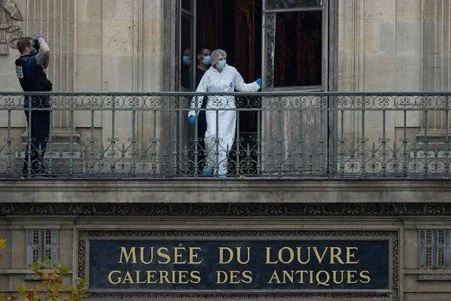
French police secure the Louvre following the daylight robbery of the crown jewels, worth €88 million. Source: Walker and Hassan, 2025.
It is difficult to establish a direct connection between the Louvre robbery and subsequent crimes without evidence from individual investigations. But the perception of vulnerability may itself be significant. A successful heist demonstrates not only that a particular museum can be breached, but also that the operation can be carried out quickly and in full view of the public. In this sense, every successful robbery becomes an unintended demonstration of what is possible.
A new type of museum thief
The apparent copycat effect, however, does not fully explain the current phenomenon. Europol’s report (2026) points to a broader transformation in the profile of the people carrying out museum thefts. Rather than relying exclusively on established art trafficking networks, criminals are increasingly operating through loosely organised groups recruited through social media and messaging platforms. The result is a model of crime that can be assembled around a particular opportunity rather than sustained by a permanent, specialised organisation.
This represents an important change from the traditional image of the art thief. Stealing a major artwork once required considerable knowledge of the cultural property market: criminals needed to understand what they were stealing, who might buy it, and how it could be moved without attracting attention. Some recent cases instead suggest a more opportunistic approach, in which criminals identify a vulnerable institution and organise a rapid operation around it.
Moreover, violent methods are becoming more common, and recent robberies illustrate this shift. Explosives have been used to break through museum entrances, while some thieves have entered buildings apparently carrying firearms to intimidate the museum’ staff. At Vienna’s Museum of Applied Arts, for example, two men reportedly entered as ordinary visitors before stealing a diamond necklace. They are believed to have avoided immediate intervention because they appeared to be carrying a gun (Bell 2026).
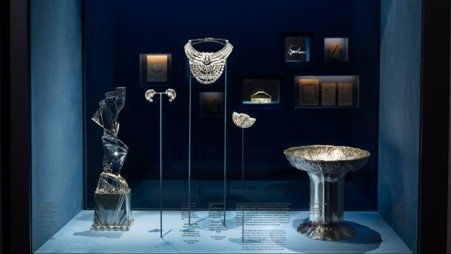
The necklace was on show at the Museum of Applied Arts in Vienna as part of "Glanzstücke," an exhibition of jewellery lent by Van Cleef & Arpels. Source: Holland, 2026.
What do thieves actually want?
There is another important change taking place: criminals may not always be targeting the objects that museums consider most culturally important. Europol identifies growing interest in jewellery and objects made from gold and other precious metals. Their attractiveness lies not only in their value but also in their portability and their ability to be dismantled, melted down or stripped of their gemstones, making them more difficult to identify and potentially easier to sell. This creates an important distinction between cultural value and criminal value. A famous painting may be worth millions but be extremely difficult to sell after being stolen. Its recognisability becomes a liability: dealers, collectors, and auction houses can easily identify it, while its provenance immediately raises questions. Gold and jewellery are different. Once removed from their original context, their material value can remain high even when their cultural identity disappears. The same logic can apply to less famous decorative objects. Chinese porcelain and other artefacts may attract less attention than celebrated masterpieces while still having substantial value on the international market. Understanding this distinction matters for deciding which artefacts to protect first: the objects most precious to a museum are not necessarily the ones most useful to a criminal (Europol 2026).
The inherent vulnerability of museums
The changing profile of criminals matters considering the specific nature of places like museums as targets. They contain objects of enormous value but are also fundamentally public institutions. Their doors are meant to be open, their collections accessible and their buildings welcoming. Many museums also occupy historic structures that were never designed with modern security requirements in mind. This creates an inherent tension between accessibility and protection. Moreover, the problem is not necessarily a lack of sophisticated technology. In many cases, the technology already exists. The problem is whether museums have enough people and resources to make that technology effective.
The Louvre robbery exposed this weakness. Despite its extensive network of surveillance cameras, the control room reportedly lacked enough screens to monitor all feeds simultaneously, meaning that footage of the thieves entering the museum was not immediately visible to security personnel. Sophisticated surveillance is therefore of limited use if nobody can respond to what it records (Feldman 2025).
The attention naturally gravitates towards the Louvre, but smaller institutions are even more exposed to this kind of threat: the Museo Regionale in Messina, Italy, is not the Louvre; the Musée Renoir in Cagnes-sur-Mer is not the Louvre. Smaller institutions may lack the enormous security infrastructure, staffing levels and financial resources available to Europe's largest national museums, while still holding objects of exceptional cultural significance. Some of these cases have highlighted much simpler vulnerabilities. At the museum in Messina, where some Antonello da Messina’s artworks were stolen, authorities were alerted only after a passerby noticed two panels abandoned in the street (Thorsberg 2026). Physical infrastructure can be equally important: thin windows, glass entrances, and poorly protected access points can provide criminals with opportunities that require little specialist knowledge. This makes response time crucial. Stronger windows, additional barriers, and other measures that slow intruders down may be less spectacular than sophisticated surveillance systems, but even a few additional minutes can give security staff or police time to intervene .
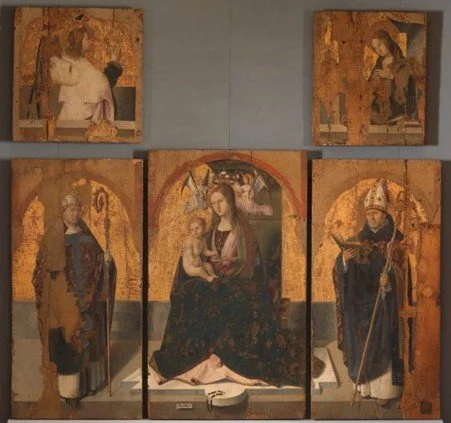
The Polittico di San Gregorio by Antonello da Messina. Thieves took three of its five surviving panels. Source: Tondo, 2026.
The impact on visitor experience
“Every museum in the world is stressing right now" said a museum security expert to BBC (2026). More guards, reinforced windows, barriers, restricted access, and advanced surveillance may help protect collections. But museums are neither banks nor military sites: their purpose is to open cultural heritage to the public. According to Jean-Yves Goriou, head of the EU Organised Crime Unit at Europol, "museums are most likely doing what they can, given budget constraints and the fact that they are - by design - open to the public,". This creates a fundamental challenge: the more vulnerable museums become, the greater the pressure to tighten security; yet too much security can make them less open and less welcoming.
"In observational research, we consistently see that visitors engage more deeply when they can approach an object, examine its detail and see it from different angles," Guy Turton, director of global audience strategy agency MHM, says. "Greater distance and more prominent barriers can weaken that connection, particularly if they make the experience feel remote or institutional." Some of those protections are already standard practice. Under the UK's Government Indemnity Scheme, for example, portable valuables such as gold, silver, and jewellery should be kept in locked, alarmed cases, certain objects must be kept at least one metre from visitors, and a gallery without enough staff to supervise indemnified works can be closed. None of this automatically worsens the visit. Guy Turton added "If security creates greater physical distance, museums need to work harder through interpretation, transparency and experience design to preserve the sense of connection." Turton points to the Rijksmuseum case with Rembrandt's The Night Watch: while the painting sits behind thick glass, visitors can observe the live restoration work that is normally hidden, turning the barrier into part of a unique experience.
Some museums are turning to replicas, avoiding displaying the original artworks for increased security. According to Turton, however, authenticity is still a strong pull for visitors. As he recognises, seeing the original piece can create "the feeling that another human made, used or encountered the same object, sometimes centuries ago," a connection he says can influence how many people are willing to visit and pay an entrance fee. However, visitors may be still willing to engage with replicas if they understand the security reasons behind this choice: this is what suggests Ellie King, who leads the museum consultancy Crown Cultures and specialises in visitor experience, and she added "for visitors, it may be the story that an object presents which is more important - especially if that story feels highly relevant and connected to the visitor" (Berg 2026).
The problem of money
These vulnerabilities are closely connected to a broader question: how much can museums realistically spend on security?
Museums have to divide limited resources among conservation, exhibitions, research, education, digitalisation, and public access. Security is only one of many competing priorities, yet a single successful theft can result in enormous cultural and financial losses. Financial pressure may therefore contribute to institutional vulnerability, although it would be misleading to assume that recent budget cuts directly caused individual museum robberies. There is no clear evidence that the reductions in French cultural funding directly affected the institutions subsequently targeted.
Nevertheless, the wider context is significant. In France, the national culture budget was cut by €150 million in 2025, and the amount allocated to national heritage projects (covering museums, monuments, archaeology and archives) was reduced of €200 million (Audureau 2025). Security has subsequently become an increasingly visible concern for French cultural institutions, and in July 2026 the government announced a €30 million fund specifically aimed at strengthening museum security (Schneid 2026).
The issue is therefore not simply whether museums need more security, but whether cultural institutions can maintain adequate protection while continuing to finance the many other functions expected of them.
The new challenges of the future
A period of transformation lies ahead for European museums, and for cultural institutions well beyond Europe. The recent wave of robberies will push museums to strengthen their security, but they will have to do so without spoiling the experience of those who come to see their collections. The change is already under way. Governments are setting up dedicated security funds, institutions are rethinking what they put on show, and some are placing replicas in the galleries to keep their most precious originals out of harm's way. Such measures may make collections safer, but they also alter what museums offer to the public.
The task ahead is therefore threefold. Museums must invest in the essentials that recent cases have shown to be decisive, such as enough staff, more resistant windows and glasses, and faster responses. Moreover, they must be inventive in how protection appears to visitors, so that a barrier or a replica is explained and, where possible, becomes part of the visit itself, as the Rijksmuseum has done with The Night Watch. And they cannot act alone. Shared audits and closer cooperation between museums, police and bodies such as Europol, Interpol and ICOM will matter as much as any lock or camera, especially for smaller museums that hold exceptional objects but have the fewest resources. The museums that adapt best will be those that treat security as a shared responsibility and openness as something worth protecting, so that they keep both their collections and their public.
References
AFP. “Salvador Dali-designed ‘Book of the Apocalypse’ stolen in France.” Daily Sabah, October 6, 2026. https://www.dailysabah.com/arts/salvador-dali-designed-book-of-the-apocalypse-stolen-in-france/news.
Audureau, William, Aude Dassonville, Iris Derœux, Maxime Ferrer, Assma Maad, Manon Romain, and Maxime Vaudano. “What's in the French state's 2025 budget.” Le Monde, February 7, 2025. https://www.lemonde.fr/en/les-decodeurs/article/2025/02/07/what-s-in-the-french-state-s-2025-budget_6737882_8.html.
Bell, Bethany. "Thieves steal 600-diamond necklace from Vienna museum in broad daylight." BBC News, August 28, 2026. https://www.bbc.com/news/articles/cqxvwpe0plro.
Berg, Bailey. “Every museum in the world is stressing': How brazen art heists are affecting visitors”. BBC News, October 1, 2026. https://www.bbc.com/travel/article/20260930-what-the-rise-in-museum-heists-means-for-visitors.
Europol. “Changing Tactics, Changing Targets: The Evolving Nature of Museum Heists.” August 24, 2026. https://www.europol.europa.eu/cms/sites/default/files/documents/Changing-targets-changing-tactics-museum-heists-report.pdf.
Feldman, Ella. "Louvre Robbers Escaped with Less than a Minute to Spare Due to Major Security Fumbles." Smithsonian Magazine, December 16, 2025. https://www.smithsonianmag.com/smart-news/louvre-robbers-escaped-with-less-than-a-minute-to-spare-due-to-major-security-fumbles-180987870/.
Holland, Oscar. “Thieves steal $4 million diamond necklace in brazen smash-and-grab heist”. CCN News, August 31, 2026. https://edition.cnn.com/2026/08/31/style/vienna-jewelry-heist-diamond-mak-hnk-intl.
Schneid, Rebecca. "Yes, There Has Been an Uptick in High-Profile Art Heists. Here's Why." TIME, September 8, 2026. https://time.com/article/2026/09/08/-we-are-under-siege-renoir-heist-joins-an-art-thievery-trend/.
Thorsberg, Christian. "As Sicilians Flocked to a Religious Festival, Thieves Broke into a Nearby Museum and Stole Four Renaissance Paintings." Smithsonian Magazine, August 17, 2026. https://www.smithsonianmag.com/smart-news/as-sicilians-flocked-to-religious-festival-thieves-broke-into-nearby-museum-stole-four-renaissance-paintings-180989352/.
Tondo, Lorenzo. “Renaissance paintings by Antonello da Messina stolen from Sicilian museum”. The Guardian, August 16, 2026. https://www.theguardian.com/artanddesign/2026/aug/16/antonello-da-messina-renaissance-paintings-stolen-sicilian-museum-holiday.
Walker, Mark and Hassan, Adeel. “Other Brazen Art Heists Like the Louvre Jewelry Theft”. The New York Times, October 20, 2025. https://www.nytimes.com/2025/10/20/us/art-museum-heists-louvre.html.