Where Pharaohs Meet the Future: The Grand Egyptian Museum is Finally Here
These are important months for Egyptian culture. On November 1, 2025, the Grand Egyptian Museum (GEM) in Cairo will host its Grand Opening, attended by international leaders and distinguished guests, before opening to the public on November 4.
Located near the iconic Pyramids of Giza, the GEM will showcase over 100,000 artifacts, including the complete Tutankhamun collection, offering a comprehensive view of ancient Egyptian civilization. Beyond its vast collection, the Grand Egyptian Museum is a state-of-the-art hub for scientific research and heritage preservation, showcasing cutting-edge technologies that protect, study, and bring ancient Egyptian civilization to life for the modern world. The opening is both an archaeological milestone and a powerful symbol of Egypt’s cultural diplomacy and national identity.
The timing is even more significant considering the recent appointment of Khaled El-Enany, former Minister of Tourism and Antiquities, as Director-General of UNESCO on October 6, 2025. He is the first Egyptian and the first Arab to hold this position, reflecting Egypt’s growing influence in international cultural leadership and its commitment to preserving and promoting its rich heritage on the global stage.
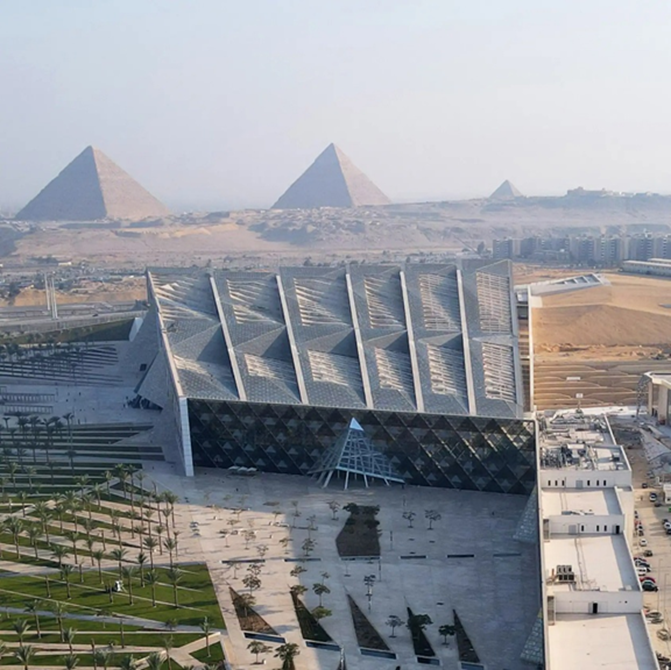
The Grand Egyptian Museum (foreground) and the Pyramids of Giza (background). Source: arabmls.org
Building the “Fourth Pyramid”
The Grand Egyptian Museum[1] has been over thirty years in the making. Plans began in 1992, with the foundation stone laid about ten years later by President Hosni Mubarak. Construction was delayed by various political upheavals, including the 2011 Arab Spring, funding challenges, and a collapse in tourism, while the COVID-19 pandemic and regional instability caused further setbacks.
While parts of the museum were occasionally opened to small groups during limited previews, the official inauguration was postponed several times. In June 2025, the Egyptian government announced that the opening, which had been scheduled for July 3, would be moved to the final quarter of the year due to regional tensions. For perspective, the construction of the Great Pyramid of Giza is estimated to have taken between fifteen and thirty years, and the Grand Egyptian Museum has now been under development for twenty-three years. Undoubtedly, a monumental work.
The GEM will be the largest museum in the world dedicated to a single civilization, spanning around five hundred thousand square meters with exhibition halls, conservation labs, research facilities, shops, and restaurants (National Geographic 2025; GEM 2025).
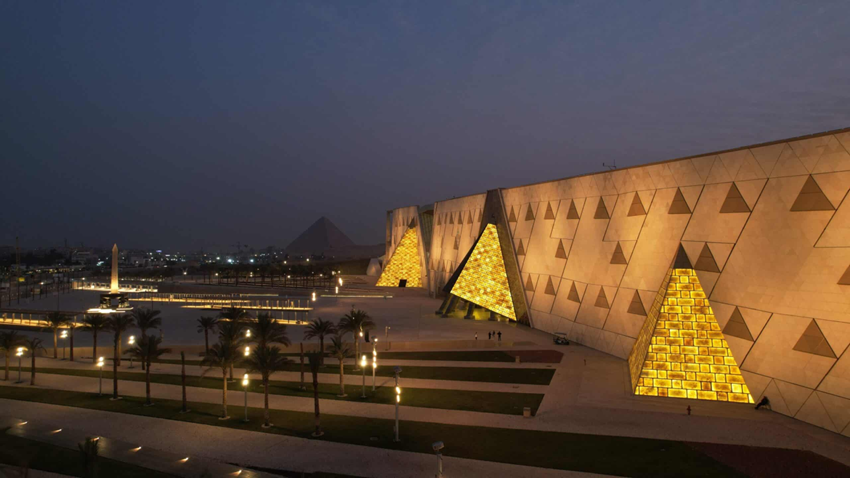
The Grand Egyptian Museum. Source: arabmls.org
What the Museum Will Display
The museum promises an unparalleled journey through more than five thousand years of Egyptian history, presenting over one hundred thousand artifacts that collectively tell the story of one of the world’s most influential civilizations. The cornerstone will be the complete Tutankhamun collection, with more than five thousand objects from the young pharaoh’s tomb displayed together for the first time since their discovery by Howard Carter in 1922. Visitors will see the iconic golden funerary mask, intricate jewellery, chariots, weapons, and ceremonial furnishings, all carefully conserved and presented using state-of-the-art museum techniques.
Beyond Tutankhamun, the museum will showcase masterpieces such as the colossal statue of Ramses II, sculptures of Hatshepsut and Amenhotep III, and artifacts spanning the Old, Middle, and New Kingdoms through to the Greco-Roman period, all arranged in twelve galleries centred on three themes: society, kingship, and belief (National Geographic 2025; Artnet 2025).
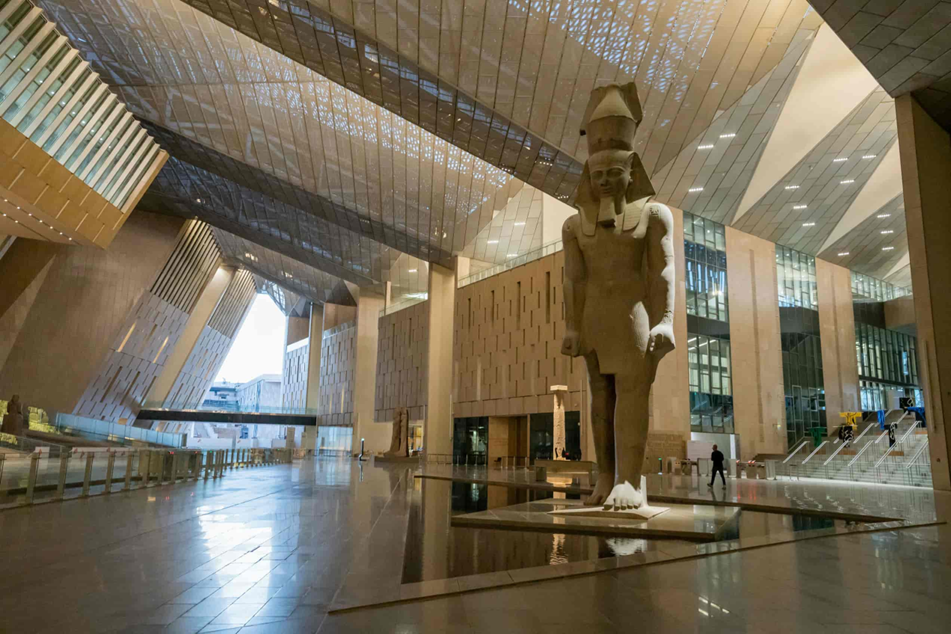
At the centre of the Grand Hall, the statue of Ramesses II is displayed. Source: experienceegypt.eg
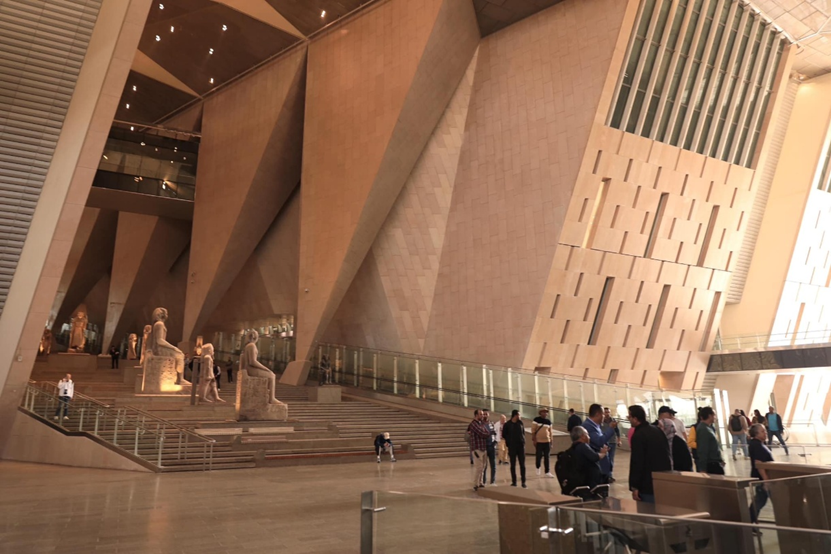
The Grand Staircase. Source: archaeologicalpaths.com
Blending Heritage and Innovation: The GEM as a Global Hub of Conservation and Technology
The GEM is at the forefront of heritage conservation and archaeology in the Middle East, incorporating technologies that preserve and interpret Egypt’s ancient legacy. The structure of the museum, designed by the Irish firm Heneghan Peng Architects[2] and named one of the 2024 Laureates of the prestigious Prix Versailles, features advanced environmental control systems, seismic protection, and carefully calibrated lighting to protect delicate artifacts. The Conservation Centre, among the biggest in the world, uses tools such as three-dimensional scanning, infrared spectroscopy, multispectral imaging, and X-ray fluorescence to analyse and restore objects with unprecedented precision (Goppion 2025; Johnson 2025; GEM 2025).
Digital photogrammetry and laser mapping have been extensively used, allowing careful documentation, monitoring, and reconstruction. The museum also employs Building Information Modelling (BIM) and advanced predictive maintenance systems to ensure the long-term preservation of its collections. Beyond conservation, immersive virtual and augmented reality installations allow visitors to experience temples and tombs as they would have appeared thousands of years ago. In this way, the GEM blends ancient heritage with digital innovation, positioning itself as a global hub for both cultural preservation and technological advancement (Autodesk 2022; Mohammed and Metwaly 2024; Ali et al. 2024).
Reclaiming Heritage, Projecting Influence
The museum is also a powerful symbol of Egyptian identity and pride. By celebrating Egypt’s past, the GEM strengthens the connection between modern Egyptians and their historical roots. Its proximity to the Pyramids makes it both a national emblem and a site of international recognition. Displaying the full Tutankhamun collection allows Egypt to tell its own story and assert its custodianship over its cultural heritage.
The Grand Opening is expected to bring together heads of state, ambassadors, and cultural leaders, demonstrating Egypt’s ambition to be a hub for international cultural activity. The GEM is central to Egypt’s strategy of using culture as a form of soft power, promoting heritage to enhance the country’s global image, foster partnerships, and attract tourism. The museum is expected to stimulate economic growth, create jobs, support urban development around Cairo and Giza, and attract infrastructure investment, showing that cultural promotion can advance identity, diplomacy, and economic development simultaneously (Ibrahim 2025).
The museum’s opening coincides with a historic moment for Egyptian cultural leadership. Khaled El-Enany, former Minister of Tourism and Antiquities, was appointed Director-General of UNESCO on October 6, 2025, becoming the first Egyptian and Arab to hold the position. Known for modernizing heritage sites and promoting cultural tourism, El-Enany has expressed his intention to use UNESCO as a platform for education, science, and human rights through culture. His leadership underscores Egypt’s aspiration to shape global cultural policy while elevating its own heritage narrative (UNESCO 2025).
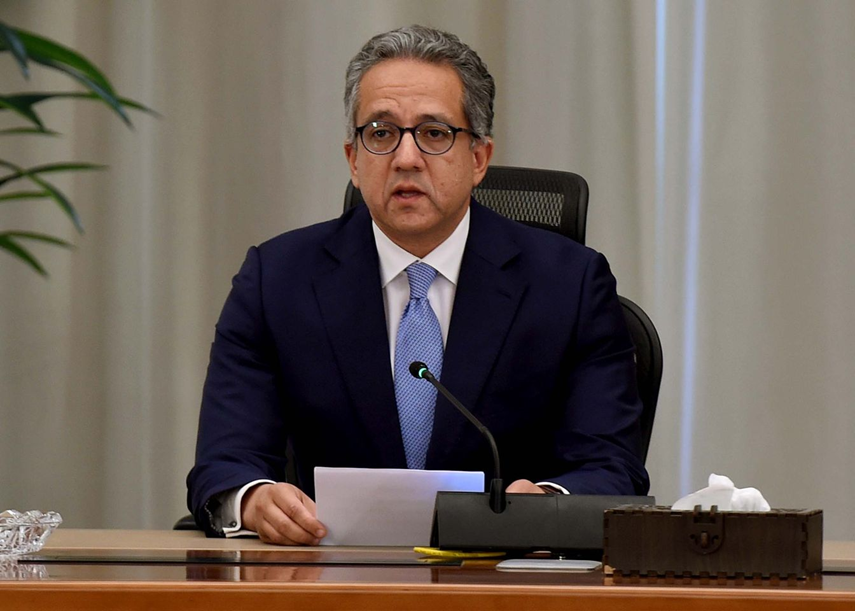
The former Egyptian Minister of Tourism and Antiquities, Khaled El-Enany, has been appointed as the next Director-General of UNESCO, prevailing over Firmin Edouard Matoko from the Democratic Republic of the Congo and Gabriela Ramos from Mexico. Source: wbnmedia.com
The opening of the Grand Egyptian Museum is more than a cultural milestone: it marks Egypt’s re-emergence as a global centre of heritage, research, and innovation. By celebrating its ancient past, the country redefines its present and projects its future, transforming memory into a living force of creativity and discovery. The GEM not only preserves millennia of history but also advances cutting-edge technologies in conservation, digital documentation, and museum experience. It embodies both national pride and international dialogue, demonstrating that history can serve as a bridge rather than a boundary: a monument to memory and a laboratory for humanity’s shared future.
References
Ali, Nancy, Ayman El-Sayed, and Amr Abdel Nasser. 2024. “Digital Transformation at the Grand Egyptian Museum.” Cybrarians Journal, no. 73 (December): 216–33. https://doi.org/10.70000/cj.2024.73.625.
Arab MLS. 2025. “Grand Egyptian Museum.” https://arabmls.org/grand-egyptian-museum/.
Goppion. 2025. Grand Egyptian Museum Opens November 1st.https://www.goppion.com/journal/grand-egyptian-museum-opens.
Grand Egyptian Museum Official Website. n.d. https://gem.eg/?fbclid=IwY2xjawNd401leHRuA2FlbQIxMABicmlkETFKak9NVWlrNGEyckVSQUM1AR6HHLnmdgHTkdJS7eyGZ6Qx9m58blgffYdoSUM4ja6INHbj9AADluc-RtRqrA_aem_YSuHMCWnK9WSddCDG2RzTA.
Ibrahim, Vivian. 2025. “Constructing the Grand Egyptian Museum: Heritage, Tourism, and Urban Transformation.” The Journal of North African Studies 30 (4): 547–56. https://doi.org/10.1080/13629387.2025.2498269.
Johnson, Frank. 2025. “Grand Egyptian Museum Architects: Unpacking the Vision and Design of a Global Icon.” Wonderful Museums, August 16. https://www.wonderfulmuseums.com/museum/grand-egyptian-museum-architects-4.
Lawson-Tancred, Jo. 2025. “What Ancient Treasures Does the Grand Egyptian Museum Hold? Here’s a Sneak Peek.” Artnet, March 17. https://news.artnet.com/art-world/what-ancient-treasures-does-the-grand-egyptian-museum-hold-heres-a-sneak-peek-2620471.
Link, Jeff. 2022. “The Grand Egyptian Museum, Where History Meets 21st-Century Software Modelling.” Autodesk, November 21. https://www.autodesk.com/design-make/articles/grand-egyptian-museum.
Mohammed, Said Nasser, and Heba Khairy Metwaly. 2024. “Digitization and the Collection Sustainability: Report on the Grand Egyptian Museum Project, Egypt.” Studies in Digital Heritage 7 (2): 161–74. https://doi.org/10.14434/sdh.v7i2.36417.
National Geographic. 2025. “The Grand Egyptian Museum: Egypt’s Monumental Cultural Project.” https://www.nationalgeographic.com.
UNESCO. 2025. “Khaled El-Enany Appointed Director-General of UNESCO.” Paris:
UNESCO. https://www.unesco.org/en/articles/khaled-el-enany-unesco-director-general.
Notes
[1] GEM Official Website: https://gem.eg/?fbclid=IwY2xjawNd401leHRuA2FlbQIxMABicmlkETFKak9NVWlrNGEyckVSQUM1AR6HHLnmdgHTkdJS7eyGZ6Qx9m58blgffYdoSUM4ja6INHbj9AADluc-RtRqrA_aem_YSuHMCWnK9WSddCDG2RzTA
[2] Heneghan Peng Architects Official Website: heneghan peng architects