In Times of Uncertainty, Iran Looks Back: Rediscovering Ancient Persia to Navigate Modern Crises
On the evening of November 7, 2025, a crowd gathered in central Tehran to witness the unveiling of a new statue: Shapur I, depicted in the act of defeating the Roman Emperor Valerian. The scene was visually striking, but its significance ran deeper. Iran has long maintained an uneasy relationship with its pre-Islamic past, oscillating between pride and ideological caution. Yet recently, and especially after the so-called “Twelve Day War” with Israel, ancient Persia has returned to the forefront of public discourse with renewed prominence.
However, behind the appearance of cultural celebration lies a clear political message. Confronted with internal pressures and external challenges, the Islamic Republic has increasingly turned to pre-Islamic imagery to reinforce national identity and craft new narratives of legitimacy. The Shapur I statue offers a clear example of how historical symbols can be repurposed by a state seeking to project strength and continuity.
Nationalism’s Dilemma in the Islamic Republic
For much of the Islamic Republic’s history, ancient Persian identity was treated with suspicion. Ayatollah Khomeini repeatedly described nationalism as a “poison,” a distraction from Islam’s universal mission. In his view, pre-Islamic history might have cultural value, but it was politically unsafe. Khomeini once declared unequivocally: “Islam has come to eliminate these nonsensical ideas. Nationalist people are of no use to us; Muslim people are. Islam is opposed to nationalism. Nationalism means we want the nation, and we do not want Islam.” For decades, this doctrine shaped education, media, and cultural policy. Iran was meant to champion a universal Islamic revolution, not revisit the triumphs of ancient kings. This contrasted starkly with the example set during the pre-1979 Pahlavi period, in which references to the ancient past were used to construct a narrative of unbroken Persian greatness stretching 2,500 years (Steele 2020, 2021). Assuming power in 1989, Ayatollah Ali Khamenei maintained a contrary stance for decades, portraying ancient dynasties as eras defined by corruption and monarchy rather than sources of national pride. But political circumstances have a way of reshaping ideological boundaries (Özkan, 2025; ITF 2025; Samiei & Shao-Quian 2020).
In the days following the 12-day Iran-Israel conflict (13 June – 24 June 2025), Khamenei’s tone shifted notably. He praised Iran’s ancient civilization and insisted that the country possessed “cultural and civilizational wealth greater than that of America.” After years of sanctions, domestic unrest, economic strain, and now the shock of war, invoking ancient Persia provides the government with a unifying narrative: Iran has endured hardship before, and it will endure again. Yet today, the tone is evolving, marking a shift that sits uneasily with the Islamic Republic’s founding principles (Alinejad 2025; Torbati 2025).
“You Will Kneel Before Iran Again”
At the center of this renewed nationalist narrative stood a campaign titled “You Will Kneel Before Iran Again,” which culminated in the unveiling of a monumental replica of the Naqsh-e Rostam relief depicting Shapur I’s capture of Emperor Valerian. In 260 CE, Valerian became the only Roman emperor ever taken alive, a moment that marked the zenith of Sasanian power and a lasting humiliation for Rome. In the current political climate, the message is clear: once again, Iran presents itself as a nation that has overcome world powers before and can do so again (ISNA 2025). Unveiling a statue of Shapur I in Tehran’s Revolution (Enghelab) square was a highly symbolical choice. The government could have highlighted more conciliatory figures, such as Cyrus the Great, known internationally for tolerance and enlightened rule. Instead, it chose a warrior king whose triumph over a Roman emperor can be interpreted as a symbolic victory over the West. This reflects the image the leadership wishes to project: a nation that is resilient, self-confident, and unshaken in the face of external pressure. Municipal official Davood Goodarzi announced that the installation would be supplemented by visual displays illustrating “other victories of Iranians over foreign aggressors,” and that it would eventually be relocated to a city gateway, “where it will stand as the first emblem of Iran before diplomats and foreign visitors” (Sinaiee 2025).
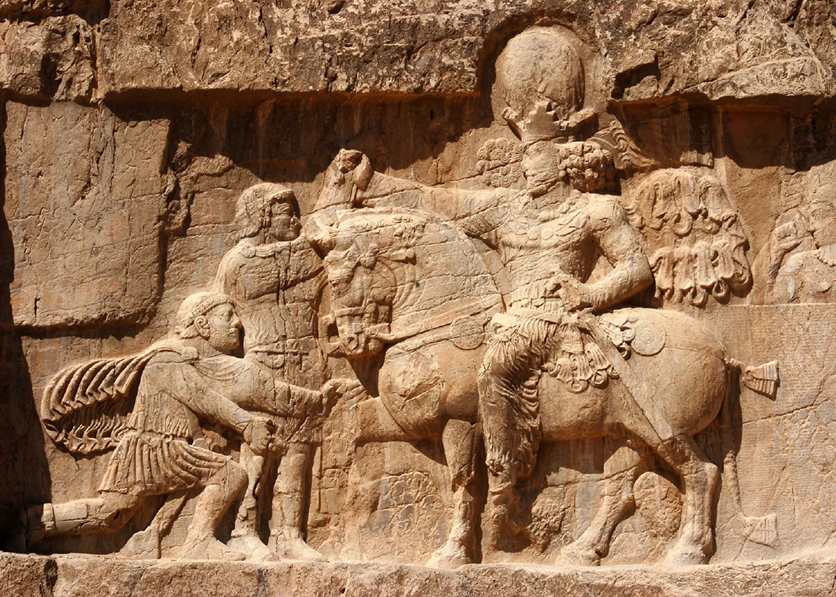
The surrender of the emperor Valerian to the Persian king Shāpūr I, rock relief, 260 CE; in the province of Fārs, Iran. Source: Britannica.com
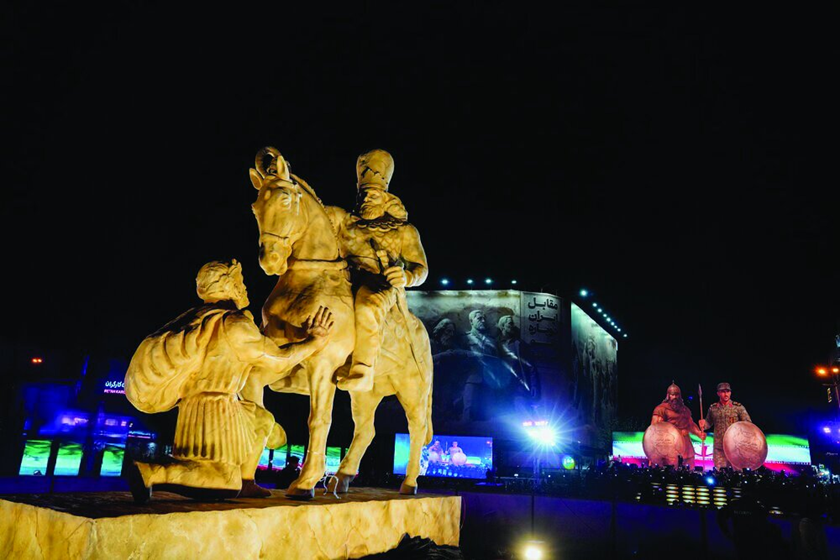
The new statue revealed in Tehran at the culmination of the “You Will Kneel Before Iran Again” campaign. Source: tehrantimes.com
Reclaiming the Past, Performing the Nation
The Shapur statue is only one component of a broader cultural shift. In the aftermath of the Israeli attack and the Twelve Day War, Iranian state media intensified its use of heroic national imagery. Visuals of Achaemenid soldiers and national ancient heroes began to dominate screens, posters, and official broadcasts. Even before the conflict, the city of Tehran had installed a statue of Arash in Vanak Square, the biggest statue in the Middle East, an event that many observers described as a form of “belated nationalism,” a sudden revival of cultural pride precisely at a moment when the state required a unifying narrative (AmordadNews 2025).
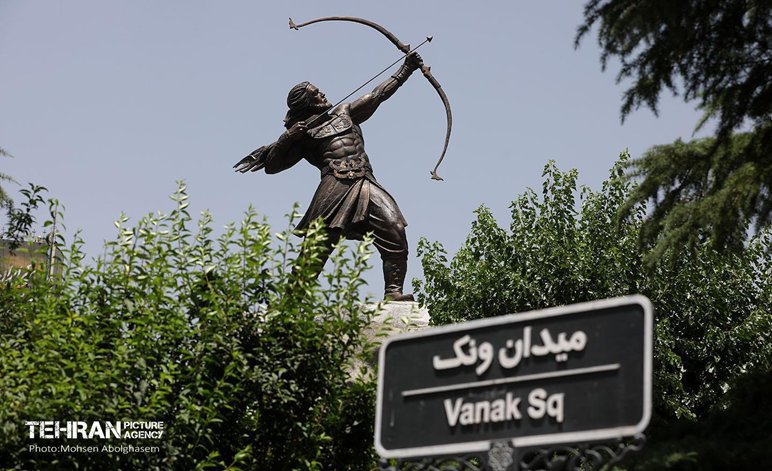
The statue, representing Arash’s sacrifice and defence of Iran’s borders, was unveiled on June 21, 2025 at Vanak Square. Source: tehranpicture.ir
Another event that drew international attention was the concert held in early September this year among the ruins of Persepolis, the ancient Persian capital destroyed by Alexander the Great but whose remains still symbolize the grandeur of Persia’s past. The concert, which featured the Armenian National Philharmonic Orchestra, was meant to highlight the deep bonds between Persians and Armenians, two ancient peoples with millennia of shared history.
During the evening, particular emphasis was placed on “Ey Iran,” a secular patriotic anthem popular before the 1979 Revolution and therefore long considered problematic by the Islamic Republic. “These orchestras remind us where Iran stands and what it is capable of,” said Mehdi Parsaei, deputy governor of Fars Province, home to the ruins of Persepolis. “Our people carry deep historical and cultural values, and in difficult times they turn to those treasures.”
The representative of the Southern Iranian Christian Armenians added: “This performance at the historical site of Persepolis, beside its majestic columns regarded as the gates of civilization, as well as the rendition of ‘Ey Iran’ by this group of artists, not only strengthens nationalist sentiment but also demonstrates the historic depth and power of the Iranian empire, something the West cannot tolerate” (ISNA 2025; RSAA 2025).
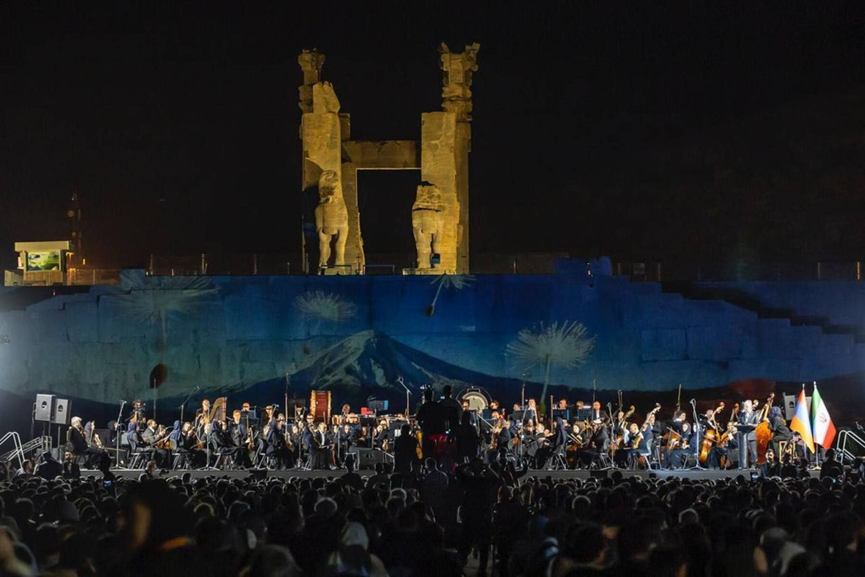
National Philharmonic Orchestra of Armenia performs at Persepolis. Source: anmmedia.am
A Hybrid Identity for a New Generation
The result is a hybrid identity that combines revolutionary rhetoric with carefully curated elements of ancient history. It is less an ideological transformation than a rebranding effort. The government now presents itself as both guardian of Iran’s cultural heritage and defender of its Islamic mission. For many young Iranians, symbols such as Persepolis or the Sasanian kings feel more inspiring and cohesive than the familiar slogans of 1979, and the regime is fully aware of this shift.
Iran’s renewed fascination with ancient Persia is then more than cultural nostalgia. It reflects a government searching for legitimacy and unity in a time of uncertainty, using history to reshape the national story on its own terms. Whether this transformation will last is uncertain, but its effects are already visible. The state is redefining itself through symbols of endurance, pride, and antiquity. By reaching back to ancient Persia, Iran is not merely recalling its past, it is transforming it into a political weapon. For now, that past has become indispensable to the present.
References
Alinejad, Mahmoud. “Iran – Nationalism versus Islamism.” SSRN Electronic Journal, 2025. https://papers.ssrn.com/sol3/papers.cfm?abstract_id=5189978.
Amordad News. “Middle East’s Largest Statue at Vanak Square Honors the Legend of Arash.” July 2025. https://en.amordadnews.com/?p=158478
Asadian, Reza. “Power from Revolution: The Configuration and Evolution of Iran’s Political Identity Reflected in the Supreme Leaders’ Hajj Messages.” World Studies on Politics and Society 11, no. 2 (2023).
Encyclopaedia Britannica. “Sasanian Dynasty.” Last modified 2024. https://www.britannica.com/topic/Sasanian-dynasty.
Iran International. “Tehran’s ‘Kneel Before Iran’ Statue Rekindles Debate over Nationalist Turn.” November 8, 2025. https://www.iranintl.com/en/202511082960.
Iranian Students’ News Agency (ISNA). “Reaction of the Representative of Southern Iranian Christian Armenians to the Armenian Philharmonic Orchestra’s Performance at Persepolis.” ISNA News, September 9, 2025. https://www.isna.ir/news/1404061710269.
Islamic Thought Foundation. “Imam Khomeini on Nationalism and Islam.” Accessed November 29, 2025. https://www.imam-khomeini.com/web1/english/showitem_cid_2491_pid_2843.html.
Özkan, Mazlum.Middle East Monitor (MEMO). “From Ummah to Nationalism: The Islamic Republic’s Identity Shifts under Airstrikes.” July 27, 2025. https://www.middleeastmonitor.com/20250727-from-ummah-to-nationalism-the-islamic-republics-identity-shifts-under-airstrikes.
Royal Society for Asian Affairs. “Persepolis, Armenia, and Iran’s Balancing Act.” RSAA Blog, 2025. https://rsaa.org.uk/blog/persepolis-armenia-and-irans-balancing-act/.
Steele, Robert. "Crowning the “Sun of the Aryans”: Mohammad Reza Shah's Coronation and Monarchical Spectacle in Pahlavi Iran." International Journal of Middle East Studies (2021): 1-19.
Steele, Robert. The Shah’s Imperial Celebrations of 1971: Nationalism, Culture and Politics in Late Pahlavi Iran. IB Tauris, 2020.
Torbati, Yeganeh. The Washington Post. “Iran’s Leaders Reach Back to Pre-Islamic Times to Stoke Nationalism.” July 27, 2025. https://www.washingtonpost.com/world/2025/07/27/iran-khamenei-islamic-republic-nationalism.