Cosmopolitan Mosaics: Italian Heritage in the Heart of Istanbul
Walking along Istiklal Caddesi, the great pedestrian artery of Beyoğlu, you might be surprised to come upon a neo-Gothic church that seems more at home in Venice or Milan than in the heart of Istanbul. It is Saint Anthony of Padua, the city’s largest Catholic church, built in 1912 by Italians. This is not an isolated anomaly: Istanbul in fact preserves a little-known yet significant cultural heritage tied to the Italian presence. From the Dominican churches of Galata to the Genoese palaces, from Levantine schools to the painters who depicted the Bosphorus, the traces of this long history are still present and speak to the role Italians played in shaping the city’s cosmopolitan character.
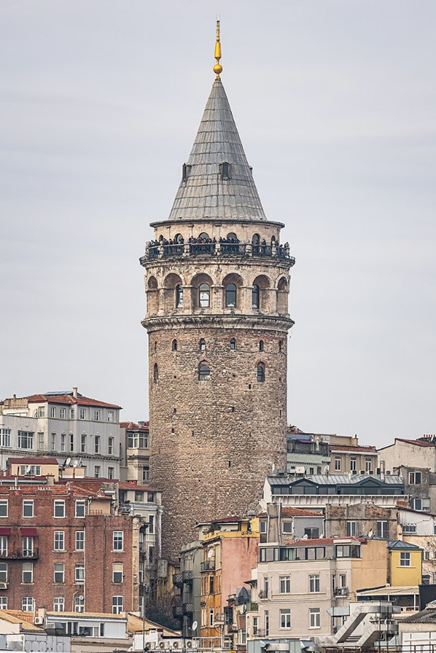
Built in 1348, the Galata Tower still rises over the heart of the Pera district. Source: Wikipedia.
Italian roots in Istanbul
The Italian presence in Istanbul reaches back to the Middle Ages. In 1261, after Michael VIII Palaiologos granted the Genoese the quarter of Galata, they turned the hill above the Golden Horn into a thriving urban and cultural outpost; the Galata Tower still bears witness to that chapter. After the Ottoman conquest of 1453 the Italians stayed, many folding into the Levantine milieu of Pera and Galata[1], a cosmopolitan web of merchants, bankers, artists, and intellectuals that linked the city to the wider Mediterranean. The Venetians, too, left a durable imprint, sustained for centuries by Ottoman capitulations that afforded privileges and commercial freedom[2]. By the nineteenth century these districts had become Istanbul’s cosmopolitan core: a multilingual world of theaters and concerts, foreign newspapers, and cafés that functioned as true cultural agoras. In Costantinopoli (1878), Edmondo De Amicis captured this crossroads with vivid detail, underscoring how Italians shaped, and were shaped by, the city’s restless, cosmopolitan spirit (Dursteler 2006, Özkan and Speelman 2021).
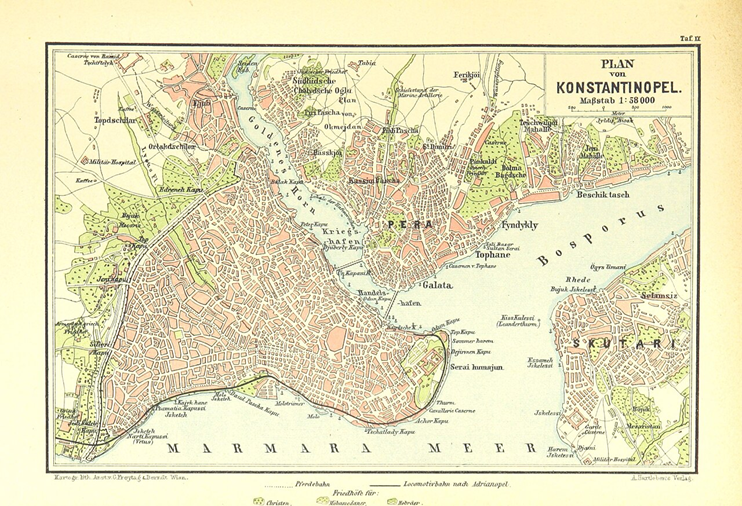
German map of Constantinople (1887). At the center of the European side, the Pera district, home to much of the Levantine community, is highlighted. Source: The British Library.
The Italian Traces of Beyoğlu
In the Pera district, now known as Beyoğlu, the cosmopolitan elegance of the late nineteenth and early twentieth centuries is still palpable. During this period, the area served as the European heart of the Ottoman Empire. Its streets are lined with European-style buildings that reflect a strong Italian influence, visible in grand residences, theatres, consulates, and places of worship. One notable example is the Church of St. Anthony of Padua, the biggest Catholic building in the city, a beautiful structure built in the Venetian Neo-Gothic style and designed by the Italo-Levantine architect Giulio Mongeri. Among the many distinguished architects of the time, Raimondo D’Aronco stands out as a renowned Italian architect from Friuli who was appointed chief architect to Sultan Abdulhamid II. D’Aronco introduced the elegance of Italian Art Nouveau, or Stile Liberty, to Istanbul, skillfully blending it with Ottoman decorative elements in a highly original manner. His works, which include imperial pavilions, private villas, and public buildings, contribute to making Pera a unique space where Eastern and Western aesthetics converge in refined architectural harmony (Girardelli 2005, Batur 2007).
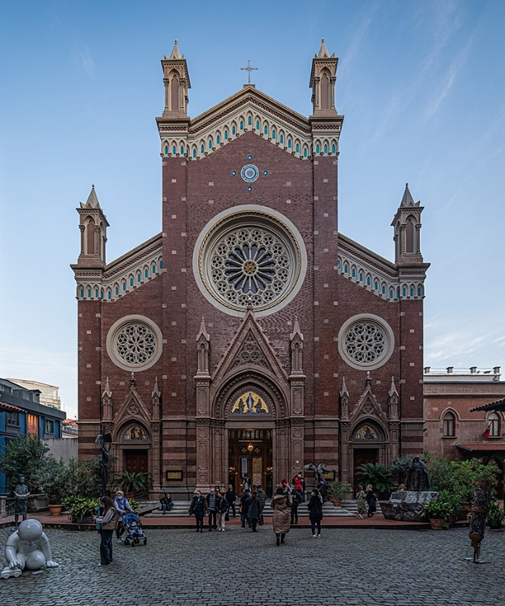
Saint Anthony of Padua, Beyoğlu, Istanbul. Source: Wikipedia.
During the Ottoman Empire's long decline, architecture became both a symbol of reform and a bridge between East and West. Following military defeats, especially after the Treaty of Karlowitz (1699), Ottoman elites turned to Europe for inspiration not only in warfare but also in education, aesthetics, and city planning. Western architecture emerged as a powerful expression of this shift, expanding from military buildings to schools, hospitals, banks, and mosques. It reflected the Empire’s efforts to modernize and align with European powers, while also sparking debates about cultural identity and authenticity (Akbas et al. 2020).
Schools and Cultural Institutions
Another pillar of the Italian presence is represented by schools and cultural institutions. The Liceo Italiano Galileo Galilei[3], founded in 1888, remains one of the city’s most prestigious foreign schools. Its bilingual programs, library, and international outlook have made it a bridge between Italy and Türkiye, educating generations of students able to move across multiple cultural worlds. Likewise, the Italian Cultural Institute of Istanbul[4] continues to play a decisive role. Its exhibitions, film series, lectures, and concerts not only keep the connection with Italy alive, but also renew Istanbul’s cosmopolitan vocation. In a sense, the Institute carries forward the legacy of the literary and musical salons that once animated Pera, translating that tradition into a contemporary language.
Istanbul on Canvas
Alongside the architecture and the schools, there is a less visible but equally precious heritage: the legacy left by the Italian painters. Their works not only helped shape Europe’s image of the city and its inhabitants, but also offered intimate, vivid portrayals, at times more faithful than any written account. Italian painters arrived in the Ottoman capital soon after its conquest in 1453. Sultan Mehmed II, intrigued by the Italian Renaissance, welcomed the Venetian artist Gentile Bellini, who stayed from 1478 to 1481 and painted the famous portrait of the Sultan, now in the National Gallery, London. Commissioned after the peace treaty between the Serenissima and the Sublime Porte, Bellini’s presence was both an artistic exchange and a diplomatic gesture to foster peace between the two states (Crouzet-Pavan 2012).
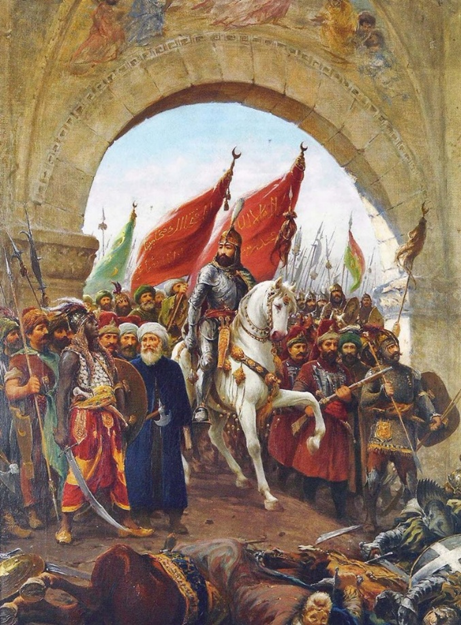
In the celebrated painting “Mehmed II Enters Constantinople,” Zonaro chose to depict himself beside the sultan in the guise of a janissary (the figure shouldering a rifle with a full beard), a gesture that reveals his intent to inscribe himself into the city’s history. Source: WorldHistory.org.
Particularly important were the Italian Orientalist painters of the nineteenth century, who helped shape the European vision of the Ottoman capital. Among them, Fausto Zonaro stands out as the last court painter of the Ottoman Empire. Indeed, after moving to Istanbul in 1891, he became the official painter to Sultan Abdülhamid II. In the Ottoman capital, Zonaro gradually established himself within high aristocratic circles, earning the trust of increasingly influential patrons. The turning point came in 1896, when the sultan purchased his painting Ertuğrul Süvari Alayı (The Imperial Regiment of Ertuğrul on the Galata Bridge). Struck by the power and realism of the scene, the sovereign appointed him Court Painter, a role he would hold until 1909, when a coup d’état deposed the sultan[5]. Alberto Pasini, from Parma, portrayed markets, the Bosphorus, and suspended atmospheres, conveying an image of Istanbul that is vital and luminous (Zatti 1991).
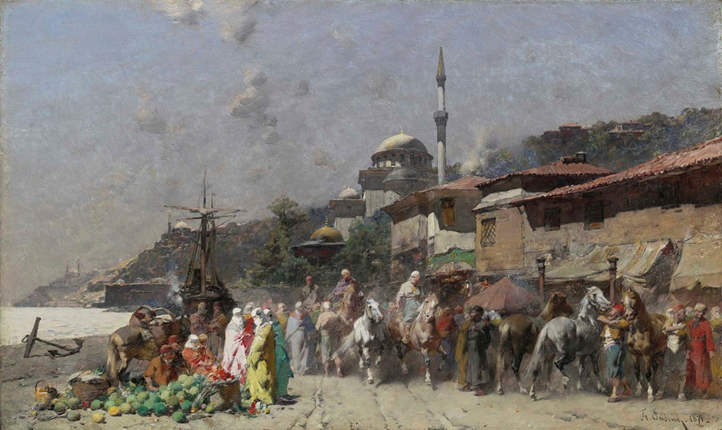
Marketplace on the Bosphorus, Alberto Pasini, 1871. Source: artvee.com
Taranto-born Leonardo de Mango settled in Istanbul in 1883 and lived there for the rest of his life, producing a prolific visual archive of the city’s streets, mosques, and markets with an Italian academic hand and a near-Impressionist feel for light and atmosphere.
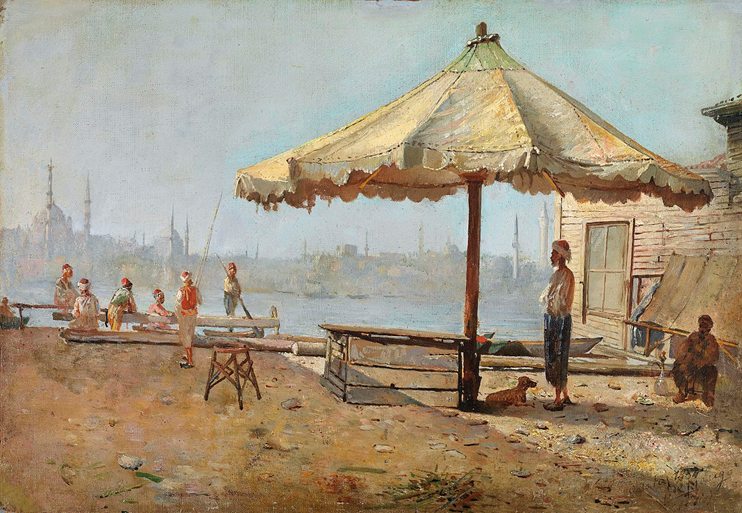
On the Golden Horn, Leonardo de Mango, 1884. Source: dorotheum.com
These Italian artists were part of the broader European Orientalist movement of the late 19th century, which turned its attention to Istanbul. Blending Romanticism and imperial imagination, Orientalism often portrayed the Ottoman world through exoticized urban scenes, daily life, and monumental architecture. Their works revealed the city’s unique atmosphere, rich history, and striking visual culture. (PERA 2008)
A Living Memory in the City
Although the Italian community in Istanbul has grown smaller, its cultural legacy remains visible in churches, schools, and historic buildings. Institutions such as the Italian High School and the Cultural Institute are still active, while the work of Mongeri, Pasini, and Zonaro reflects the city’s Mediterranean and cosmopolitan character. Looking at Istanbul through the Italian presence reveals a history shaped by cultural exchange. Churches hosted concerts, schools created bilingual classrooms, and artists captured the spirit of the Bosphorus. From the medieval tower of Galata to the neo-Gothic façades of İstiklal Caddesi, these traces continue to mark the urban landscape and invite us to read the city in more than one language. Istanbul appears as a cultural network, sustained by maritime routes, diplomacy, exhibitions, and education. Reconnecting with this heritage today means embracing diversity as a strength and recognizing cosmopolitanism as a deep-rooted identity. And it could not be otherwise, in a city that De Amicis, in 1878, defined as “a shimmering mosaic of races and religions” that gives life to “a Babylon, a world, a chaos”.
Notes
[1] Istanbul Urban Database, a collection of lots of maps of the city from different eras: http://www.istanbulurbandatabase.com/
[2] It is possible to consult official documents from the Italian states (pre-1861) and the unified Kingdom of Italy (post-1861) concerning diplomatic missions in Istanbul in two online archives: -Italian Consular Archives 1814-1860 (cur. Costanza Lisi): Italian consular archives (1814-1860)-Ambasciata d’Italia a Istanbul 1847-1925 (cur. SALT Research): https://consoli.hypotheses.org/979
[3] “History” on the official page: https://www.galileilisesi.k12.tr/it/chi-siamo/storia
[4] Official Page: https://iicistanbul.esteri.it/it/
[5] There is a comprehensive archive of Fausto Zonaro’s works curated by his grandson, Cesare Mario Trevigne: https://www.faustozonaro.it/mission.html
References
Akbas, Gamze, Arzu Erçetin, Vehbi Tosun, and Zuhal Erdemir. 2020. “Westernization in Ottoman Culture and Built Environment.” International Journal of Humanities, Arts and Social Sciences 6, no. 3: 111–123. https://doi.org/10.20469/ijhss.6.20002-3.
Batur, Afife. 2007. “Galata and Pera 1: A Short History, Urban Development, Architecture and Today.” ARI: The Bulletin of the Istanbul Technical University 55, no. 1: 1–10. https://www.levantineheritage.com/pdf/Galata-Pera-Afife-Batur.pdf.
Crouzet-Pavan, Elisabeth. 2012. Rinascimenti italiani 1380–1500. Rome: Viella.
De Amicis, Edmondo. 1878. Costantinopoli. Milan: Treves.
Dursteler, Eric R. 2006. Venetians in Constantinople: Nation, Identity, and Coexistence in the Early Modern Mediterranean. Baltimore: Johns Hopkins University Press.
Girardelli, Paolo. 2005. “Architecture, Identity, and Liminality: On the Use and Meaning of Catholic Spaces in Late Ottoman Istanbul.” Muqarnas: An Annual on the Visual Culture of the Islamic World 22: 233–264. https://doi.org/10.1163/22118993_02201011.
Özkan, N., and R. Speelman. 2021. “Italians and Others in the Shadow of Abdulhamid Khan.” Ankara Üniversitesi Dil ve Tarih-Coğrafya Fakültesi Dergisi 61, no. 2: 676–705. https://doi.org/10.33171/dtcfjournal.2021.61.2.3.
Pera Museum. 2008. İstanbul: The City of Dreams: Views of İstanbul and Daily Life in the Ottoman World from the 17th to 20th Century with Selected Works from the Suna and İnan Kıraç Foundation Collection. Istanbul: Pera Museum. https://www.peramuseum.org/Images/pdf/digital-publications/duslerin-kenti_ing.pdf.
Archives and Databases
Ambasciata d’Italia a Istanbul, 1847–1925. Curated by SALT Research. https://consoli.hypotheses.org/979.
Fausto Zonaro Database. https://www.faustozonaro.it/mission.html.
Italian Consular Archives, 1814–1860. Curated by Costanza Lisi. Italian Consular Archives (1814–1860).
Istanbul Urban Database. http://www.istanbulurbandatabase.com/.