As Ethnic and Religious Tensions Persist, the New Syria is Seeking Rebirth through Culture
On 1 January 2026, the General Directorate of Antiquities and Museums outlined Syria’s new national strategy for the protection and management of cultural heritage. Spanning the period from 2025 to 2035, the strategy presents heritage as both a national and a deeply human asset, something to be safeguarded not only for its historical value, but also for its potential role in social recovery and sustainable development.[1] This marks an important shift, since for more than a decade speaking about culture in Syria has largely meant speaking about loss: destroyed libraries, looted artworks, artists forced into exile, and cultural institutions silenced by war and political repression.
In the first months of 2026, it has become increasingly clear that the country’s new political institutions are placing renewed emphasis on culture. This investment works for both repositioning Syria on the international stage and addressing the profound social and psychological wounds left by years of conflict. In this sense, 2026 has begun to take on a symbolic meaning: a cautious moment of cultural reawakening. Events such as the return of the Damascus International Book Fair as major public gathering, and Syria’s participation in the Venice Biennale with artist Sara Shamma, both for the first time since the fall of Assad, have been widely read as signs that something is slowly beginning to change. However, the representation of a new and unified Syria conveyed by these events is still far from the reality on the ground, where ethnic and religious tensions continue to erupt into violence and clashes.
Damascus Turns Page
The first edition of the Damascus International Book Fair since the fall of Assad recorded remarkable attendance, attracting 1.29 million visitors, while hosting around 500 publishing houses from 35 countries, according to Deputy Culture Minister and Fair Director Saad Na’ssan.[2][3] Syria’s Culture Minister Mohammad Yassin Saleh framed the event in explicitly symbolic terms: “Through this fair, Syria returns with strength and regains its word, meaning and identity,” he said. “The sun rises again from here, the sun of letters and the sun of civilization.”[4]
What surprised international observers was not merely the return of the fair itself, but the unprecedented degree of freedom of expression. Under Assad, censorship had been systematic and pervasive. A display at the entrance explicitly addressed this past: “Intellectual captivity under the old regime was one of the cruellest forms of injustice. Minds were imprisoned, words were shackled, and thinkers were trapped within the walls of censorship, forced into silence or flight.” Syrian writer Abdul-Razzaq Ahmad Saryoul, who for a long time wasn’t allowed to participate due to censorship under the old regime, said he was surprised to be issued a permit the same day he applied, without being asked about the content of his books. The range of titles on display made this year’s edition “unprecedented,” he noted.[5]
A particularly significant development was the presence of a pavilion dedicated to Kurdish history, literature, and heritage. This is the first time the fair has included a space specifically devoted to Kurdish cultural production, which was interpreted as a gesture toward recognition and coexistence, especially considering recent armed clashes in Aleppo and northeastern Syria.[6]
The range of books on display further underscored this openness. English-language offerings spanned classics and contemporary works, from Oscar Wilde’s The Picture of Dorian Gray and George Orwell’s 1984 to Margaret Atwood’s The Testaments and Mark Manson’s Everything Is F*cked: A Book About Hope. Alongside them were Arabic translations of influential authors such as bell hooks, Noam Chomsky, and Friedrich Nietzsche.[7]
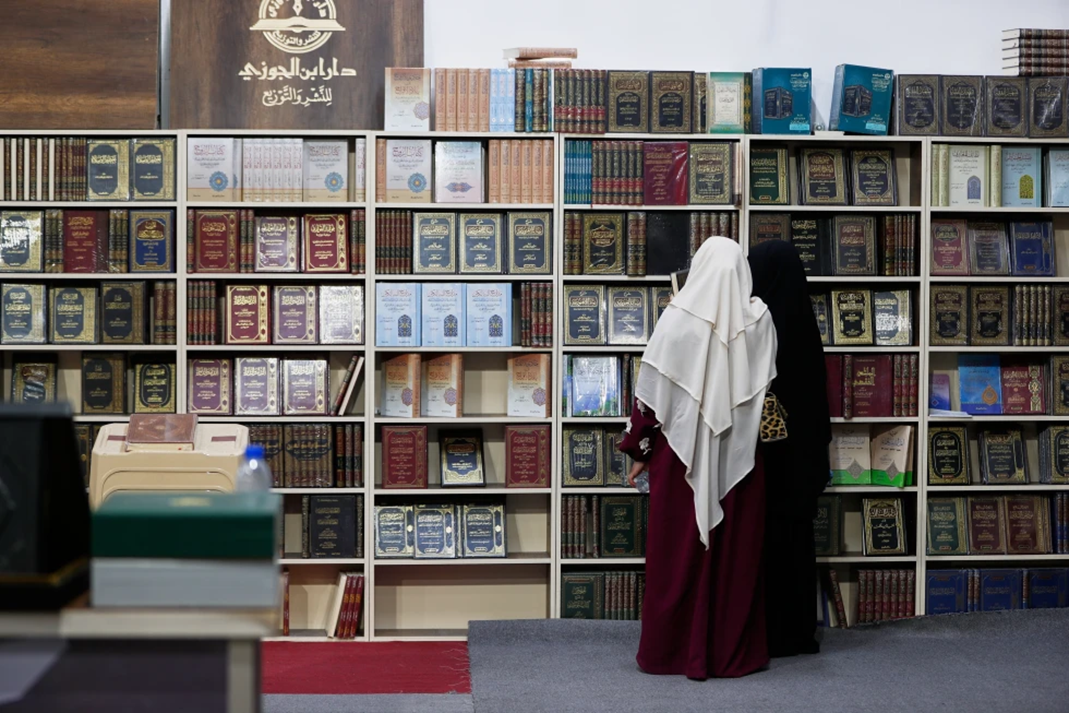
Photo from the 57th Damascus International Book Fair edition, the first since the fall of Assad. Source: https://apnews.com/article/syria-damascus-international-book-fair-censorship-kurds-e160adebadccad076ba13269a8b5e9de
Yet this new openness was not without controversy. While many welcomed the broader intellectual space, the circulation of previously banned Islamist literature raised concerns among religious minorities. Works by Ibn Taymiyya, an author long prohibited under Assad, were openly sold. The only known banned title this year, “Have You Heard the Talk of the Rafida?”, contained audio addresses by Abu Musab al-Zarqawi, al Qaeda's leader in Iraq until he was killed in 2006, and was reportedly removed at Iraq’s request for inciting hatred against Shiite Muslims.[8]
During the fair, the Ministry of Culture also launched the Syrian Cultural House project, a national initiative structured around participation, digital transformation, training, and capacity-building. The project seeks to overcome the elitist framing of culture and transform it into a daily, accessible practice. In her opening remarks, project director Taqwa Alal described its launch at the heart of the book fair as “a new historical beginning” and a reaffirmation of Damascus as a compass for Arab culture.[9]
Ishraqat Festival: “Guided by Light, United by Culture”
This narrative of recovery continued with the Ishraqat Cultural and Arts Festival, held from 8 to 12 February and inaugurated at the Damascus Opera House. Organised by the United Nations Development Programme and Violet Organization, in partnership with Syrian ministries and funded by Japan, Ishraqat aimed explicitly at cultural recovery and social cohesion. The festival offered a wide programme of exhibitions, poetry readings, musical and theatrical performances, and intellectual seminars, highlighting Syria’s cultural diversity and creative vitality. As Syria entered a new phase of rebuilding, culture was framed as “a powerful force for connection, healing, and social cohesion.” Through art, storytelling, and living heritage, the festival wanted to bring communities together by reclaiming public space and reaffirmed shared values, beyond divisions.[10]
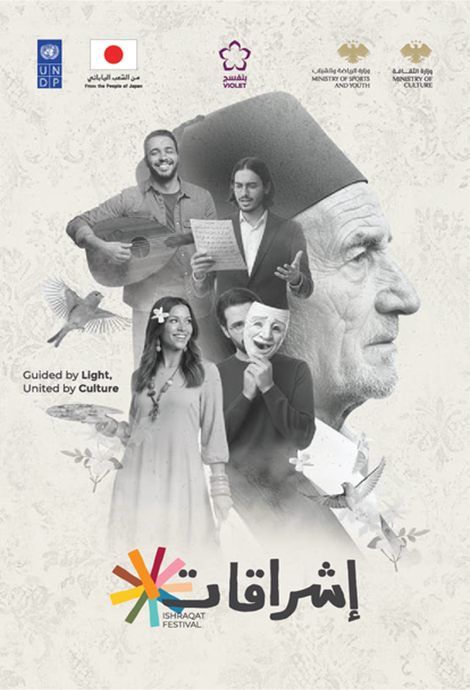
Ishraqat Festival poster. The motto "Guided by Light, United by Culture" insist on the concept of culture as a vehicle of unity in a torn country. Source: https://www.undp.org/syria/events/ishraqat-festival-syria-art-and-cultural-heritage
From Damascus to Venice
If culture is reclaiming internal public space in Syria, the country wants also to reassert itself internationally. The 2026 Venice Biennale will host Syria’s first national participation since 2022, centred on a project by Sara Shamma inspired by Palmyra. “Through The Tower Tomb of Palmyra, I aim to honour Syria’s cultural heritage and the resilience of its people,” Shamma stated; “this exhibition is not only a reflection on loss, but a message of hope, unity, and the importance of protecting and restoring our shared heritage.” The pavilion in Venezia will use painting, architecture, sound, and scent to evoke memory and resilience. As its curator Hasegawa noted, “The exhibition invites audiences to experience these themes through an immersive artistic experience, and positions Syria firmly within global contemporary art discourse.”[11]
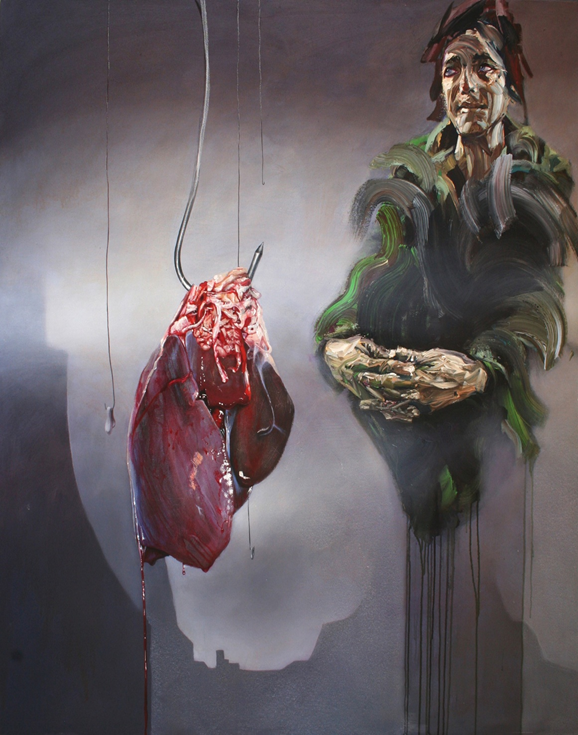
Butcher, by Sara Shamma, 2014. A painting part of the “World Civil War Portraits” described as “a powerful and moving product of the gruesome civil war in Syria, was created after Shamma was forced to flee the country in 2012 proceeding a car bomb that exploded outside her home.” Source: https://www.sarashamma.art/?3/33
Palmyra occupies a powerful place in the collective memory of the Syrian people and has long been a symbol of cultural pride. It was precisely this significance that turned the site into a focal point during the Syrian war, when it was heavily damaged and systematically looted, particularly during the occupation by the Islamic State.[12]
Between Inclusion and Unresolved Tensions
While the government has promoted artistic and cultural initiatives to convey messages of peace, unity and inclusivity, religious and ethnic tensions have continued to surface in post-war Syria. Years of conflict have left deep scars that have not been easily resolved, and the current political transition seems to struggle with a real reunification. Communities such as the Kurds, Druze, and Alawites continue to raise concerns about security, representation, and the protection of their cultural and religious rights, particularly in light of violence, localised clashes, and attacks on places of worship. This contrast highlights the distance that still exists between official narratives of reconciliation and the realities faced by many communities on the ground. Using the words of The Economist, these events are “a window on the new Syria, but many worry it will not stay open for long”.[13]
Bibliography
Dalatey, Feras & Rasheed, Ahmed, Syria blocks display of al Qaeda-linked text at book fair, Iraqi official says, Reuters,4 February 2026 https://www.reuters.com/world/middle-east/syria-blocks-display-al-qaeda-linked-text-book-fair-iraqi-official-says-2026-02-04/.
Hayden, Sally, Syria turns page on Assad era with international book fair as censorship eases, The Irish Times, 17 February 2026 https://www.irishtimes.com/world/middle-east/2026/02/17/syria-turns-page-on-assad-era-with-international-book-fair-as-censorship-eases/.
Kannawi, Ammar, A Report on the Initial Observations of the Current State of Palmyra’s Antiquities After Liberation, Syrians for Heritage, 2 January 2025 https://syriansforheritage.org/?p=6506.
SANA, Culture Ministry launches Syrian Cultural House project at Damascus Book Fair, 12 February 2026 https://sana.sy/en/culture-and-arts/2296316/.
SANA, Damascus International Book Fair draws 1.29 million visitors, 20 February 2026 https://sana.sy/en/culture-and-arts/2297827/.
SANA, Syria launches new national strategy to safeguard cultural heritage, 1 January 2026 https://sana.sy/en/culture-and-arts/2288151/.
SANA, Syria waives publisher fees for Damascus International Book Fair, 14 February 2026 https://sana.sy/en/culture-and-arts/2296692/.
Sanadiki, Omar & Mroue, Bassem, The Damascus book fair draws crowds, with censorship eased in post-Assad Syria, AP News, 16 February 2026 https://apnews.com/article/syria-damascus-international-book-fair-censorship-kurds-e160adebadccad076ba13269a8b5e9de.
Shafaq News, First-ever Kurdish pavilion opens at Damascus Book Fair, 15 February 2026 https://shafaq.com/en/Middle-East/First-ever-Kurdish-pavilion-opens-at-Damascus-Book-Fair.
Talass, Rawaa, Sara Shamma will represent Syria at the Venice Biennale 2026, Artsy, 22 January 2026 https://www.artsy.net/article/artsy-editorial-sara-shamma-will-represent-syria-venice-biennale-2026.
The Economist, A book fair in Damascus is a window on the new Syria, but many worry it will not stay open for long, 19 February 2026 https://www.economist.com/middle-east-and-africa/2026/02/19/a-book-fair-in-damascus-is-a-window-on-the-new-syria.
Tiliakou, Katerina, Sara Shamma to represent Syria at the 61st International Art Exhibition in Venice, Al Arabiya, 10 February 2026 https://english.alarabiya.net/life-style/art-and-culture/2026/02/10/sara-shamma-to-represent-syria-at-the-61st-international-art-exhibition-in-venice-.
UNDP, Ishraqat Festival: Syria Art and Cultural Heritage, 4 February 2026 https://www.undp.org/syria/events/ishraqat-festival-syria-art-and-cultural-heritage.
Notes
[1] SANA, Syria launches new national strategy to safeguard cultural heritage, 1 January 2026.
[2]SANA, Damascus International Book Fair draws 1.29 million visitors, 20 February 2026.
[3] Sanadiki, O. & Mroue, B., The Damascus book fair draws crowds, with censorship eased in post-Assad Syria, AP News, 16 February 2026.
[4] SANA, Syria waives publisher fees for Damascus International Book Fair, 14 February 2026.
[5] Sanadiki, O. & Mroue, B., op.cit.
[6] Shafaq News, First-ever Kurdish pavilion opens at Damascus Book Fair, 15 February 2026.
[7] Hayden, Sally, Syria turns page on Assad era with international book fair as censorship eases, The Irish Times,17 February 2026.
[8] Dalatey, F. & Rasheed, A., Syria blocks display of al Qaeda-linked text at book fair, Iraqi official says, Reuters,4 February 2026.
[9] SANA,Culture Ministry launches Syrian Cultural House project at Damascus Book Fair,12 February 2026.
[10] UNDP, Ishraqat Festival: Syria Art and Cultural Heritage, 4 February 2026.
[11] Tiliakou, Katerina, Sara Shamma to represent Syria at the 61st International Art Exhibition in Venice, Al Arabiya, 10 February 2026; Talass, Rawaa, Sara Shamma will represent Syria at the Venice Biennale 2026, Artsy, 22 January 2026.
[12] Kannawi, Ammar, A Report on the Initial Observations of the Current State of Palmyra’s Antiquities After Liberation, Syrians for Heritage, 2 January 2025.
[13] The Economist, A book fair in Damascus is a window on the new Syria, but many worry it will not stay open for long, 19 February 2026.