
The Fortified City of Mértola
A Reading in the Architectural Traces of Gharb al-Andalus
8 January 2026
Mértola is located in the southeast region of Alentejo, Portugal. The city was established on hills overlooking the most navigable section of the Guadiana River. Today, its inhabitants live among numerous archaeological remains from different eras. Continuous archaeological investigations in Mértola have revealed human occupation during the Iron Age, Roman period, Paleo-Christian era, Islamic period, and after the Portuguese conquest in AD 1238. Most of the evidence found was related to the fortification of structures such as walls and towers and, in some cases, to religious and domestic buildings (Torres, 2018).

Location of Mertola, QGIS.
A. Nusair 2025.
The city of Mértola occupies a strategic location on top of a hill surrounded by watercourses from two sides - the Guadiana River to the east and the Oeiras stream to the west - which has resulted in mostly north-facing fortifications. These defend the city from the only overland routes connecting it to other urban centres, such as Beja. Its position at the most navigable section of the Guadiana River not only supported Mértola’s development as a key port city, enabling commercial exchanges with other territories, but also provided a highly strategic military advantage, allowing effective control over the surrounding region.

Aerial view of Mértola.
Google Earth.

Layout of the strategic location of Mértola.
A. Nusair, 2022.

Sunset over Mértola and the Guadiana River.
A. Nusair, 2023.
This unique location made it famous among historic Islamic geographers due to the advantage of the natural defensive elements which made the city one of the most fortified cites in Gharb al-Andalus. These descriptions have designated Mértola as Hisn or ‘fortress’ due to its defensive morphology (Gómez, 2009, p. 405–428).
Yāqūt al-Ḥamawī, a 13th century geographer, describes Mértola in his work Muʿjam al-Buldān as “a fortress belonging to the region of Beja, which is among the most protected fortifications of the west and one of the most important ancient structures on the Anna River (Guadiana)” (translated by author) (al-Ḥamawī, 1224, p. 42).
Despite this reputation, there is a scarcity of information on the exact circumstances of the Muslim troops’ arrival in Mértola, including the precise date. However, it can be approximated to the period when they reached the nearby city of Beja in AD 713. Historically, Mértola was always subordinate to Beja, even during the Roman era.
In the 9th century, a rebellion against Umayyad rule in the Iberian Peninsula was led by ʿAbd al-Raḥmān Ibn Marwān al-Ğillīqī, known as ‘the Galician.’ His supporter, ʿAbd al-Mālik Abī l-Ğawwād, conquered Beja and Mértola in support of the rebellion (Ibn ‘Idhārī, 1312/1983, p. 291). According to Gómez & de Palma (2013), ʿAbd al-Mālik reinforced the defenses of Mértola, marking the first documented reference to fortifications in the city during the Islamic period (p. 405–412).

The castle and city walls of Mértola rising atop the hills along the Guadiana River.
A. Nusair, 2023.
Mértola reappears in historical sources during the final years of Almoravid period in al-Andalus, when local uprisings challenged their authority. The city became a stronghold for a rebellion led by its ruler, Ahmad ibn Qasi. Later, during the Almohad period, there was a need by Almohads to legitimize their authority over the Muslims of the Iberian Peninsula by defending the Andalusian territories from Christian kingdoms’ attacks (Márquez-Daza, 2008, pp. 115–134).
The fall of Beja to the Portuguese kingdoms marked a turning point in the history of Gharb al-Andalus. After Beja’s conquest, many of its inhabitants migrated to Mértola, seeking refuge in one of the region’s most fortified cities. This event reinforced Mértola’s role as a strategic center during the Almohad period, when it served as both a military base and a hub of resistance. However, this was for a short period. In 1238 AD, Mértola itself fell to the Portuguese crown, ending centuries of Islamic rule and reshaping the political and cultural landscape of the Guadiana valley (Shaisha, 2014, pp. 105–127).
Although the Islamic rule in Mértola ended with its fall in the 13th century, the city still preserves remarkable evidence of its Islamic past, visible in its architecture and urban fabric. Most of these traces dated back to the Almohad Caliphate which was the last period in the Islamic rule in Mértola. The strongest evidence includes the castle, the mosque, the Alcáçova neighborhood (name derived from the Arabic word ‘al-qaṣaba’, meaning ‘fortress’), and fortifications outside the city walls.
Understanding these surviving structures is key to uncovering their architectural vision - a vision that is shaped by the Almohads’ distinctive style and defensive strategies, influenced by their origins, strict religious principles, and constant military pressures.
One of the most significant examples of Almohad architecture in Mértola is its fortified castle, which illustrates the evolution of defensive strategies over time. Covering approximately 3,000 m2, the castle was subjected to continuous modifications across different historical periods. Although evidence of Iron Age occupation exists within the site, the exact date of its initial construction remains uncertain. Based on early written records and archaeological excavations, scholars attribute the trapezoidal shape of the original enclosure of the castle to the Umayyad emirate period in the 9th century, when ʿAbd al-Mālik Abī l-Ğawwād captured Mértola and reinforced its defenses to support the rebel ʿAbd al-Raḥmān Ibn Marwān (Gómez & Palma, 2014, pp. 341–343).
During the 10th and 11th centuries, the castle was partially occupied by urban structures, where several artifacts were uncovered. In the Almohad period (12th-13th centuries), a comprehensive construction program was initiated to strengthen the fortifications and reconstruct the main gate. These interventions were carried out under the reign of the Almohad caliph Abū Yaʿqūb Yūsuf in AD 1171 (Gómez & Palma, 2014, pp. 341–343).


The Castle of Mértola.
Youdrone, Google maps (left), A. Nusair, 2021 (right).
The Almohad fortifications have been identified by some features like the construction of fortresses to separate the military space from the town. One of the most notable features was the appearance of flanking defenses, like Albarran towers and couraça towers, such as the Torre del Oro in Seville. These features are further illustrated in historical works of art, such as Duarte de Armas’s 16th century drawing, which provides valuable insight into the fortifications of Mértola. The drawing shows some remains of continuous fortification structures outside the castle. Comparing it to the current state, there are few structures that have survived until today.


Adaptation of Duarte de Armas’s 16th century iconographic drawing from Livro das Fortalezas, highlighting a remaining tower in red.
Illustration adapted by A. Nusair.

The remains of Almohad earth that once safeguarded Mértola during the 12th–13th centuries.
A. Nusair, 2023.
Given that Mértola was naturally protected by watercourses on almost all sides, it is logical to interpret these additional defenses as a second layer of fortification toward the north, the only direction accessible by land. The Almohad fortifications in Mértola are an important example of military architecture that demonstrates advanced knowledge of defensive techniques and their ability to adapt to the specific topographical features of the site.

Northern approach to Mértola, the only land access point, requiring an additional layer of fortifications to reinforce the city’s defenses against potential attacks.
A. Nusair, 2023.
Alongside these defensive structures, the Almohads also left their mark on Mértola’s religious architecture, most notably through the construction of a mosque built using stone bricks on the site of a Roman temple and a church from the Paleo-Christian period. Later, in AD 1238, the mosque was repurposed as the main church of Mértola (Torres, 2018).
The iconography drawing of Mértola by Duarte de Armas in the 16th century depicted the mosque differently from its current state, which provides a closer look of the Almohad structure. The mosque is depicted in the drawing as having five aisles covered by pitched roofs and a minaret attached to the northeastern façade. Some Islamic architectural elements have survived to the present day, including the mihrab and four horseshoe-arched doorways (Macias, 1996).


The mosque of Mértola as depicted in Duarte de Armas’s 16th century iconographic drawing from Livro das Fortalezas, showing its original Almohad structure with five aisles and an attached minaret.

The mosque of Mértola today, a former Almohad structure transformed into the town’s main church after AD 1238.
A. Nusair 2021.
This architectural evidence of the Islamic period is complemented by archaeological findings from the Alcáçova area, located north of the castle, where excavations uncovered seventeen houses and other contemporaneous urban structures. It is believed that this was due to the political events of the Almohad period when Mértola received Muslim immigrants from Beja which was conquered by the Portuguese only four years before the conquest of Mértola in AD 1238 (Macias, 2014, p. 65-74).

Sculpture of Senhor de Mértola, Ahmad Ibn Qasi, standing in front of the castle.
A. Nusair, 2023.
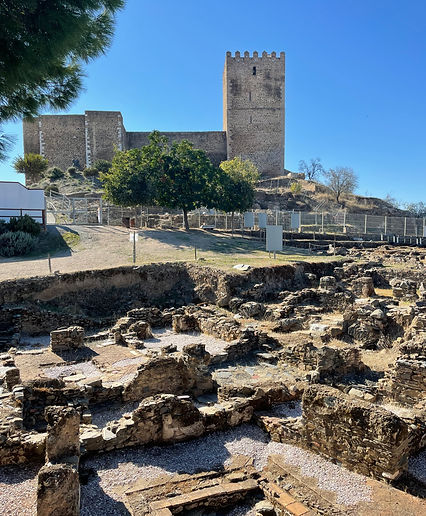
Archaeological remains of the Islamic neighborhood in the Alcáçova area.
A. Nusair, 2023.
Despite the geographical distance from the Mediterranean Sea, the discovered houses have a character reminiscent of the southern region, incorporating typical architectural features. The houses were developed around a central courtyard to provide light and ventilation to the other compartments located around the open space. Their exterior walls had few openings, reflecting Islamic urban regulations designed to preserve privacy and prevent harm to neighbors. Archaeological evidence from this area also offers insights into daily life during the Islamic period, including dietary habits, many of which have survived and become part of the cultural practices of Gharb al-Andalus (Macias, 2014). These include the use of olive oil as essential ingredient, the preparation of dishes based on bread and cereals such as harisa and tarida, and the consumption of soups like gaspacho made with bread and vegetables. Additionally, the preference for rich vegetable diets reflect continuity from medieval times to present day regional gastronomy (Macias, 2018, p.10).
Mértola’s architectural evolution reveals how geography shaped its urban identity. From its natural defenses to the layered fortifications, the city’s morphology reflects a constant focus on security and control. Even after the end of Islamic rule, these structures lasted as silent witnesses to centuries of adaptation. This continuity shows that Mértola was not only a fortified settlement but a strategic location whose identity was deeply tied to its defensive architecture and riverine position.
The surviving structures and households that remain serve as a link between the past and the traditions that define the region’s character. Today, Mértola is widely seen as a symbol of Islamic heritage in Portugal; it is known for its annual Islamic festival, unlike most Portuguese towns that celebrate medieval fairs and obscure their Islamic histories. This event reflects the continuing influence of Islamic culture, extending beyond architecture and urban design to language, music, and culinary traditions. Despite demographic shifts and the systematic dismantling of Islamic structures after the 15th century, these cultural elements have persisted, shaping local identity and linking Portugal to the broader legacy of al-Andalus.
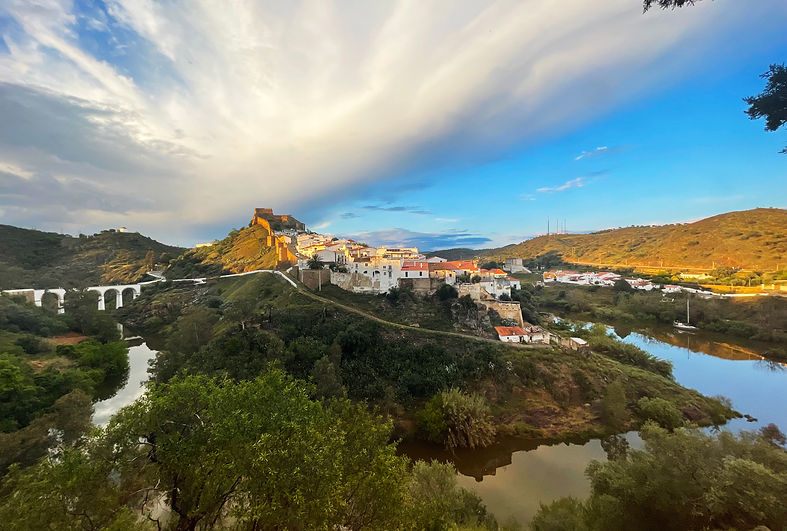
Mértola surrounded by watercourses.
A. Nusair, 2022.
Western References and Further Readings
Duarte de Armas. (1510). Livro das Fortalezas situadas no extremo de Portugal e Castela (Public Domain facsimile). Retrieved from https://archive.org/details/pt-tt-cf-159-m-0154.
Gómez Martínez, S. (2008). Mértola Arqueológica 2003–2008. Câmara Municipal de Mértola.
Gómez Martínez, S., & Palma, M. de F. (2013). O castelo de Mértola em época islâmica. Repositório Comum (RCAAP).
Gómez Martínez, S., & Palma, M. de F. (2016). O Castelo de Mértola em época islâmica. In I. C. F. Fernandes (Coord.), Fortificações e território na Península Ibérica e no Magreb (séculos VI a XVI) (Vol. 1).
Gómez Martínez, S., Lopes, V., Torres, C., De Fátima Palma, M., & Macías, S. (2009). Mértola islâmica: A madina e o arrabalde. XELB: Revista De Arqueologia, Arte, Etnologia E História, 9, 405–428.
Gómez Martínez, S., Lopes, V., Torres, C., Palma, M. de F., & Costa, M. R. (2016). Mértola e o Guadiana: Uma charneira entre o mar e a terra. In Entre Rios e Mares: Um património de ambientes, história e saberes (Tomo V).
Gómez Martínez, S., Palma, M. (2014). O castelo de Mértola: As transformações da Ordem de Santiago (séculos XIV–XV), pp. 341–343.
González Cavero, I. (2018). The Almohad Caliphate: A look at al-Andalus through Arabic documentation and their artistic manifestations. Arts, 7(3), 33.
Graciani García, A., & Tabales Rodríguez, M. Á. (2008). El tapial en el área sevillana: Avance cronotipológico estructural. Arqueología de la Arquitectura, CSIC-Universidad del País Vasco, 135–158.
Macías, S. (1996). Mértola Islâmica: Estudo Histórico-Arqueológico do Bairro da Alcáçova (Séculos XII–XIII). Campo Arqueológico de Mértola.
Macías, S. (2014). Mértola Citadel: Late antiquity and Islamic period. In Mértola Museum: General catalogue, Campo Arqueológico de Mértola, pp. 65–72.
Macias, S. (2018). Houses and daily life in Islamic Portugal (12th–13th century): Mértola in the context of Gharb. Arts, 7(4), 77.
Maldonado, B. P. (1993). Ciudades y fortalezas lusomusulmanas. M.A.E., Agencia Española de Cooperación Internacional, Instituto de Cooperación con el Mundo Árabe.
Márquez Bueno, S., & Gurriarán Daza, P. (2003). La muralla almohade de Cáceres: Aspectos constructivos, formales y funcionales. Arqueología y Territorio Medieval, 10(1), 57–118.
Márquez Bueno, S., & Gurriarán Daza, P. (2008). Recursos formales y constructivos en la arquitectura militar almohade de al-Andalus. Arqueología de La Arquitectura, 5, 115–134.
Martos Quesada, J. (2022). Historiografía andalusí: Manual de fuentes árabes para la historia de al-Andalus (2 vols.). Cáceres: SEEM-Univ.
Rafael, L., Gómez Martínez, S., & Torres, C. (2016). Mértola Vila Museu: Um projecto arqueológico de desenvolvimento integrado. Revista Arqueologia Pública, 10(3).
Torres, C. (2018). O complexo religioso e os batistérios de Mértola na Antiguidade Tardia. Medievalista, 23.
Torres, C. (2018). The Museum Town of Mértola | Campo Arqueológico de Mértola. Retrieved December 16, 2022, from https://www.camertola.pt/en/info/museum-town-m%C3%A9rtola
Vegas, F., & Mileto, C. (2014). La restauración de la Tapia en la península ibérica: Criterios, técnicas, resultados y perspectivas. Argumentum Edições.
Arabic References and Further Readings
Al-Ḥamawī, Yāqūt ibn ʿAbd Allāh al-Rūmī. (1224/1995). Muʿjam al-Buldān [Dictionary of Countries] (Vol. 5, 2nd ed.). Beirut: Dār Ṣādir.
Al-Idrīsī, M. ibn M. ibn ʿAbd Allāh. (1154/2008). Nuzhat al-Mushtāq fī Ikhtirāq al-Āfāq [The Delight of Him Who Longs to Travel the Horizons] (Vol. 1). Cairo: Maktabat al-Thaqāfa al-Dīniyya.
Al-Santarīnī, ʿAlī ibn Bassām. (1108/1981). Al-Dhakhīra fī Maḥāsin Ahl al-Jazīra [The Treasury of the Merits of the People of the Peninsula] (Vol. 2, 2nd ed.). Libya–Tunisia: Al-Dār al-ʿArabiyya lil-Kitāb.
Al-Sarjānī, R. (2011). Qiṣṣat al-Andalus min al-Fatḥ ilā al-Suqūṭ [The Story of al-Andalus from the Conquest to the Fall] (Vol. 1). Cairo: Muʾassasat Iqrāʾ lil-Nashr wa al-Tawzīʿ wa al-Tarjama.
Ibn ʿIdhārī al-Marrākushī, A. A. (1312/1983). Al-Bayān al-Mughrib fī Akhbār al-Andalus wa al-Maghrib [The Clear Statement on the History of al-Andalus and the Maghreb] (3rd ed.). Beirut: Dār al-Thaqāfa.
ʿInān, M. ʿA. (1963/1997). Dawlat al-Islām fī al-Andalus [The Islamic State in al-Andalus] (Vol. 3, 4th ed.). Cairo: Maktabat al-Khānjī.
Shaisha, Ḥ. al-D. (2013). Awjuh min al-Ḥuḍūr al-Islāmī fī Madīnat Mīrtula al-Burtughāliyya [Aspects of Islamic Presence in the Portuguese City of Mértola]. Majallat al-Tafāhum, University of Sharjah, 353–373.
Shaisha, Ḥ. al-D. (2014). Gharb al-Andalus aw al-Burtughāl al-Islāmiyya wa Madīnat Mīrtula fī al-Maṣādir al-ʿArabiyya [Gharb al-Andalus or Islamic Portugal and the City of Mértola in Arabic Sources]. University of Sharjah Journal for Humanities and Social Sciences, 11(2), 105–127.