
The Andalusian West: Cities, Heritage, and Identity
A Reading in Portuguese Islamic Heritage
15 September 2025
The name of Al-Andalus immediately evokes the powerful Islamic presence that dominated the Iberian Peninsula for centuries. Historically, the term was used to describe the entire peninsula, from the lands of the Normans in the west to the "Sea of Darkness" - the Atlantic Ocean - which medieval Islamic geographers considered the end of the known world. Though more than five centuries have passed since the fall of the last Islamic kingdom in Granada in 1492, Al-Andalus continues to hold a profound significance for the Arab and Islamic world. It is remembered as a place where sciences and arts flourished, and where different cultures and peoples converged in a remarkable human experience.
Today, the historical land of Al-Andalus is divided between modern-day Spain and Portugal. However, the modern designation 'Andalusia' often refers just to the major cities of Spain, such as Córdoba, Granada, Toledo, and Valencia, where governance was concentrated and where science, literature, and the arts flourished, leaving us with major architectural landmarks such as the Alhambra Palace in Granada and the Mosque of Córdoba.
While the cities of the Andalusian East (Spain) receive all this attention, what about the cities of Portugal - the “Forgotten West”? The cities that today fall within the borders of Portugal, such as Beja, Coimbra, Lisbon, Silves, Santarem, and others, have been absent from collective Islamic memory, whether intentionally or by negligence. This aspect is hardly mentioned in the educational curricula or seriously documented in Arab or Western cultural media, as if the collective memory of Al-Andalus was confined to the southeast of the Iberian Peninsula, while the Andalusian West cities remain in the shadows.
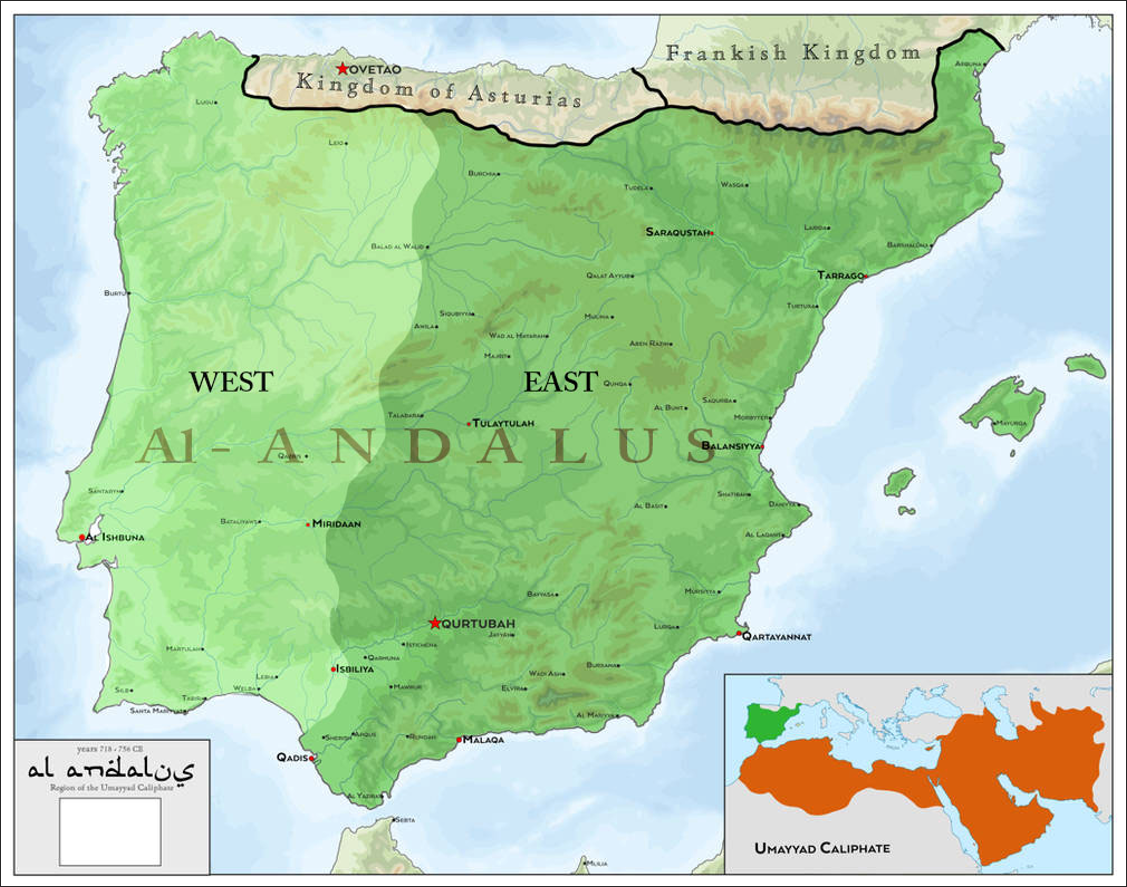
Al-Andalus at its greatest extent in AD 719. Adaptation on SalesWorlds photo, 2017.
The oblivion that surrounds the Andalusian West can be seen not merely as a lack of documentation, but as a complex consequence of political, cultural, and colonial factors. After the expulsion of certain Muslim populations and the forced Christianization of others, Portuguese authorities actively worked to construct a distinct national identity that ignored or minimized the importance of the Islamic presence, which was considered an "occupation" in the official narrative, rather than part of the national heritage. Additionally, Arab scholars and historians in the centuries after the fall of Granada gave little attention to these territories, likely due to the absence of the major political symbolism enjoyed by the cities of the Andalusian East.
The Islamic presence in what is now Portugal began in 714 AD, following the region's conquest from the Visigoths. Over the centuries, the cities of the West of Al-Andalus flourished under successive periods of Islamic rule. This era started with the governors under the Umayyad Caliphate in Damascus and continued through the Umayyad new state and Caliphate in Cordoba.
After the fall of the Caliphate, the region entered the Taifa period (independent city-states), which was marked by significant cultural and scientific prosperity. This era saw remarkable advancements in urbanism, intellectual life, and literature. Independent city-states, or Taifas, emerged in the west, such as the Bani al-Aftas dynasty, which controlled large parts of modern-day Portugal. Other independent cities also appeared, including Mértola and Faro.
The development of these cities continued under the subsequent Almoravid and Almohad empires. During this time, the previously rival emirates were unified into a powerful empire, which strengthened their military and economic importance in the region. Their influence gradually waned as the north Christian kingdoms advanced, conquering one city after another and ultimately forming the Portugal we know today.
This historical development of the cities of Andalusia, in all its stages of prosperity and decline, would not have been known so accurately if it were not for the testimonies and maps documented by Arab sources, which have given us an accurate description of the cities of western Andalus. In this context, works such as Yaqut al-Hamawi's Mu'jam al-Buldan ("Dictionary of Countries") and Muhammad al-Idrisi’s Nuzhat al-Mushtaq ("Tabula Rogeriana") stand out. Al-Idrisi, for example, did not limit himself to mapping cities, but also documented their trajectory in detail. In his description of the Wadi Yana River (Guadiana River) in the western cities of Al-Andalus, he stated: “This river comes from the meadows above it and passes through the village of Yanna to the castle of Rabah, then it goes to the fortress of Arenda and from there to Mareda (Merida), then it passes through Batlyous (Badajoz) and it gets close to Sheresha, then it passes by the fortress of Martala (Mértola), then it pours into the dark sea” (Al-Idrisi, 1154, p. 550).
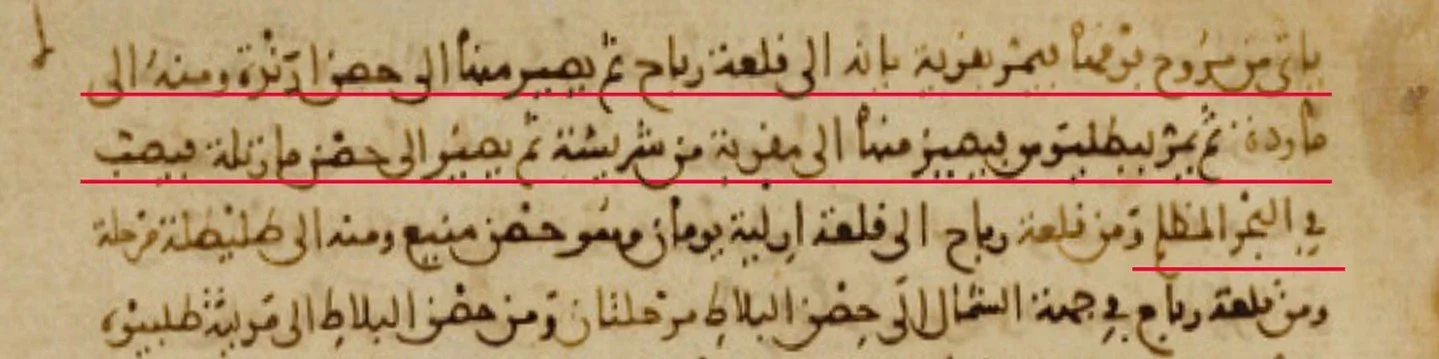
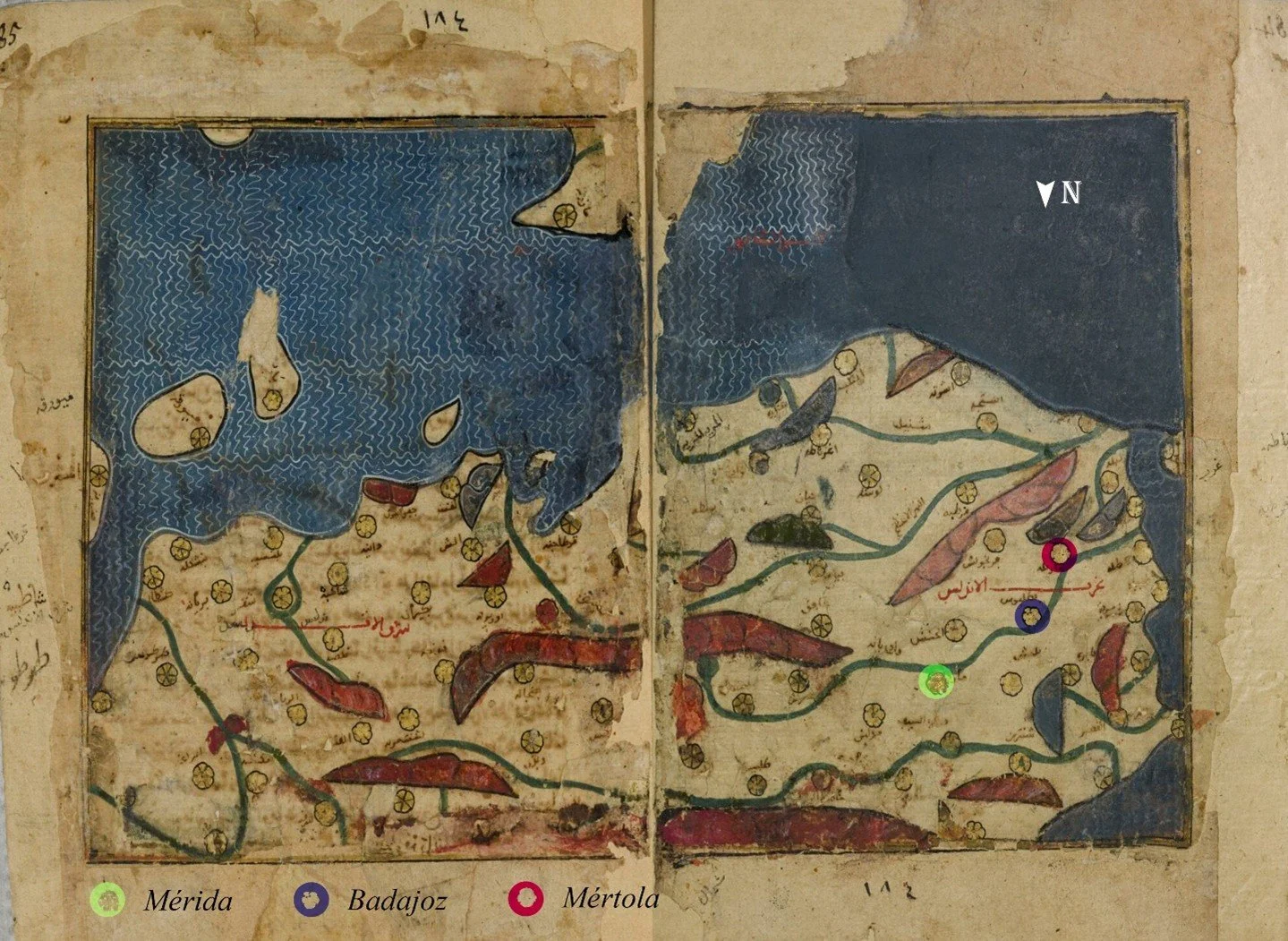
Adaptation of the text and the southwestern coast map of the Iberian Peninsula by the Idrisi in 1154 AD. Nuzhat al-Mushtaq fi Ikhtiraq al-Afaq, World Digital Library. Original manuscript held at the National Library of France.
The greatness of this Islamic heritage is not only that it was preserved in the pages of books and manuscripts, but also that it left behind physical traces that are still visible today. From the far north to the far south, we can find the remains of residential architecture, city planning, baths, castles, palaces, fortresses, and mosques that were later converted into churches. Among the most famous of these are the castles of Sintra, Silves, and Sesimbra. The Grand Mosque of Mértola, whose mihrab was recently discovered, still stands as a testament, located next to the Islamic Quarter with its houses and market.
The rich history of Islamic heritage in Portugal is still not completely understood by many Portuguese people today. In fact, the Islamic presence is often confused with Islamic rule in the western part of Al-Andalus, meaning there is a common misconception that when Islamic governments fell, the Muslim presence in the region also disappeared.
However, many Muslims and Jews continued to live and practice their religions freely under Christian rule, sometimes up until the late 15th century. This period of relative tolerance ended with the start of the Portuguese Inquisition.
During the Inquisition, courts used forceful methods to make people in Andalusian cities convert to Catholicism. At first, this involved taking away certain rights, like closing public baths and banning prayers and large gatherings. Later, it became much more severe, with extreme torture and the mass expulsion of people.
Even with these efforts to erase the Andalusian heritage, we can find documents from trials in the city of Évora during the 16th and 17th centuries. These records show that the Inquisition put individual Muslims on trial because the court questioned their loyalty to the Catholic faith.
Portugal's Islamic heritage was not limited to urbanism and science. Its influence also extended to the language, with the name “Algarve” being more than just a region in southern Portugal; it is also key to understanding the deep linguistic and historical relationship between Arabic and Portuguese. The word Algharb in Arabic means "place of sunset," which is the description given by Arabs to this region, which they knew as "west of Al-Andalus" (later becoming Algarve in Portuguese). This influence also extends to the hundreds of words that have entered and spread in the Portuguese language, as evidence of the period of Islamic existence that lasted for centuries in the Iberian Peninsula.
This great legacy, with its various dimensions that go beyond repression and urbanism, is what we will explore in detail. Therefore, we invite you to follow our upcoming series of articles, titled "The Andalusian West: Cities, Heritage, and Identity - A Reading in Portuguese Islamic Heritage."
In this series, we'll shine a light on the forgotten Islamic history of these Portuguese cities and examine the surviving ruins of the western part of Al-Andalus. We'll also review what Arab and Western sources say about them. We'll discuss the cultural and linguistic heritage left behind by the Islamic presence in this region, as well as the contributions of its most prominent figures.
Each article will look at surviving Andalusian monuments and their current condition, followed by a cultural and architectural analysis. We will also explore the level of awareness of the local communities and Portuguese authorities towards the importance of this national heritage.
In conclusion, a crucial question remains: how do Portuguese cities engage with their Andalusian heritage? Hence, we will present some proposals to revive the memory of Islamic heritage in Portugal, which comprises a living testimony that Islam as a religion, and Arabic as a language and a civilization, has effectively contributed, along with other factors, to the formation of Portugal as we know it today.