The Pope in the Eastern Mediterranean: A Journey between Faith, Culture, and Diplomacy
The Eastern Mediterranean provided the setting for Pope Leo XIV’s first steps on the global stage. By traveling to Türkiye and Lebanon, lands marked by ancient Christian memory and complex religious histories, and marked today by geopolitical strain, the head of the Catholic Church articulated a vision of dialogue amid fragmentation and uncertainty.
Indeed, alongside the commemoration of Christianity’s roots in these lands, the visit also worked as an act of cultural and religious diplomacy, a soft but powerful way for the Holy See to engage a region marked by deep divisions, complex memories, and geopolitical tensions, while sending messages that reach the whole world.
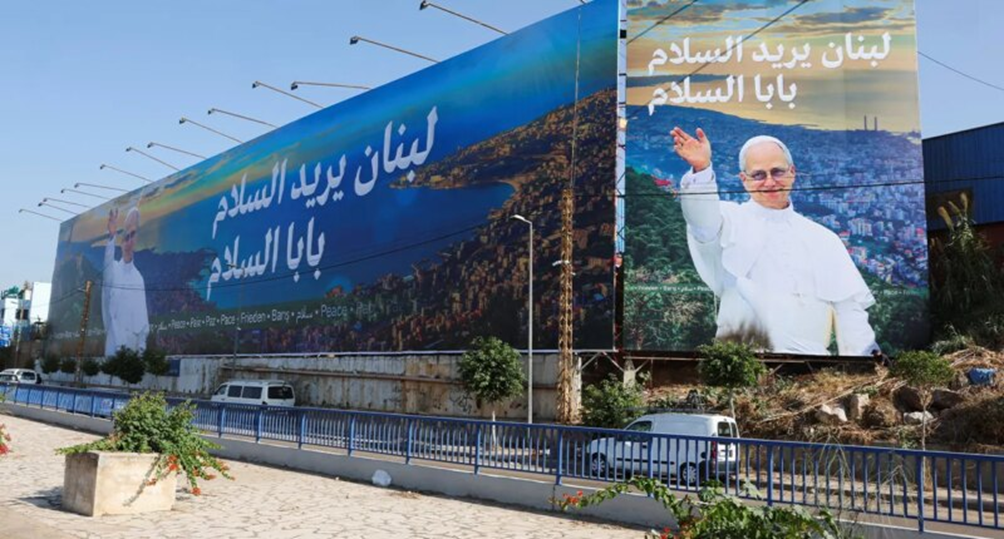
Welcoming billboards for Pope Leo XIV’s visit in Beirut, with the message written in Arabic: “The Pope of Peace.” Adventmessenger.org.
Sixty Years of Vatican Diplomacy in the Middle East
The history of papal journeys to the Middle East is relatively recent, yet it has had a profound impact on Vatican diplomacy toward the region. The first pontiff to travel to the Holy Land was Paul VI in 1964, in a journey that marked an epochal turning point: he was the first pope to leave Italy in centuries and the first to meet the Ecumenical Patriarch of Constantinople, inaugurating a new phase of dialogue with Eastern Christianity. In the following years, John Paul II turned the Middle East into one of the pillars of his pastoral diplomacy. He visited Türkiye in 1979, Jordan, Israel, and Palestine in 2000, and Syria in 2001, but perhaps most importantly, Lebanon in 1997, which he famously described as “more than a country, it is a message” for its model of religious coexistence, a phrase recently invoked also by Pope Leo during his visit (Bordoni 2025). Under Benedict XVI, these visits took on a more theological and cultural tone, with trips to Türkiye in 2006 and Lebanon in 2012, the latter devoted to revitalizing the role of Christians in the region. Pope Francis further broadened the horizon, visiting Jordan, Palestine, and Israel in 2014, Egypt in 2017, the United Arab Emirates in 2019 (the first papal visit to a Gulf country), and finally Iraq in 2021.
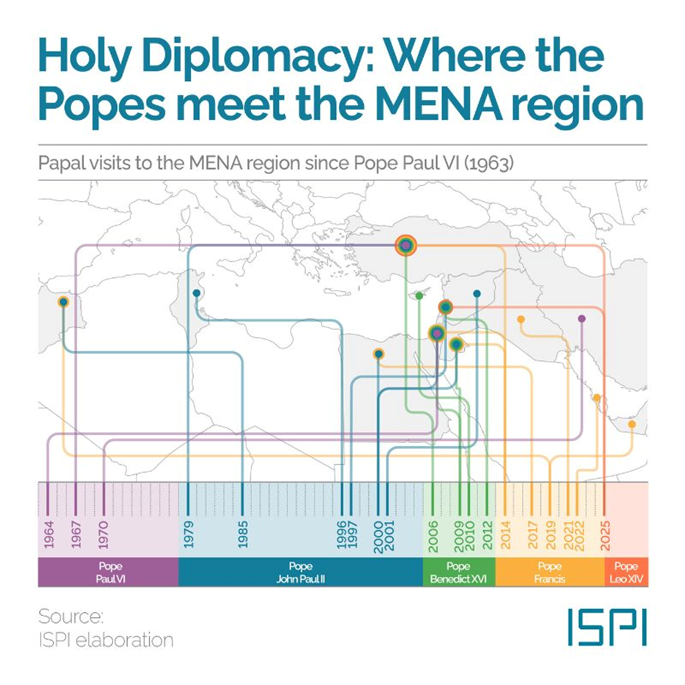
Source: ispi.it.
The diplomacy of the Holy See has developed a sustained relationship with Middle Eastern countries, focusing on three main pillars: the protection of Christian minorities, the promotion of interreligious dialogue, and moral appeals for peace in contexts of conflict. Since the Second Vatican Council (1962-1965), the Holy See has favored an approach based on trust building, the symbolic use of sacred sites, and the valorization of shared memory among Christians, Muslims, and Jews. Papal journeys have thus become fully fledged diplomatic instruments: cultural and political interventions aimed at keeping the region’s religious pluralism alive and supporting dynamics of reconciliation during the most critical moments of Middle Eastern history (Piwko 2025; Roggero & Dall’Asta 2025).
Türkiye and the Roots of Christianity
In Türkiye, the Pope visited Ankara and Istanbul as well as İznik (Nicaea), where the first ecumenical council of Christianity was held in 325 CE. The Council of Nicaea marked the first attempt to define a unified Christian doctrine, addressing key theological disputes and setting a common framework for the institutional Church. The commemoration of its 1700th anniversary was an occasion to recall that the roots of Christianity are also Anatolian roots, and an integral part of Türkiye’s cultural history. At a time when identity narratives tend to harden, the Pope evoked a shared and layered history that predates contemporary divisions (Roggero & Dall’Asta 2025).
During the journey, Leo XIV met different religious leaders, took part in moments of interreligious prayer, and visited mosques and sites laden with historical significance. These choices were interpreted in Türkiye as a recognition of the role the country has played over the centuries in facilitating dialogue between Islam and Christianity. His stop at the Blue Mosque in Istanbul, one of the city’s most iconic sites, and his meetings with Sunni authorities and representatives of the Ecumenical Patriarchate clearly signal the Pope’s intention to leverage religion as a bridge rather than a line of division (Yülek 2025).
In fact, the diplomacy of the Holy See operates through symbolic gestures rather than political pressure. It is a form of diplomacy that works when signs, even more than words, succeed in generating trust: a “choreography” of gestures of mutual respect, composed of an unwritten but deeply political language (Ataman 2025). For example, one of the most significant gestures was the visit to the Istanbul‘s Blue Mosque, an icon for Turkish Muslims. As the Holy See Press Office stated: "The Pope experienced the visit to the Mosque in silence, in a spirit of recollection and attentive listening, with deep respect for the place and for the faith of those who gather there in prayer" (Vatican News 2025). Simple gestures that, when performed by the head of the Catholic Church, acquire profound symbolic significance. Through visits to emblematic sites and encounters with local communities and religious leaders, Pope Leo XIV promoted an alternative narrative to the “clash of civilizations,” rejecting the use of religion to justify war, violence, or fanaticism and calling for unity beyond ethnic, national, and religious divides (Lamb & Haq 2025).
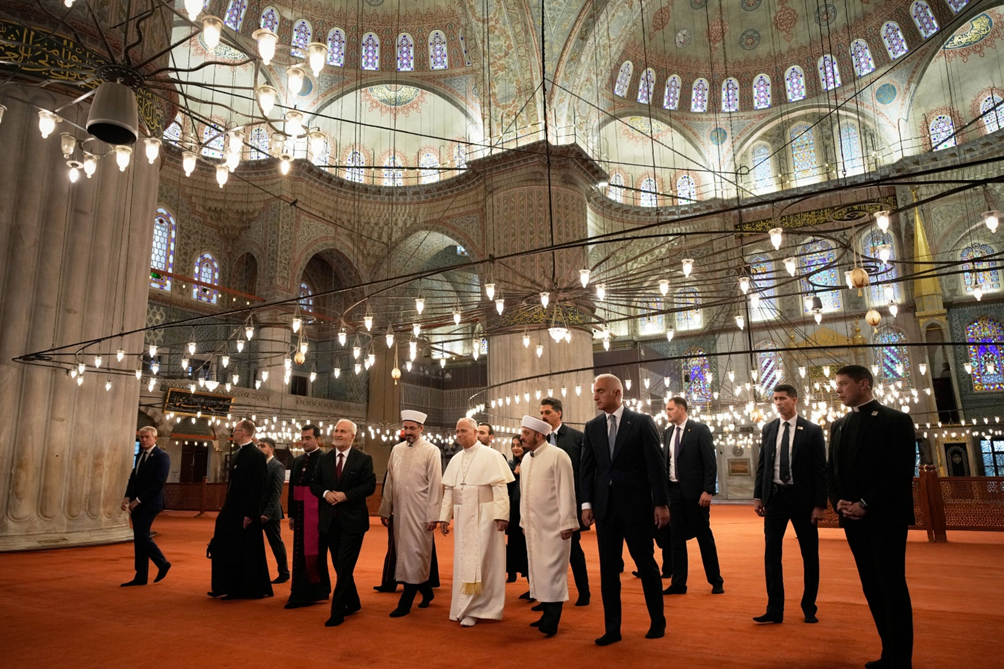
Pope Leo XIV inside the Blue Mosque in Istanbul. Religionnews.com.
Journey to Lebanon, the “Message Country”
The trip to Lebanon, in contrast, took on an even stronger emotional and political dimension. In a country struck by economic crisis, instability, and migration, the Pope’s presence was perceived as an act of unity in a time of fractures, a sign of hope and continuity for a society built on confessional coexistence. In Lebanon, Leo XIV delivered a powerful message to Christian communities, reminding them that they are not isolated. The Holy See recognizes that the Christian presence in the Middle East is not only religious but also cultural: it safeguards languages, arts, liturgies, memories, and educational institutions that contribute to the region’s identity (McLellan 2025).
At the same time, the Pope avoided any impression of partiality, addressing not only Christian communities but also Muslim ones, civil authorities, and young people of all faiths, and stressing the need for shared responsibility and reform. Meeting Christian, Muslim, and Druze leaders, he reaffirmed support for a model of coexistence unique in the Middle East, though today increasingly fragile. Through gestures rather than declarations, Vatican diplomacy revived the idea of Lebanon as a “message country”: not a mosaic of competing identities, but a bridge among cultures and religions. Attention to Christian communities, weakened by emigration and the loss of public influence, was framed not as identity-based defence but as recognition of their historical and cultural role in the land of the cedars. Then, the stop in Beirut became an appeal for reconciliation and pluralism as indispensable foundations for the country’s future (Lattanzio 2025).
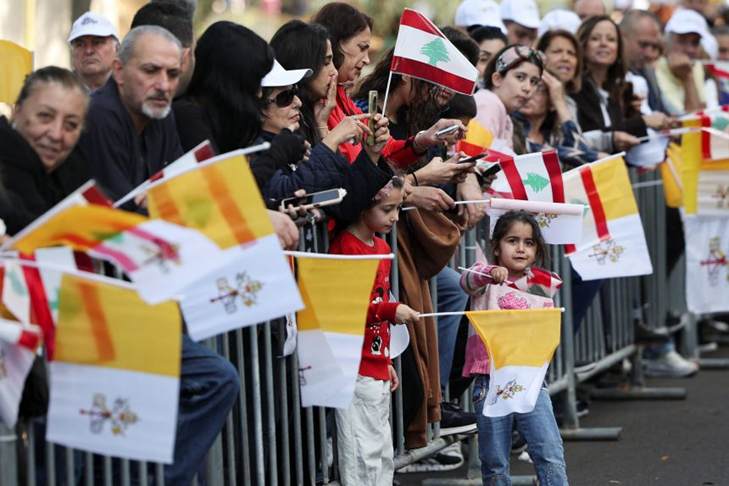
People waving Lebanese and Vatican flags gather in Baabda, Lebanon. Edition.cnn.com.
From the Levant to the World
The journey highlighted one of the most distinctive features of Vatican diplomacy: the ability to issue moral appeals that, while lacking binding force, nonetheless shape public debate and international perceptions. In Türkiye, the Pope acknowledged the country’s role as a bridge between continents and religions, while in Lebanon he recalled the responsibilities of the political class in the face of crisis. This was an invocation of the Vatican’s soft power; the Holy See does not possess coercive means, but it does wield symbolic authority capable of guiding regional and global conversations.
From this journey, three core pillars of Vatican cultural and religious diplomacy clearly emerge:
making a shared history visible in a context of polarized identities;
valuing interreligious dialogue as a political as well as a spiritual tool; and
supporting pluralism as a cultural foundation of the Mediterranean
The choice of Türkiye and Lebanon reflects the complexity of the Middle East: an Anatolia where ancient Christianity forms part of the cultural heritage, and a Lebanon that embodies, with all its fragilities, a model of confessional coexistence. The result is a journey that speaks to believers but above all to the wider world, showing that religion, culture, and diplomacy are instruments for building bridges where traditional politics often fail to reach.
References
Ataman, Muhittin. “Reasons and Implications of the Pope’s Visit to Türkiye.” SETA, December 3, 2025. https://www.setav.org/en/reasons-and-implications-of-the-popes-visit-to-turkiye.
Bordoni, Linda. “Pope Leo at Beirut Farewell: ‘Choose Peace as a Way, Not Just a Goal’.” Vatican News, December 2, 2025. https://www.vaticannews.va/en/pope/news/2025-12/pope-leo-apostolic-visit-turkiye-lebanon-farewell-ceremony-peace.html.
Lamb, Christopher & Sana Noor Haq. “Pope Leo denounces misuse of religion for ‘justifying’ war, violence or fanaticism.” CNN, November 28, 2025. https://www.cnn.com/2025/11/28/europe/pope-leo-iznik-turkey-first-foreign-visit-intl.
Roggero, Caterina & Lucia Dall’Asta. “Middle East First: Why Pope Leo’s Visits to Türkiye and Lebanon Matter.” ISPI, December 4, 2025. https://www.ispionline.it/en/publication/middle-east-first-why-pope-leos-visits-to-turkiye-and-lebanon-matter-225027.
Lattanzio, Gianni. “Il significato apostolico e diplomatico del viaggio di Papa Leone XIV in Turchia e Libano.” Gazzetta Diplomatica, December 2, 2025. https://gazzettadiplomatica.it/il-significato-apostolico-e-diplomatico-del-viaggio-di-papa-leone-xiv-in-turchia-e-libano/.
McLellan, Justin. “Pope Leo’s First Trip to Spotlight Political, Religious Unity in Time of Fracture.” National Catholic Reporter, November 25, 2025. https://www.ncronline.org/vatican/vatican-news/pope-leos-first-trip-spotlight-political-religious-unity-time-fracture.
Piwko, Aldona Maria. 2025. “Pope Francis’s Communication Strategies During His Middle East Pilgrimages: An Analysis of Interreligious Discourse and Pontifical Diplomacy.” Religions 16, no. 7: 917. https://doi.org/10.3390/rel16070917.
Vatican News, “Pope Leo Visits Blue Mosque, One of Most Important in Istanbul,” Vatican News, November 29, 2025, https://www.vaticannews.va/en/pope/news/2025-11/pope-leo-visits-blue-mosque-one-of-most-important-in-istanbul.html.
Yülek, Murat. “Subtle Signals: Pope Leo XIV’s Choice of Türkiye and Lebanon.” Daily Sabah, November 28, 2025. https://www.dailysabah.com/opinion/op-ed/subtle-signals-pope-leo-xivs-choice-of-turkiye-and-lebanon.