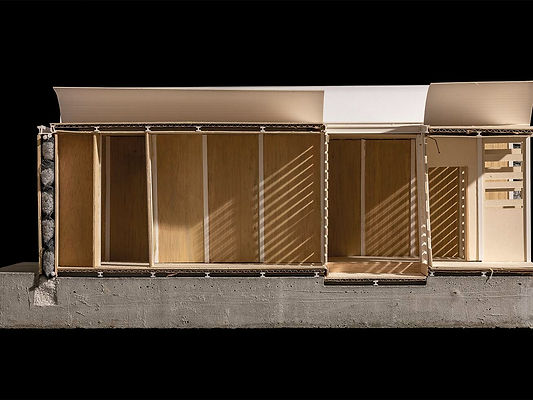
10 March 2026
On the Post-Conflict Urban Reconstruction in the Middle East:
An Interview with the Urbicide Task Force
“Carthago delenda est” (Carthage Must Be Destroyed): these are the famous words attributed to Cato, who, in a speech before the Roman Senate, is said to have urged the complete destruction of the Phoenician city state. Rome soon embarked on a three-year siege that ended with the Carthaginians being, in the words of Polybius, “utterly exterminated”[1] and the city completely devastated. According to the legend, the ruins of the city were later covered with salt, so that nothing could grow again. Beyond the myth, the destruction of Carthage stands as one of the most powerful archetypes of what we now refer to as “urbicide”. Yet there is still no single, shared definition of the term in international law, especially regarding the intentionality of the act of destruction. In a military context, for example, the devastation of buildings, infrastructure, and cultural sites is often described as unintended and a potential consequence of any armed violence. However, there are many cases in which the scale, systematic character, and selectivity of this destruction exceed what can plausibly be reduced to collateral damage. This is evident in cases such as Gaza and other cities in the Middle East, where urban and cultural annihilation go way beyond military objectives, striking instead at the foundations of collective memory, social life, and identity.
To address these issues more clearly, in November 2025 I had the opportunity to interview Jacopo Galli, Coordinator of the Urbicide Task Force,[2] a research group established by Prof. Benno Albrecht at Università Iuav of Venice and specialized in post-war urban reconstruction. Over the years, the Urbicide Task Force has developed solid experience in conflict settings, leading in 2023 to the formalization of an agreement with the Bureau for Arab States of the United Nations Development Programme.
In addition to its work in Syria and Iraq, and more specifically in the reconstruction of Aleppo, Damascus, and Mosul, the Urbicide Task Force works closely with the Programme of Assistance to the Palestinian People (PAPP) - the UNDP office dedicated to the Palestinian Territories - contributing to the development of a dedicated strategy for the reconstruction of the Gaza Strip. All of this experience and knowledge converged in Galli’s 2023 book Cities Under Pressure. A Design Strategy for Urban Reconstruction,[3] which presents in detail an intervention strategy that can potentially be adapted to the specific conditions of areas of the world affected by conflicts, disasters, or social challenges.

Figure 1 - The “Sketch for Syria” initiative called architects worldwide to imagine and share scenarios for reconstruction. It gathered 132 entries from 27 countries, including 52 sketchbooks from Syria through a collaboration with UN-ESCWA, with participants using drawing as a tool to reflect on destruction, displacement, and future possibilities.
Source: https://urbicidetaskforce.iuav.it/index.php/portfolio/sketch-for-syria/
Urbicide: A Modern Term for “the Oldest Story in the World”
From the mythical Troy, Jerusalem, and Carthage, through Guernica, Coventry, Dresden, Hiroshima, and Warsaw, to the more recent cases of Aleppo, Mosul, and Gaza, the practice of urbicide has existed for as long as cities themselves. As emphasized by Professor Marshall Berman, although the specific term from the Latin urbs, meaning city, and cidium, meaning killing, was coined in the second half of the twentieth century, the destruction of cities is an ancient practice – what he calls “the oldest story in the world.”[1] Berman was among the first scholars to apply the term to a real world context, though he primarily referred to the urban transformations of the 1970s, mainly linked to the processes of urban decay and ghettoization. The term acquired a predominantly conflict-related meaning in the 1990s, when Bogdan Bogdanović, architect and former mayor of Belgrade, used it in the context of the wars in the former Yugoslavia - conflicts marked by massive urban destruction such as in Sarajevo and Vukovar - defining the practice of devastating cities as “a manifest and violent opposition to the highest values of civilization.”[2] To date, the concept of urbicide is not yet recognized under international law. However, many acts that constitute urbicide are already prosecutable under existing international law, as stated in Art. 8 of the Rome Statute where, among the list of war crimes, appears “extensive destruction and appropriation of property, not justified by military necessity and carried out unlawfully and wantonly.”[3]
The Urbicide Task Force
Benno Albrecht, rector at IUAV University of Venice and Principal Investigator of the Urbicide Task Force, writes in his essay Peace and Architecture that “one of the most pressing topics in the field of civil commitment and in the operational field of architecture is how to deal with the consequences of urbicides, with the deliberate violence against cities, with their destruction, and with the intentional elimination of collective memory made of stone.”[4] It is from this awareness that the Task Force’s approach takes shape, starting from dialogue with some Syrian colleagues in the middle of the civil war. In 2016, the Venice Charter on Reconstruction[5] was published, a collection of guidelines for post-war development that also reflected on the role that architects can, and should, play in such contexts.


Figures 2-3. Other drawings from the “Sketch for Syria” initiative. Engagement with the Syrian context and with Syrian colleagues was pivotal to the launch of the Urbicide Task Force’s activities.
Source: https://urbicidetaskforce.iuav.it/index.php/portfolio/sketch-for-syria/
Still nowadays, indeed, the role of architects in post-war reconstruction remains largely marginal, being the last ones in a long chain of decision-making actors about the future of the cities after legislators, financiers, military actors, and scientists. Architects and urban planners are still too often excluded from these processes, even though their expertise is directly concerned with the long-term transformation of urban space. The Venice Charter on Reconstruction calls for architects to act collectively as a transnational pressure group, combining solid data analysis, responsible resource management, and socially grounded design. In contexts of widespread destruction and social fragmentation, architects and planners have a specific role: not only to rebuild physical structures, but to shape the built environment in ways that respond to community needs and help restore the relationship between people and their cities. The Charter’s introduction stresses that “the increasing prevalence of Urbicide in the contemporary world places new demands on and necessitates new approaches to post-war development.”
As highlighted during my interview with Galli, his team of researchers and architects has worked toward “a graphic and also informative understanding of what urbicide is”, translating urban destruction into an extensive body of drawings of destroyed and reconstructed places. This method deliberately draws on an Italian, and specifically Venetian, tradition known as disegno urbano (urban drawing), which Galli distinguishes from the more Anglo-Saxon urban design. “Urban design,” he notes, “is essentially urban planning for the English, whereas disegno urbano is the idea that the city has forms, and that these forms are, in some way, controllable.” From this perspective emerged an intense effort to analyse and represent morphological changes in the city - changes that, as Galli emphasizes, “we drew extensively in order to grasp their deeper transformations.”
The experiences led the team to a critical conclusion: most historical experiences of urban reconstruction struggle to be carried into the present, because the major point of reference remains post-WWII reconstruction, which was largely based on rebuilding historic city centres, whereas today destruction affects entire, complex, urban areas. It follows a profound inadequacy of contemporary design tools, a shortcoming that, Galli underlines, has emerged with force in the team’s more recent work on Gaza. From this realization it appears clear the need to radically rethink the design system and procedures - an effort that has found an initial synthesis in the volume Cities Under Pressure, conceived as “a core idea of what we believe should be done when faced with large scale destruction.”
The Reconstruction of Gaza
The scale and speed of destruction in the Gaza Strip rank among the most severe in contemporary history, affecting homes, hospitals, schools, religious sites, factories, and critical infrastructure. Satellite analyses indicate that around 68 percent of roads, 70 percent of greenhouses, and nearly 70 percent of tree crops have been damaged or destroyed. [1] A recent satellite-based study estimates that over 60 percent of buildings were destroyed or severely damaged between October 2023 and September 2025. The spatial extent of devastation, from Gaza City to Rafah, points to a continuous process in which urban space is progressively emptied of its civil and symbolic functions and reshaped by military logics.
Conceiving urban space through military logics is not new in Israeli doctrine. In the concept of “inverse geometry,” associated with former IDF Chief of Staff Aviv Kochavi,[2] the city itself becomes an operational tool: military units move through buildings rather than streets, breaking walls and floors and treating the urban fabric as a continuous internal space. In this logic, walls turn into passages and the city’s geometry is reversed, producing deterritorialization and eroding urban space to the point of losing its identity.
Beyond urban warfare techniques, organizations such as Euro Med Human Rights Monitor argue that the destruction of homes and infrastructure functions as a spatial mechanism aimed at making Gaza uninhabitable, dismantling community life, and preventing the return of displaced residents.[3] In this perspective, urbicide emerges as a form of political control that operates on territory and its capacity for regeneration.

Figure 4 - The UN estimates more than 90% of the housing units in Gaza have been damaged during the war.
Source: https://www.bbc.co.uk/news/resources/idt-217c6a28-4a90-4d47-a91c-13113a7dc7db
On 3rd of October 2023, the Urbicide Task Force entered into an agreement with the Regional Bureau for Arab States, based in New York, which serves as the headquarters for UNDP’s regional programmes and country offices in sixteen Arab countries, with a seventeenth office in the Occupied Palestinian Territory. The agreement was signed just days before the attack of 7 October 2023, and Gaza was not initially included. As Galli recalled, “on 8 October we received a call from colleagues in New York, who told us: ‘start thinking about Gaza, because something very serious is going to happen.’ We presented our first proposal in March 2024 at the annual Regional Bureau meeting, held at the local headquarters in Amman, Jordan.”
Building on the ideas developed in Cities Under Pressure, the team sought to adapt its framework to the specific context of Gaza. As Galli explained: “this meant outlining a set of core principles: reconstruction in a context of near total destruction (even if that outcome was only beginning to become apparent, but it was clear how it would have ended), should proceed through dense built elements, what the team calls urban cells. It should also rely on modular, finite elements, a system that helps ensure predictable timelines, stronger operational capacity on the ground, and more effective intervention”. These principles were accompanied by broader reflections on building density, residential density, and spatial organization.

Figure 5 - Example of modular system composed by urban cells
Source: https://urbicidetaskforce.iuav.it/index.php/portfolio/sustainable-reconstruction-for-aleppo/
This initial engagement opened the way for collaboration with the Programme of Assistance to the Palestinian People. However, it soon became clear that conditions on the ground were changing too rapidly for conventional planning. “We realized that producing a plan has been practically impossible,” Galli noted, “because changes are happening too fast, and perhaps the very tool of the plan is the wrong one.” In response, the team has shifted its focus toward developing a geographic information system (GIS)-based database capable of collecting real-time information and running continuous simulations to support data-driven decision making. At present, this system is still in the early stages, serving basic but crucial needs, such as identifying where to place temporary shelters - a process that until now has often relied on incomplete data and ad hoc decisions.
The long-term ambition is for this tool to evolve alongside the reconstruction process itself, guiding the transition from emergency response to rebuilding. “At this stage,” Galli added, “we are building tools rather than implementing processes. We see these tools as coordination instruments that we can use, but that many others will also be able to use in the future.” Such instruments are essential in a context like Gaza, where thousands of actors, states, NGOs, and organizations will soon converge within an extremely limited space, creating a high risk of duplication, waste, and inefficiency. A shared coordination tool could help avoid redundant interventions, unnecessary movement of rubble, and fragmented efforts. “In our view, as practitioners working on the ground, this is the only realistic approach,” Galli concluded. “Everything else is just announcements and is ultimately unworkable” - a clear reference to the many reconstruction plans that have been proclaimed over time but never implemented.
The Role of Reconstruction and Communities in Peace-Building Processes
Professor Galli also reflected critically on the relationship between reconstruction and peace. “That reconstruction is an assurance of peace is a gamble” he argued, “however, it is also clear that the opposite is true, in the sense that reconstructions carried out in the wrong ways in recent years have led to renewed conflict.” Iraq was cited as an emblematic case. “We have already rebuilt Iraq three times,” as American colleagues have often pointed out, “and we keep destroying it.” Recalling a discussion at the World Bank, he noted how some US officers openly admitted, “I do not really know how cities should be rebuilt, but I do know that what we are doing is completely wrong and that something else is needed.” Then, while rejecting any automatic link between reconstruction and peace, he nonetheless advanced a more nuanced hypothesis: it is logical to think that rebuilding “in a certain way” can improve living conditions and help reduce conflict. It is not a guarantee, but a real possibility.
When discussing the role of local communities, which any reconstruction plan must consider if it wants to contribute to the peacebuilding process, Galli stressed that placing communities at the centre cannot mean expecting them to design reconstruction systems on their own. “Local communities are in the middle of a war, so they have other things to think about,” and reconstruction itself requires “very strong specialist knowledge.” This, however, does not undermine the principle that local communities should play a central role in the process. Rather, it acknowledges that ongoing conditions often prevent them from doing so. For this reason, external actors such as international consultants become relevant, not as substitutes for locals, but as facilitators whose task is to help create the conditions in which meaningful participation can actually take place. Then, once the necessary conditions have been reached, participation should be built on the ground, through people who speak the language, who have relationships of trust, and who possess direct knowledge of local communities.

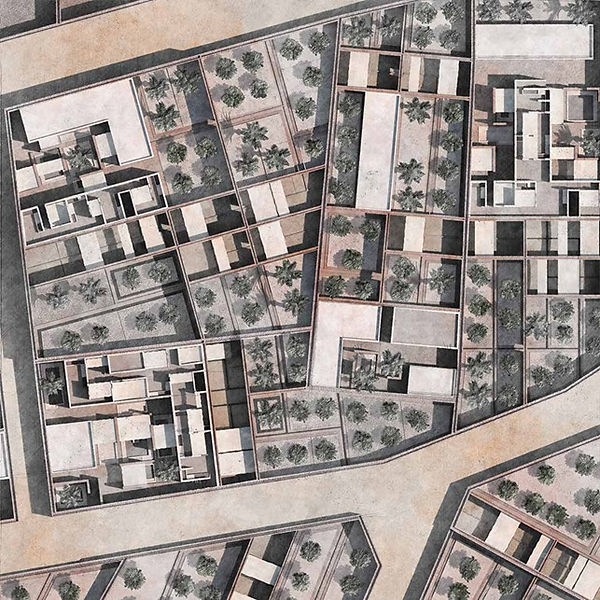
Figures 6 – 7. Rural Syria post-war scenarios
Source: https://urbicidetaskforce.iuav.it/index.php/portfolio/urbicide-rural-syria-reconstruction-of-villages/
However, the core issue remains systemic: enabling mechanisms for true participation must be created. In this regard, Galli uses an example of reconstruction financing: when international actors claim to have provided “100 billion dollars to rebuild Syria,” the issue is not only how much is invested, but how. Under current methodologies, he noted, “85 out of those 100 billion go to large international companies,” leaving only a minimal share on the ground. In this way, infrastructure may be rebuilt, but the social and economic foundations needed to sustain it over time are not. Increasing “local content”, meaning the share of resources that actually remain in the territory, “would already change everything,” providing concrete support to communities. This is not something communities can achieve on their own in the initial phases, but rather a matter of method and governance. It is these modes of intervention, he concluded, that must be seriously reconsidered if local communities are truly to play a central role in post-war reconstruction.
Reconstructing Memory: Cultural Destruction and Urban Identity
During the interview, we also addressed the issue of the destruction of historical and cultural sites. While urbicide aims at the death of the city, culturicide specifically targets the erasure of collective memory. International humanitarian law absolutely prohibits the deliberate targeting of cultural and religious sites that are not legitimate military objectives. Such protection is a cornerstone of international custom, codified in the 1954 Hague Convention (Article 4) and its two (1954 and 1999) Protocols. [1] Moreover, targeting and destroying cultural heritage sites constitutes a war crime under the Rome Statute (Article 8) of the International Criminal Court.[2] However, this has not prevented the immense devastation of the historic centres of places such as Mosul, Aleppo, and Damascus.
Gaza is no exception. As of 6 October 2025, UNESCO has verified damage to 114 sites since 7 October 2023, including 13 religious sites, 81 buildings of historical or artistic interest, 3 repositories of movable cultural property, 9 monuments, 1 museum, and 7 archaeological sites.[3] Among these are the Great Omari Mosque (one of the oldest in Palestine), the Monastery of Saint Hilarion at Tell Umm Amer, and the Pasha’s Palace, which housed Ottoman artefacts and historical documents. The World Bank assessed in February 2025 that 53 percent of heritage sites had been damaged or destroyed[4] and that rebuilding would cost at least $53 billion.[5] In its report of 16 September 2025, in which the United Nations stated that Israel was committing genocide in Gaza, the systematic destruction of cultural and religious sites was explicitly cited as relevant evidence “to infer genocidal intent.”[6]

Figure 8 - The remains of the Great Omari Mosque in Gaza following Israeli military attacks in January 2024.
During the interview, the issue of reconstruction of historical centres was a central topic. Galli stated that interventions in historic centres appear conceptually clear and grounded in a well-established tradition of urban restoration. This tradition runs through major Italian urban plans in cities such as Venice, Palermo, and Bologna and, as international cases demonstrate, can be applied in very different contexts. As he noted, “it has been scientifically proven that it can be applied anywhere.” Conservation and regulatory plans, he emphasized, are not rigid or museum like instruments. Certain elements can change, provided that clear parameters are respected - parameters capable of maintaining historical and cultural continuity. “If the information is available, everything that is historical can be reconstructed,” even after very extensive destruction. He pointed to the long-term work currently underway in Mosul, where reconstruction is proceeding through the careful cataloguing of buildings, the definition of intervention practices, and the possibility of controlled transformations within a regulatory framework designed to endure over time. “The same will happen in Damascus, with the Historic Centre” he added, “and it could also happen in Gaza, where the historic centres are very small, fragmented into tiny pieces.” At the same time, reconstructing everything exactly as it was before is not always desirable. “Ukraine, for example,” he noted, “is a case where the urban fabric being destroyed is of very poor quality - a Soviet-era fabric. We could rebuild the Soviet city, but I do not think it was a place where people loved to live, so perhaps that should be rethought.”


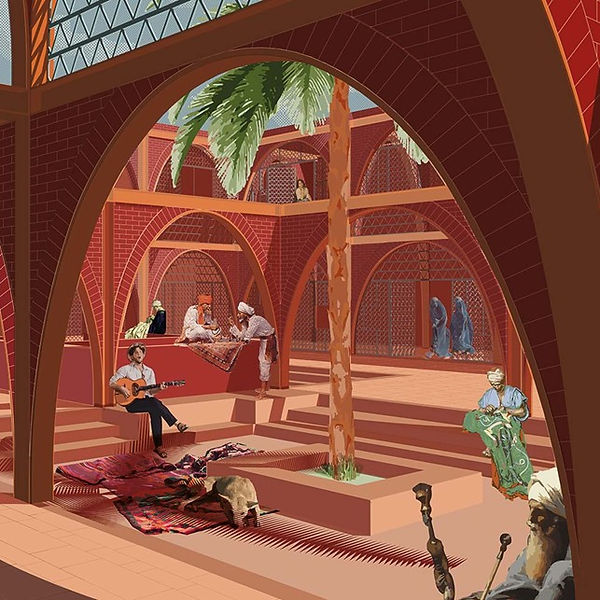
Figures 9-11. Triggers for the reconstruction of Mosul.
Source: https://urbicidetaskforce.iuav.it/index.php/portfolio/urbicide-mosul-triggers-for-reconstruction/
However, reconstruction can undermine urban identity even more deeply than war itself, and history offers numerous examples of this risk, most notably the failed reconstruction of Beirut, cited during the interview as a model to avoid. There, reconstruction was reduced to a “large-scale real estate operation” Galli stated, producing spaces that were formally rebuilt but culturally empty, “completely devoid of meaning.” The result was not a living city, but an urban fragment stripped of memory and social relations. Beirut then stands as “a great lesson in stone on what not to do.” Alongside this trajectory lies the danger of the so called “Dubai model,” often perceived in many Middle Eastern countries as a success story, including in Syria, where projects such as Marota City in Damascus have risked imposing an urbanism alien to the city’s social and historical fabric, generating deep inequalities and fractures. The problem, Galli concluded, is not the lack of negative examples, which are abundant, but the difficulty of building and consolidating reconstruction practices capable of restoring to cities: not only buildings, but also meaning, memory, and identity.
Rethinking Technology and Sustainability in Post-War Cities
In discussing the role of technologies and methodologies in urban reconstruction, Galli first downplayed the idea that technical innovation is the primary driver of the process. The most important “technology,” he argued, remains study itself: “our greatest technology is studying a great deal, trying to understand many things.” Reconstruction is described as a field that is today widely discussed at a rhetorical level, yet still weakly grounded in solid and systematic knowledge. Although “everyone talks about it,” he noted, “few have actually studied the cases in depth, not least because a true comparative history of urban reconstruction is still missing. There is no shared theoretical corpus or structured bibliography, a gap that often leads to improvisation or ad hoc solutions”. Therefore, there is crucial distinction between the design phase and the concrete implementation of reconstruction. It is above all in this latter phase, according to him, that technologies can become truly relevant. Professor Galli, however, kept underlining how “technology alone will not save us […] technology has value only insofar as it serves an idea. First come the project, the vision, and the reasoning; only afterward do the appropriate technical tools follow.” The case of Syria is emblematic:
“With millions of homes to rebuild, the large-scale use of concrete is not only economically or logistically problematic, but also environmentally unsustainable, since the water required for its production would exceed the country’s available reserves. This makes it necessary to think in terms of waterless structural technologies. Such solutions certainly involve technological innovation, but they arise from an analysis of material and environmental conditions and from careful upstream reasoning.”
Technology thus emerges not as a definitive answer, but as a tool for implementing a broader vision, aware of the specific conditions.

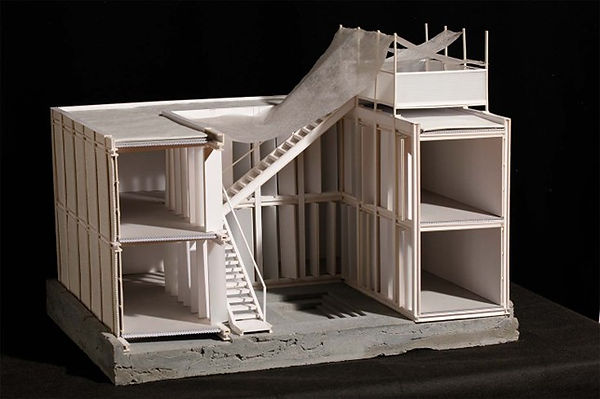


Figures 12-15. Syria: the Design of a Re-Foundation. Designs for rural Syria were presented through 1:25 models highlighting low energy, waterless technologies that reuse rubble as building material. The construction methods are simple and intended to be directly applied by local communities, supporting a bottom-up reconstruction process.
Source: https://urbicidetaskforce.iuav.it/index.php/portfolio/reconstructions-architecture-city-and-landscape-in-the-age-of-destructions/
This reasoning leads directly to the question of sustainability. In this case, the tragedy of destroyed cities can be read also as a possibility to implement new and better urban solutions. Unlike consolidated European cities that “were not built for a sustainable transition, a city that must be rebuilt offers the opportunity to bypass intermediate stages and move directly toward more advanced solutions. In such cases, there is no need to adapt what already exists; it becomes possible to design from the outset a city equipped with advanced services, efficient infrastructure, and integrated connectivity systems.” Galli also advanced a critical reading of sustainability itself, shaped by decades of research. “Sustainability,” he began, “understood as the pursuit of a stable and recoverable equilibrium, is no longer an adequate category.” Environmental, climatic, and social crises have crossed irreversible thresholds, and for this reason, he argued, we have already entered a phase of post-sustainability. In this new paradigm, sustainability is no longer the promise of a future equilibrium, but the recognition of a permanent crisis that must be addressed through strong decisions at multiple scales. This is not necessarily a catastrophic outlook, but a shift in perspective: accepting that the crisis exists and designing within it, rather than imagining a return to an ideal condition. Here again, technology remains essential, but as an operational instrument within a broader worldview. Urban reconstruction, Galli implicitly concluded, therefore requires not only advanced technical solutions, but a cultural and political project capable of directing the use of those technologies toward goals that are consistent with the real conditions of the present.
Carthago Servanda Est
The interview with Jacopo Galli unfolded as a journey through the rubble and tragedies of entire cities and communities - “a rather unsettling experience,” as he described his walk through the ruins of Mosul. It made clear that in contemporary conflicts war is increasingly fought within cities, and that urbicide represents a consolidated form of violence in which civilians and the urban environments they inhabit become primary targets. The city is therefore never a neutral backdrop to conflict, but one of its central stakes.
As emerged from the interview, post-conflict reconstruction cannot be reduced to a technical exercise. It is a political, cultural, and spatial process that can either help restore urban life or prolong the logic of urbicide through practices that erase memory, exclude communities, and impose urban models detached from local realities. This explains why the political element remains central, and it could not be otherwise. Politics, in its original sense, derives from pólis: the city as the space of common life. Within this framework, architecture occupies a critical position. As both a technical and social tool, it can contribute to healing fractured environments, rebuilding torn social fabrics, and enabling reconciliation through inclusive practices, cultural restoration, and the requalification of urban space. Yet this potential is constrained by economic limits, political polarization, and bureaucratic obstacles, which often reduce reconstruction to technocratic or speculative operations. Overcoming these limits requires coordinated action between architects, policymakers, and local communities, capable of balancing cultural sensitivity with practical constraints.
If Carthago delenda est has long symbolized the logic of urbicide, the work of the Urbicide Task Force points toward a necessary reversal Carthago servanda est (Carthage must be saved),[1] a counter-imperative already invoked in the Roman Senate against Cato’s destructive logic. In the context of post-conflict reconstruction, this does not imply a nostalgic and impossible restoration of the past, but rather a responsibility to rebuild cities in ways that safeguard memory, restore collective life and the social fabric, and resist forms of erasure produced not only by war, but also by certain reconstruction practices themselves. When buildings themselves can no longer be saved, what must be preserved are what Galli calls the city’s characteristic forms: those spatial traces and patterns that carry memory, anchor identity, and sustain the everyday life of communities.
Bibliography
Albrecht, Benno. “Peace and Architecture.” In Syria – The Making of the Future: From Urbicide to the Architecture of the City, edited by Jacopo Galli, Conegliano: Incipit Editore, 2017.
https://www.scribd.com/document/387033508/WAVE-2017-Syria-the-Making-of-the-Future.
BBC News. “Gaza War in Maps and Satellite Images,” October 13, 2025. BBC. Accessed February 29, 2026. https://www.bbc.co.uk/news/resources/idt-217c6a28-4a90-4d47-a91c-13113a7dc7db.
Berman, Marshall. “Falling Towers: City Life after Urbicide.” In Geography and Identity: Living and Exploring Geopolitics of Identity, edited by Dennis Crow, 172–192. Washington, DC: Maisonneuve Press, 1996.
Euro-Med Human Rights Monitor. Israel Expands Urbicide as a Tool of Genocide in Gaza. 2024. Accessed February 28, 2026. https://euromedmonitor.org/en/article/6569/Israel-expands-urbicide-as-a-tool-of-genocide-in-Gaza.
International Committee of the Red Cross. Rome Statute of the International Criminal Court: Article 8 (War Crimes). International Humanitarian Law Databases. Accessed February 28, 2026. https://ihl-databases.icrc.org/en/ihl-treaties/icc-statute-1998/article-8.
International Criminal Court. Rome Statute of the International Criminal Court. Rome, July 17, 1998. Entered into force July 1, 2002. https://www.icc-cpi.int/sites/default/files/NR/rdonlyres/ADD16852-AEE9-4757-ABE7-9CDC7CF02886/283503/RomeStatutEng1.pdf.
Kiernan, Ben. “The First Genocide: Carthage, 146 BC.” Diogenes 51, no. 3 (2004): 27–39. https://doi.org/10.1177/0392192104043648.
Plutarch. The Life of Cato the Elder. In Plutarch’s Lives, vol. 2, translated by Bernadotte Perrin. Cambridge, MA: Harvard University Press; London: William Heinemann, 1914. https://penelope.uchicago.edu/Thayer/E/Roman/Texts/Plutarch/Lives/Cato_Major*.html.
Tavoletta, Concetta. “A New Idea of Revitalization for Urbicide Crisis.” In Proceedings of the 7th International Conference of Contemporary Affairs in Architecture and Urbanism, vol. 7, no. 1 (2024). https://doi.org/10.38027/ICCAUA2024EN0193.
Turan, A. Menaf. “Israel’s Genocide in Gaza: A Crime of Urbicide?” Politics Today, October 16, 2025. https://politicstoday.org/israels-genocide-in-gaza-a-crime-of-urbicide/.
UNESCO. Convention for the Protection of Cultural Property in the Event of Armed Conflict, with Regulations for the Execution of the Convention, and the First and Second Protocols. The Hague, May 14, 1954; First Protocol, May 14, 1954; Second Protocol, March 26, 1999. https://unesco.nl/sites/default/files/2018-11/conventie_1954.pdf.
UNESCO. “UNESCO’s Action in the Gaza Strip/Palestine.” Accessed February 28, 2026. https://www.unesco.org/en/gaza/assessment.
United Nations. “Israel Has Committed Genocide in the Gaza Strip, UN Commission Finds.” September 16, 2025. https://www.ohchr.org/en/press-releases/2025/09/israel-has-committed-genocide-gaza-strip-un-commission-finds.
Urbicide Task Force. Official Website. Accessed February 29, 2026. https://urbicidetaskforce.iuav.it/.
Urbicide Task Force. “Venice Charter on Reconstruction.” Accessed February 28, 2026. https://urbicidetaskforce.iuav.it/index.php/portfolio/venice-charter-on-reconstruction/.
Weizman, Eyal. Hollow Land: Israel’s Architecture of Occupation. London: Verso, 2007. https://stankievech.net/projects/counterintelligence/workshop/Weizman-Eyal_HollowLand_2007-Ch07.pdf.
World Bank, European Union, and United Nations. Gaza and West Bank Interim Rapid Damage and Needs Assessment. February 2025. Accessed February 28, 2026: https://thedocs.worldbank.org/en/doc/133c3304e29086819c1119fe8e85366b-0280012025/original/Gaza-RDNA-final-med.pdf.
Notes
[1] Ben Kiernan, “The First Genocide: Carthage, 146 BC,” Diogenes 51, no. 3 (2004): 27–39.
[2] Urbicide Task Force “Official Website”: https://urbicidetaskforce.iuav.it/
[3] Cities Under Pressure https://architangle.com/book/cities-under-pressure
[4] Marshall Berman, “Falling Towers: City Life after Urbicide,” in Geography and Identity: Living and Exploring Geopolitics of Identity, ed. Dennis Crow (Washington, DC: Maisonneuve Press, 1996), 175.
[5] Concetta Tavoletta, “A New Idea of Revitalization for Urbicide Crisis,” in Proceedings of the 7th International Conference of Contemporary Affairs in Architecture and Urbanism, vol. 7, no. 1 (2024).
[6] International Committee of the Red Cross, “Article 8 – War Crimes,” International Humanitarian Law Databases, accessed February 28, 2026. https://ihl-databases.icrc.org/en/ihl-treaties/icc-statute-1998/article-8
[7] Benno Albrecht, “Peace and Architecture,” in Syria – The Making of the Future: From Urbicide to the Architecture of the City, ed. Jacopo Galli (Conegliano: Incipit Editore, 2017).
[8] Urbicide Task Force, “Venice Charter on Reconstruction,” accessed February 28, 2026. https://urbicidetaskforce.iuav.it/index.php/portfolio/venice-charter-on-reconstruction/
[9] BBC News, “Gaza War in Maps and Satellite Images,” October 13, 2025, accessed February 28, 2026. https://www.bbc.co.uk/news/resources/idt-217c6a28-4a90-4d47-a91c-13113a7dc7db
[10] Eyal Weizman, Hollow Land: Israel’s Architecture of Occupation (London: Verso, 2007).
[11] Euro-Med Human Rights Monitor, Israel Expands Urbicide as a Tool of Genocide in Gaza (Geneva, 2024), accessed February 28, 2026. https://euromedmonitor.org/en/article/6569/Israel-expands-urbicide-as-a-tool-of-genocide-in-Gaza
[12] UNESCO, Convention for the Protection of Cultural Property in the Event of Armed Conflict, The Hague, May 14, 1954; Protocol to the Convention for the Protection of Cultural Property in the Event of Armed Conflict, May 14, 1954; Second Protocol to the Hague Convention of 1954 for the Protection of Cultural Property in the Event of Armed Conflict, March 26, 1999. https://unesco.nl/sites/default/files/2018-11/conventie_1954.pdf
[13] International Criminal Court, Rome Statute of the International Criminal Court (Rome, July 17, 1998). https://www.icc-cpi.int/sites/default/files/NR/rdonlyres/ADD16852-AEE9-4757-ABE7-9CDC7CF02886/283503/RomeStatutEng1.pdf
[14] UNESCO complete list: https://www.unesco.org/en/gaza/assessment
[15] World Bank, European Union, and United Nations, Gaza and West Bank Interim Rapid Damage and Needs Assessment (February 2025). https://thedocs.worldbank.org/en/doc/133c3304e29086819c1119fe8e85366b-0280012025/original/Gaza-RDNA-final-med.pdf
[16] A. M. Turan, “Israel’s Genocide in Gaza: A Crime of Urbicide?” Politics Today, October 16, 2025, accessed February 28, 2026. https://politicstoday.org/israels-genocide-in-gaza-a-crime-of-urbicide/
[17] United Nations Human Rights Council, “Israel Has Committed Genocide in the Gaza Strip, UN Commission Finds,” September 16, 2025. https://www.ohchr.org/en/press-releases/2025/09/israel-has-committed-genocide-gaza-strip-un-commission-finds
[18] Plutarch, The Life of Cato the Elder, in Plutarch’s Lives, vol. 2, trans. Bernadotte Perrin (Cambridge, MA: Harvard University Press; London: William Heinemann, 1914), 383.
https://penelope.uchicago.edu/Thayer/E/Roman/Texts/Plutarch/Lives/Cato_Major*.html