Echoes of the Deep: Tracing the UAE’s Pearl Diving Heritage Across Emirates
Step into the heart of Dubai Mall. If you pause for a moment among the designer shopfronts and neon cafés, you’ll notice something that feels slightly out of place in a world of glass and steel. Suspended under soft light is a sculpture that shimmers like a school of fish caught mid-dance. Its pearl-like curves and flowing forms recall the rhythm of waves, a subtle reminder of a time before oil and skyscrapers, when the Emirates lived by the rise and fall of the sea.
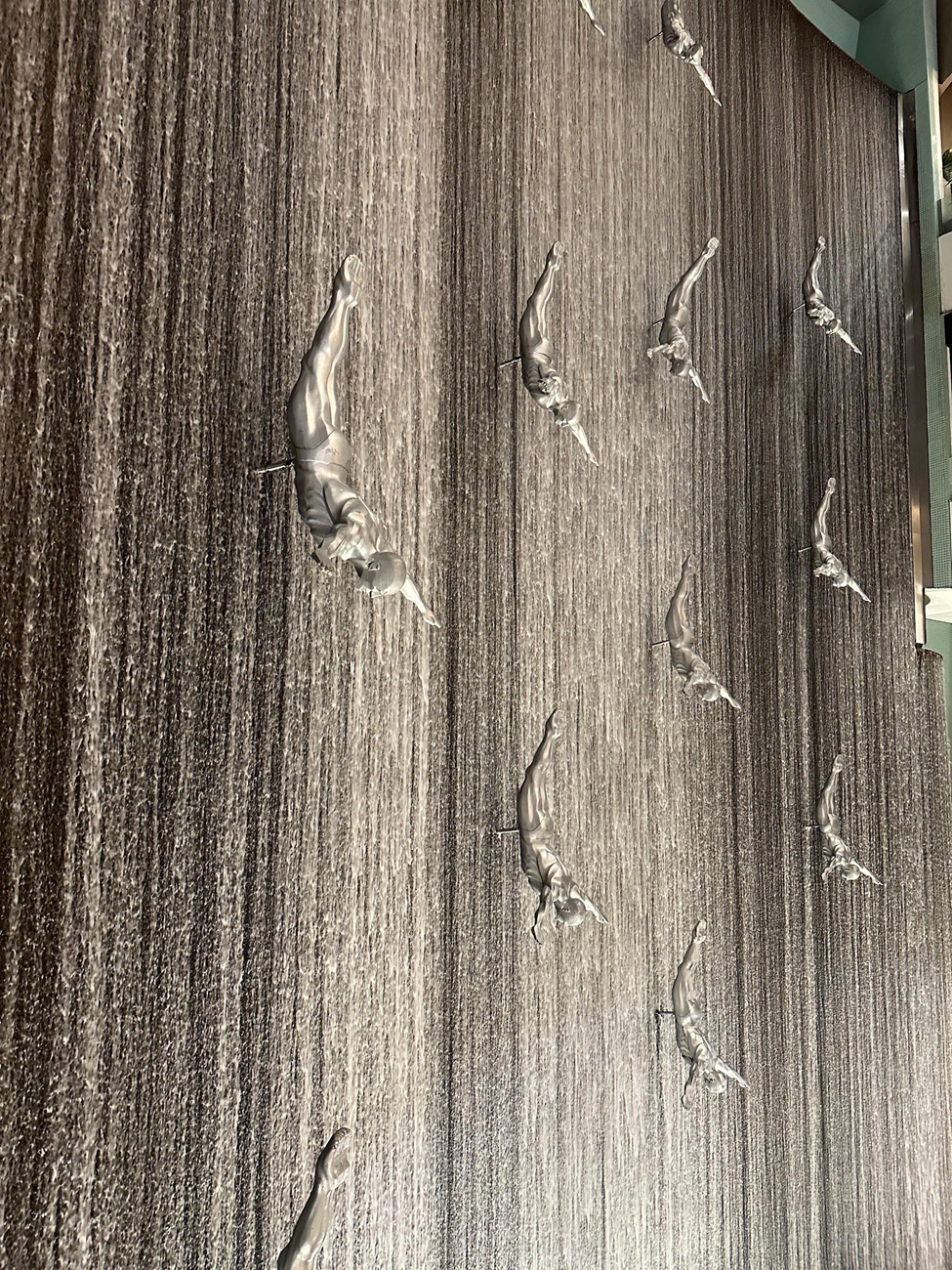
The Human Waterfall installation at Dubai Mall: a towering indoor cascade adorned with life-sized fiberglass sculptures of pearl divers, symbolizing the UAE’s maritime heritage designed by DP Architects (Personal Archive).
For centuries, pearl diving shaped life in the Gulf. It was the heartbeat of communities and a foundation of the economy. Even as the modern skyline draws the eye today, echoes of that older rhythm remain, visible in museums and festival that keep the memory alive.
Pearl Diving: The Lifeblood of the Pre-Oil Economy
Until the mid-20th century, survival in the Trucial States (what we now call the UAE) depended on three main trades: date farming, fishing, and pearling. Among them, pearling reached far beyond local shores. By the 1800s, Gulf pearls were prized in Bombay’s bazaars, Parisian workshops, and the ornaments of royalty (Hightower, 2016).
The work was brutally hard. Each summer, fleets of wooden dhows would set out, sometimes for months. Divers plunged as deep as 14 meters, holding their breath for over a minute, armed with little more than a nose clip and finger guards. Imagine the silence down there, broken only by the rush of bubbles, the sting of saltwater in your eyes, and the weight of the rope pulling you back to the boat (Willis, 2016).
Life on board was its own small world. There was the nakhuda, the captain who steered the dhow and the expedition’s fate; the ghawwas, the divers; the saib, who hauled the divers up; the nahham, whose fijiri chants kept morale afloat; and the cook, who kept everyone going on simple but vital meals. Those chants were more than music; they were a lifeline, a way to measure time and share the load (Abdellatif & Missaoui, 2020).
Museums Preserving the Deep
Today, you don’t have to brave the Gulf waters to experience that world. Walk into the Sharjah Maritime Museum, and you’ll see the tools of the trade: heavy rope weights, oyster baskets, and even full dhow replicas. Just next door, the Sharjah Heritage Museum offers life-sized scenes that bring the pearling season to life, so vivid you can almost hear the creak of the boat and the distant songs of the crew.
In Umm Al-Quwain’s National Museum sits within an old fort. It’s “Sea Chamber,” a room that smells faintly of aged wood and salt, lined with relics of the diving days. In Abu Dhabi’s Louvre and Qasr Al Hosn blend these artifacts into larger stories of the nation’s history, making you see how the pearling era fits into a much older and richer tapestry (Exell & Rico, 2014).
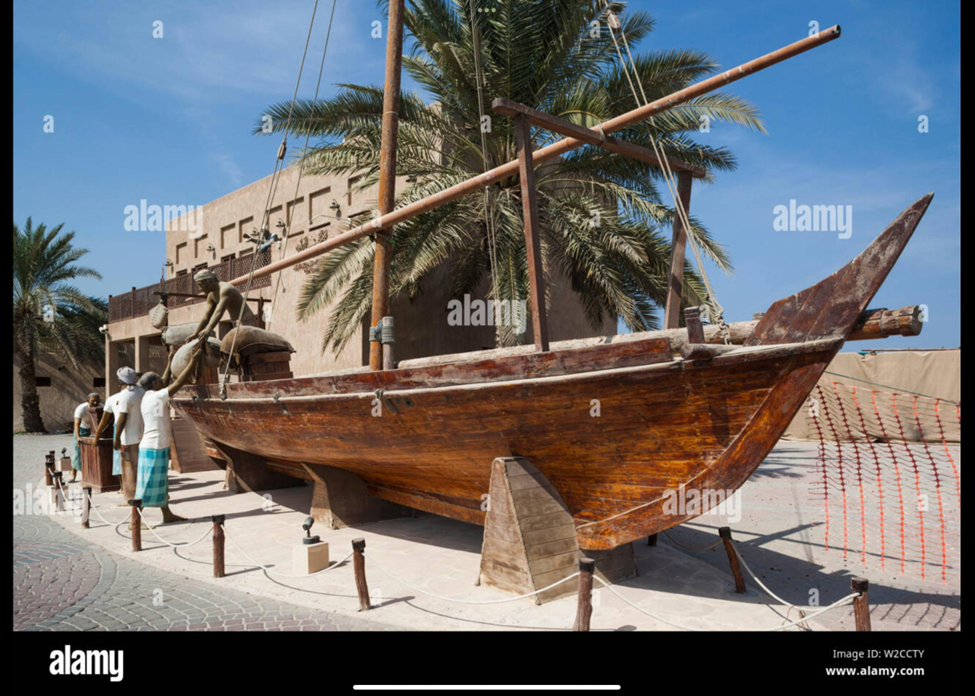
A replica of a traditional dhow displayed at Dubai Museum, illustrating the vessels used in pearl diving expeditions (Image: Alamy).
Reviving the Tradition: Festivals and Living Heritage
The UAE doesn’t just preserve pearling in museums; it pulls it back into the present. At Sharjah Heritage Days or Abu Dhabi’s Al Gharbia Water Sports Festival, you might catch a reenactment of a pearl dive. Boats painted in traditional colors, men in historic dress, children leaning in to watch as baskets of oysters are hauled from the water.
And the songs! The fijiri chants echo across the festival grounds, carrying something deep and old. For the elders who know them, it’s a way of passing on not just lyrics, but an entire way of life (Hightower, 2020).
Contemporary Expressions: Pearls in Digital and Public Art
Even the art world hasn’t let go of pearling’s imagery. In 2024, Saudi artist Farah Al-Ibrahim transformed the story into "Pearls of Emotions", a digital installation at Dubai’s Theatre of Digital Art. Using AI-generated visuals, she captured both the grit and beauty of diving, translating it into sweeping, fluid imagery.
Across the Emirates, you’ll notice pearl and dhow motifs worked into public spaces. Hotel lobbies with mother-of-pearl tiles to government buildings with sculpture installations. These aren’t just decoration; they’re quiet nods to a shared heritage (Wakefield & DeTurk, 2021).
Why It Still Matters
In a country so often photographed for its skyline and high-speed development. Yet beneath that image lies a quieter story: one of endurance, trust, and an intimate relationship with the sea.
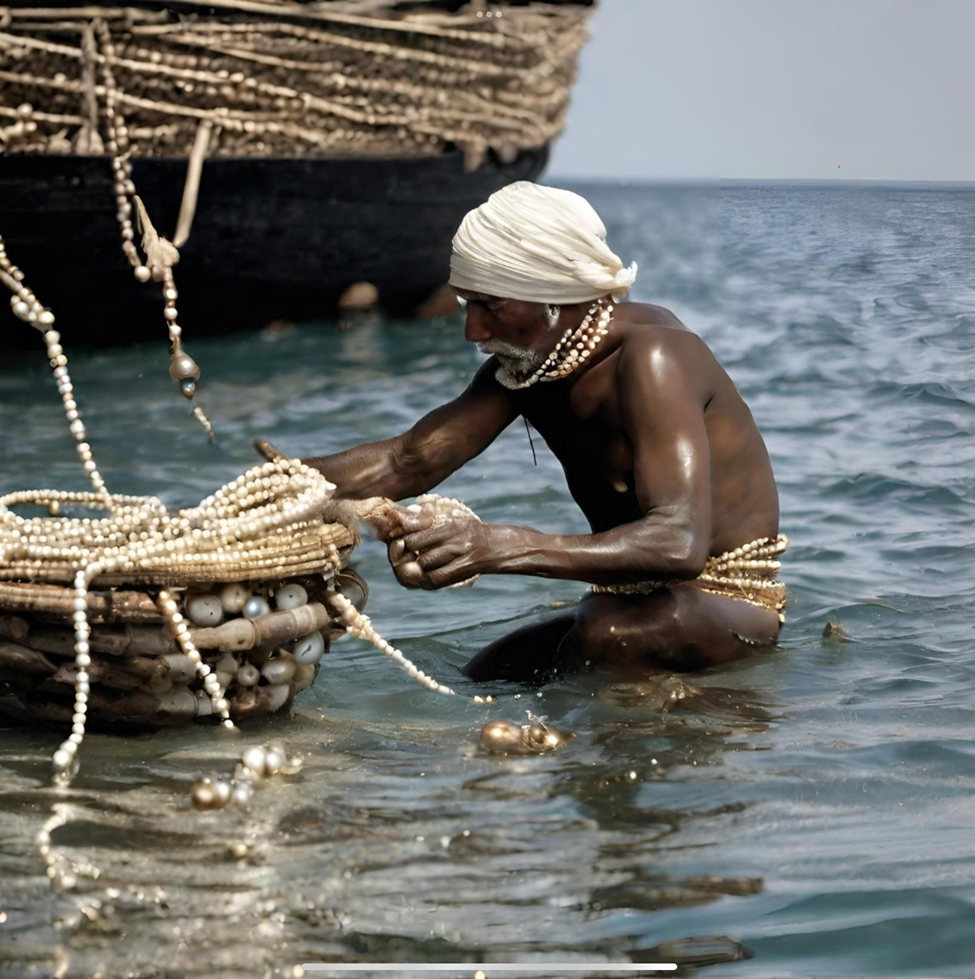
A pearl diver sorting oysters in the shallow waters of the Gulf, a scene that recalls the daily realities of the trade (Getty Images).
Pearl diving was more than a trade; it was a whole way of being. It built communities, shaped traditions, and taught respect for the Gulf’s natural bounty (Alkhuzaei et al., 2025).
Recommended Reading
Abdellatif, S., & Missaoui, K. (2020). Cultural Heritage between Rooting and Continuity: Crossed Views of Pearls in the Emirates. Read here.
Alkhuzaei, M., Aljenaid, S. S., & Mohamed, G. (2025). Systematic Review: The Ecology and Cultural Significance of Oysters in the Arabian Gulf. Read here.
Exell, K., & Rico, T. (2014). Cultural Heritage in the Arabian Peninsula: Debates, Discourses and Practices. Read here.
Hightower, V. P. (2016). Purposeful Ambiguity: The Pearl Trade and Heritage Construction in the United Arab Emirates. Read here.
Hightower, V. P. (2020). The Tyranny of the Pearl: Desire, Oppression, and Nostalgia in the Lower Gulf. Read here.
Simpson, I. R. (2016). Concern Amid the Oysters as Pearling is Honoured: Nature and the Environment in Heritage Practice. Read here.
Wakefield, S., & DeTurk, S. (2021). Introduction: Gender, Cultural Constructions and Representations in the Gulf. Read here.
Willis, J. T. (2016). A Visible Silence: Africans in the History of Pearl Diving in Dubai, UAE. Read here.