Archaeotourism: Navigating Heritage and Tourism in a Global Context
Archaeotourism is the intersection of archaeological heritage and tourism, and it has emerged as a major force in cultural economies worldwide. While it stimulates development, employment, and cross-cultural exchange, it also places unprecedented strain on fragile heritage sites and local communities. Every year on 27 September, World Tourism Day reminds us that travel is more than movement, it is an exchange of ideas, cultures, and identities. Archaeotourism captures where tangible remnants of the past intersect with modern aspirations.
According to the UN World Tourism Organization (UNWTO), cultural and heritage tourism represent over 40 percent of global tourism activity, and archaeological sites are among its most visited destinations (UNWTO, 2018). This growth reflects a public desire for authenticity as visitors increasingly seek immersive experiences that connect them with the deep time of human civilization. For host nations, archaeotourism offers jobs, local pride, and investment in conservation infrastructure. Yet these benefits come with challenges: crowding, erosion, and cultural commodification. Managing these pressures requires integrated policy frameworks that balance access, authenticity, and protection.
In the twenty-first century, archaeotourism has grown rapidly as governments, heritage organizations, and communities recognize its potential for sustainable development and cultural diplomacy. However, archaeotourism reveals tension between economic imperatives and conservation responsibilities, and between global heritage branding and local authenticity. Mass visitation accelerates physical decay, foot traffic, humidity, and microvibrations, all of which threaten materials never intended for modern crowds (Pedersen 2002, 33). In parallel, narratives can become simplified for market appeal, alienating local voices and traditions. The risk is that heritage becomes a backdrop, not a dialogue.
Government Campaigns and Heritage Branding
Governments increasingly integrate heritage into national branding strategies, using archaeotourism as both soft power and economic stimulus. These programs often rely on partnerships between ministries, municipalities, and private tour operators, blending heritage management with economic diplomacy.

These campaigns elevate global visibility but can also intensify visitor pressure if not paired with management capacity.
Heritage branding transforms archaeological assets into symbolic capital. As Călin Vegheș (2022) notes, “heritage branding extends commercial branding logic to cultural identity,” helping states project images of authenticity, stability, and sophistication. UNESCO World Heritage status functions as a global brand, with the UNESCO logo conferring perceived prestige and credibility (Poria et al. 2013). However, empirical results are mixed; some studies show that World Heritage inscription increases visitation and willingness to pay (Su and Lin, 2013), while others suggest the effect depends on complementary marketing and accessibility (Yang et al. 2010).
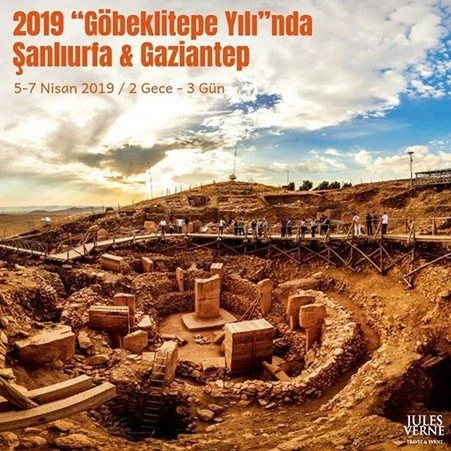
Promotional poster for “The Year of Göbekli Tepe” (2019), launched by the Turkish Ministry of Culture and Tourism as part of a nationwide campaign to promote archaeological heritage in Şanlıurfa and Gaziantep. The initiative exemplified how state-led branding integrates archaeotourism with national identity and regional development strategies. Image source: Jules Verne Travel & Event, 2019.
UNESCO and the Global Framework
The 1972 UNESCO World Heritage Convention remains the most influential international instrument shaping archaeotourism. Its core principle, the recognition of Outstanding Universal Value, sets a global standard for site protection and presentation. Through the World Heritage and Sustainable Tourism Programme, UNESCO (2018) encourages integrated approaches balancing conservation, economic benefit, and local participation.
While UNESCO does not directly govern tourism operations, its frameworks influence national policies. The “UNESCO effect” can be double-edged; listing attracts visibility and funding, yet it can lead to overtourism or over-commodification (Meskell 2018). The organization’s monitoring mechanisms - periodic reports, reactive monitoring, and the List of - offer soft governance tools but lack enforcement capacity.
Recent innovations include digital tools such as the Sites Navigator and Dive into Heritage platforms, offering 3D visualizations, geospatial data, and disaster-risk mapping for heritage sites (UNESCO 2022). These resources reflect an increasing emphasis on digital transformation in heritage interpretation, aligning with UNESCO’s Recommendation on the Ethics of Artificial Intelligence (2021) in heritage communication.
UNESCO also supports transnational initiatives like the Silk Roads Program and the African World Heritage Fund, which foster cooperation, joint nomination, and cross-border cultural routes. Such projects link archaeotourism with heritage diplomacy, advancing dialogue among member states while reinforcing UNESCO’s soft power.
Beyond the 1972 Convention, the 2003 Convention for the Safeguarding of Intangible Cultural Heritage and the 2005 Convention in the Protection and Promotion of the Diversity of Cultural Expressions indirectly shape archaeotourism by emphasizing community participation, intercultural dialogue, and local empowerment (Blake 2015). Together, these frameworks form an evolving “global heritage regime” that governs how archaeological sites are interpreted, marketed, and managed.
Conclusion
Archaeotourism today stands at a decisive crossroads. What began as an economic opportunity to link cultural heritage with tourism has evolved into a complex system of global visibility, cultural diplomacy, and local responsibility. Campaigns such as Go Türkiye and Find Your Story exemplify how heritage is increasingly used to shape national identity and attract international visitors. Yet, when promotional narratives outpace conservation capacity, heritage risks becoming a mere spectacle consumed rather than understood.
The policy challenge, therefore, is not whether to promote archaeotourism but how to do so responsibly. Sustainable archaeotourism must transcend short-term revenue goals and integrate scientific conservation, community participation, and ethical storytelling. Heritage sites are living entities; they require protection from overexposure, but they also thrive through public engagement that fosters empathy and awareness. Data-driven management systems, combining visitor analytics, conservation monitoring, and digital interpretations, can help policymakers balance access and preservation more effectively.
At the heart of this balance lies the human dimension of heritage. Archaeotourism should not only transmit the material traces of the past but also empower the people who live alongside them. Local communities must be more than caretakers or performers; they are co-authors in the narratives that shape how heritage is experienced. UNESCO’s evolving global frameworks increasingly emphasize this perspective, aligning site management with social sustainability and cultural rights.
Looking ahead, archaeotourism will inevitably be shaped by digital transformation and climate change. Virtual heritage tours, 3D documentation, and AI-assisted interpretation are expanding access to sites once limited by geography or fragility. Meanwhile, rising temperatures, coastal erosion, and environmental stressors are redefining how and where archaeological tourism can occur. These factors drive technological innovation as ecological urgency demands adaptive, forward-thinking governance.
If managed wisely, archaeotourism can become more than a leisure economy; it can be a bridge between past and future, fostering global citizenship rooted in respect for cultural diversity and shared history. The ultimate measure of success will not be the number of visitors a site receives, but the depth of understanding it inspires. In this sense, archaeotourism is not merely an industry, it is an ethical practice of connecting humanity with its own deep time.
References
Blake, J. International Cultural Heritage Law. Oxford: Oxford University Press, 2015.
Dubai Department of Economy and Tourism. “Find Your Story Campaign Launch.” 2024.
Greek Ministry of Tourism. Sustainable Greece 2023–2027 Strategy. Athens, 2023.
Indian Ministry of Tourism. Incredible India 2.0 Strategy Document. New Delhi, 2022.
Italian National Tourism Agency (ENIT). Open to Meraviglia Campaign Report. Rome, 2023.
Meskell, L. 2018. A Future in Ruins: UNESCO, World Heritage, and the Dream of Peace. New York: Oxford University Press.
Pedersen, A. Managing Tourism at World Heritage Sites: A Practical Manual for World Heritage Site Managers. Paris: UNESCO, 2002.
Philippine Department of Tourism. Love the Philippines Campaign Overview. Manila, 2023.
Poria, Y., Arie R., and Cohen, R. 2013. “Tourists perceptions of World Heritage Site and its designation.” Tourism Management, Elsevier, vol.35(C):272. https://doi.org/10.1016/j.tourman.2012.02.011
Su, YW., and Lin, HL. 2014. “Analysis of International tourists arrivals worlwide: The role of World Heritage Sites.” Tourism Management, Elsevier 40(C): 46–58. https://doi.org/10.1016/j.tourman.2013.04.005
Türkiye Tourism Promotion and Development Agency (TGA). “Go Türkiye: Cultural Heritage Campaign.” 2024.
UNESCO World Heritage Centre. World Heritage and Sustainable Tourism Programme. Paris: UNESCO, 2015.
United Nations World Tourism Organization (UNWTO). Tourism and Culture Synergies. Madrid: UNWTO, 2018.
Vegheș, Călin. 2022. “Cultural Heritage Branding and Nation Branding: A Marketing Driver for Sustainable Development.” European Journal of Sustainable Development 11(1):42. https://doi.org/10.14207/ejsd.2022.v11n1p42.
Yang, C. H., Lin, H. L., & Han, C. C. (2010). Analysis of international tourist arrivals in China: The role of World Heritage Sites. Tourism management, 31(6), 827–837. https://doi.org/10.1016/j.tourman.2009.08.008